
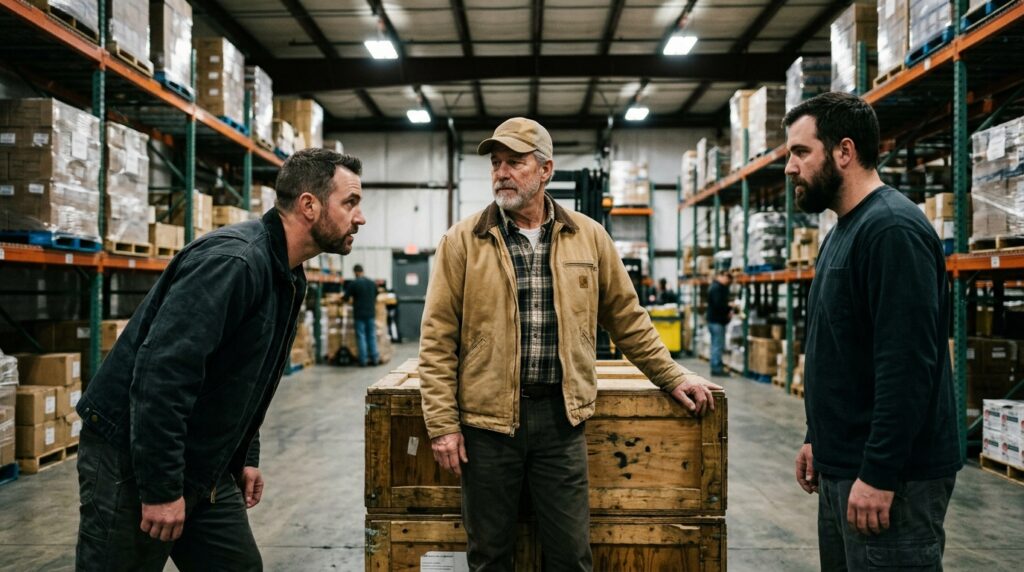
CHAPTER 5: THE COLD SILENCE
The metal legs of the stool scraped against the concrete grit with a sound like a bone saw as Miller sat back down. He pulled the aluminum clipboard across the dented iron surface of the desk, his pencil point hovering precisely above the unverified entry for the north-corridor haul. Behind him, the low, mechanical wheeze of the 03:45 transport rig settling into Bay Four sent a rhythmic vibration through the corrugated iron siding of the office wall.
Vance and Garrett had not followed him out of the narrow lane. Their heavy boots remained stationary down the dark corridor, their low, furious murmurs swallowed by the sudden overhead groan of the main exhaust grid kicking into its first morning cycle.
“The log is still open, Miller,” a new voice said.
Miller didn’t raise his head. He recognized the specific, soft slide of thin-soled leather shoes on the platform steps behind him. It wasn’t a floor worker. It was Hendrick, the administrative assistant from the facility office—a man whose clothes never carried the scent of treated pine or forklift grease. Hendrick held a cold ceramic mug in his left hand, the steam from the dark liquid rising to dissipate in the dry, drafty air beneath the light tubes.
“The log stays open until the yellow seals match the gate ticket,” Miller said, his tone flat, retaining the hard, mineral texture of the loading docks. He pulled his left hand out of his jacket pocket, letting the scuffed steel digital stopwatch drop onto the desk with a sharp, heavy clink. “Vance is handling freight that hasn’t cleared the regional desk. Go back upstairs, Hendrick. This isn’t a billing error.”
Hendrick didn’t leave the platform. He stepped down until his leather soles reached the concrete floor, his eyes darting toward the dark aisle where Vance’s shadow was finally beginning to move back toward the light. “The office wants the manifest stamped before the shift change, Miller. The regional office called down at midnight. They aren’t looking for a line audit tonight. They want the turnaround clear.”
Miller turned his head slightly, the stiff bill of his tan canvas cap catching the hard glare of the fluorescent tube above. His weathered jaw looked as if it had been chipped out of a dry riverbed. “Which regional office? The one in Columbus, or the private line that handles the scrap variance?”
Hendrick’s hand tightened on the handle of his ceramic mug, the knuckles turning a smooth, bloodless white. He didn’t answer. He looked past Miller toward the yellow pallet jack parked near the wooden crates. The hydraulic cylinder was still hissing, a tiny pool of amber fluid gathering around the small steel pressure release valve at the base of the lift.
Vance emerged from the dark corridor first. His dark utility jacket was torn at the shoulder seam, the white padding showing through the blue-collar fabric like salt in a wound. His face was gray with concrete dust, his jaw set in a hard, rigid line that looked entirely dead to the noise of the incoming trucks. He didn’t look at Miller. He looked directly at Hendrick.
“The old man won’t sign,” Vance said, his voice husky with the sulfur dust from the racks. “He thinks he’s tracking a federal transit code. He’s got his finger on the bill.”
“Miller,” Hendrick said, his voice dropping into a lower, more transactional register that didn’t carry past the iron edge of the desk. “Leave the clipboard. The company has an automated adjustment policy for the grade-four fasteners. It’s covered under the primary operational insurance.”
Miller leaned forward, his calloused thumb sliding down the aluminum frame of the clipboard until it pressed against the small, notched hinge at the top. He released the clamp. The master paper sheets flipped up, revealing the greasy, yellow carbon copy hidden beneath the standard company forms—the specific unlogged manifests that had been filled out by hand, using a heavy, dark ink that hadn’t come from any terminal computer.
“This isn’t an insurance adjustment,” Miller whispered, his voice cutting through the high-frequency hum of the light tubes like an iron file. He pointed a scarred index finger at the bottom signature line of the yellow carbon. The ink was fresh, but the name wasn’t Vance’s, and it wasn’t Hendrick’s. It was a block-letter imprint that matched the private corporate seal of the logistics terminal’s primary bondholder. “The siphon is running directly out of the secure bays. Twelve tons of fasteners don’t disappear into a scrap variance unless the master circuit is dead.”
Garrett came out of the lane then, his heavy tools clinking against his thigh, his eyes wide and bloodshot as he checked the main entrance doors behind the desk. The morning shift was already arriving at the main gate; the distant rumble of employee cars parking on the gravel lot was a steady, rhythmic thud against the foundation. The time was 03:52. The circle was widening, the isolated quiet of the night bay dissolving into the public pressure of fifty oncoming workers.
“We don’t have the time for this,” Garrett muttered, his hand trembling as he wiped his forehead with a grease-stained rag. “The gate is opening. The crew is coming through the turnstiles.”
Vance didn’t move toward the gate. He took three slow steps toward the desk, his eyes fixed on the yellow manifest paper under Miller’s hand. The physical defeat in the aisle had left a hard, sour residue in his chest, but the presence of Hendrick seemed to restore a different kind of leverage to his shoulders. “You’re an inventory manager, Miller. You count what’s here. You don’t ask where it goes after it leaves the dock.”
“I count what stays,” Miller replied. He rose from his stool, his boots planted firmly in the concrete dust. He picked up his scuffed stopwatch, his thumb sliding over the steel back casing before he slipped it into his jacket. “And I’m going down to Bay Seven to check the secondary seal on the vault.”
Hendrick stepped directly into his path, his leather shoes making a small, hollow sound against the concrete. His face was completely smooth, but his lower lip was dry. “The vault is locked, Miller. The keys are in the front office. You don’t have the clearance.”
Miller didn’t back up. He let his gray eyes lock onto Hendrick’s forehead, his posture straight and unyielding against the administrative pressure. “Then I’ll use the manual override on the circuit breaker. If the line is short, the terminal drops its power until the inspectors arrive from the state line.”
Vance took a short, sharp breath, his hand sliding back toward the handle of his utility belt. The room tone had changed again, the stale air thick with the smell of high-voltage ozone and the first cold draft from the opening loading dock doors.








