
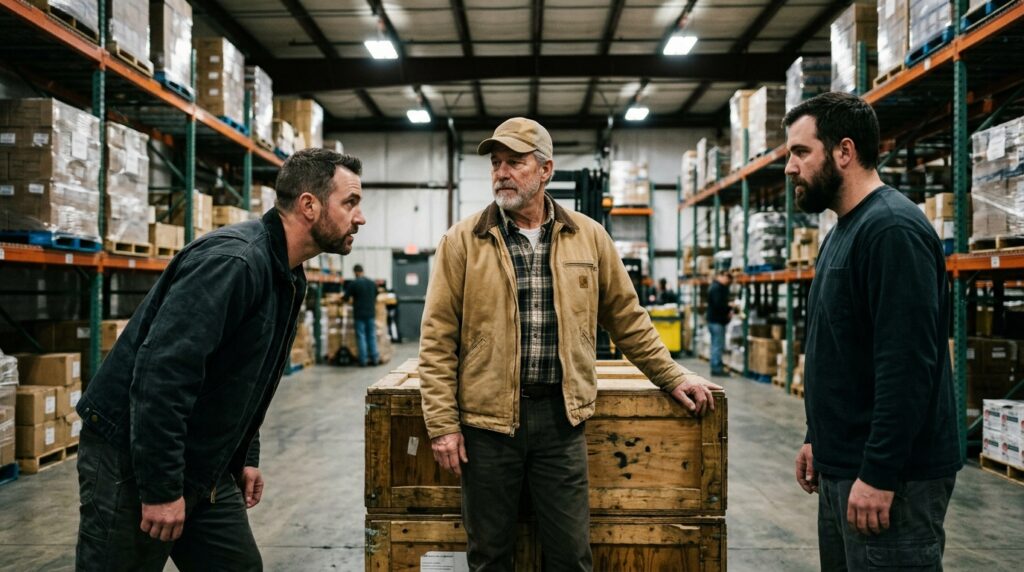
CHAPTER 4: THE MEASURED PIVOT
“The lane isn’t yours to clear,” Miller said.
He left his left hand inside the canvas pocket, the fingers steady against the cold steel back of the stopwatch. His right hand remained perfectly flat against the coarse grain of the nearest wooden crate. He could feel the dry, ancient sap of the pine splintering slightly beneath his thumb—a tiny, localized point of friction in a world that was suddenly narrowing down to the exact distance between three sets of boots.
Vance didn’t offer another warning. The time for administrative bluffing had passed the moment Miller pointed out the unsealed yellow twine. The larger man moved with the raw, heavy momentum of an ungreased piston, his right arm swinging upward in a sudden, violent arc to collar-grab Miller’s jacket and shove him flat against the vertical timber supports of the rack. It was a standard floor move—the heavy-shouldered rush meant to pin an older man before his heels could find leverage on the concrete dust.
Miller’s eyes didn’t track the hand. They tracked the mass of Vance’s chest, watching the shift of the dark utility fabric that signaled the exact instant the weight left the younger man’s back leg.
The calculation was entirely silent, automatic, and paid for by twenty winters of basic service repetition. Miller didn’t raise his hands to block. He didn’t drop his clipboard. As Vance’s shadow broke his personal space, Miller executed a minimal, three-inch pivot on the ball of his left heel, sinking his weight slightly into his hip while drawing his right shoulder back along the face of the crate.
The kinetic economy was absolute. Vance’s fingers grazed the rough canvas of Miller’s lapel but found no resistance to anchor against. The momentum of twenty-two hundred pounds of meat and velocity carried Vance blindly forward into the empty sector where Miller’s chest had been a micro-second prior. His heavy work boot skidded through the amber grease slick near the hydraulic tongue of the jack, his arms flailing outward in a wide, desperate circle to catch the rough edge of the wooden stack.
A loud, hollow boom echoed through the aisle as Vance’s shoulder slammed into the gray pine timbers, jarring the top shelf until a shower of iron dust and dried rust scales drifted down through the beams like soot.
Garrett reacted instantly, his boots scraping the concrete as he swung the steel banding cutter upward, but the movement died before the tool could clear his belt line. Miller had already stepped into the newly opened space, his posture perfectly upright, his tan cap still level over his forehead. He hadn’t changed his breathing. His left hand was still in his pocket, and his right arm was relaxed at his side, the aluminum clipboard steady against his thigh.
The space between them settled into an immediate, freezing silence. The distant hum of the exhaust fans felt miles away, buried beneath the heavy, unblinking pressure of the overhead industrial lights.
Vance remained pinned against the crate for three full seconds, his chest heaving as he struggled to pull his weight back over his center of gravity. His face had turned a deep, dark red under the gray dust from the beams, his knuckles scraped and white where they had dragged across the splintered timber. He looked down at the floor, then slowly turned his head to look at Miller’s boots. They hadn’t moved more than half a pace from the original line.
“Are we done here?” Miller asked.
The words were sparse, dry, and entirely devoid of performance. He didn’t use the sharp, ringing volume of a drill instructor; he used the flat, unbothered tone of an inspector who had just found a faulty gasket on an auxiliary pump.
Garrett didn’t move. The steel cutter hung loose in his fingers, its long handles trembling slightly against his thigh as he looked from Vance’s wide, unbalanced stance back to the old supervisor’s steady gray eyes. The younger man’s mouth opened slightly, his tongue running over his lower lip as his brain tried to reconcile the speed of the shift with the frayed canvas jacket standing before him. He had seen men fight in the taverns near the transit yards, but he had never seen someone disappear from an attack without changing his pulse.
Vance pulled himself away from the crate, his right shoulder dropping lower than his left as he tried to wipe the grease from his sleeve. The arrogance had leaked out of his posture, leaving behind a raw, hollow confusion that made his utility jacket look too large for him. He didn’t lunge again. His eyes kept darting to Miller’s left hand, trying to see what weapon or leverage was hidden inside the pocket, completely unaware that the only thing Miller was holding was the time.
“You’re tracking this wrong, Miller,” Vance muttered, his voice cracked by the dry sulfur in the air. He didn’t look into the shadow of the bill. He looked at the floor three feet in front of it. “You don’t know what’s inside these boxes.”
“I know exactly what’s inside them, Vance,” Miller said, his thumb finally shifting to press the top crown of the stopwatch inside his pocket. The tiny mechanical click was lost in the silence. “And I know the transit logs aren’t the only things you’ve been cutting.”
Behind them, far down the main corridor near the loading docks, the first low whistle of the morning air brakes sounded—the 03:45 arrival from the regional distribution center. The shift was changing, the floor was about to fill with fifty men with clipboards and lunch tins, and the dark aisle was suddenly the smallest room in the state.
Miller turned his back on them. It wasn’t a gesture of trust; it was the calculated indifference of a man who had already verified the clearance. He walked toward the manifest desk, his boots making a steady, unhurried crunch through the rust scales.








