
CHAPTER 6: THE ALTERED HORIZON
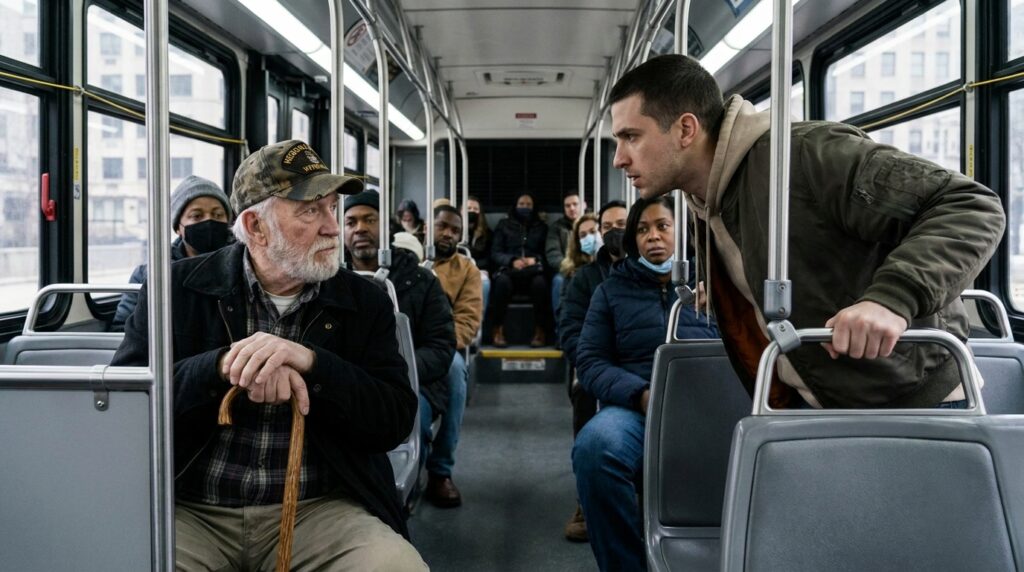
The heavy rubber-treaded boots of the young man vanished into the gray, rain-swept sheets of the terminal platform, leaving only a dark, slick trail of wet footprints slowly expanding across the blue non-slip floor. The front pneumatic doors stayed open for three additional seconds, their thick rubber seals vibrating as cold air rushed into the cabin, stripping away the lingering scent of damp leather and panic.
Thomas did not watch the kid run. His eyes remained fixed on the lower iron frame of the seat across the aisle, where the small, obsidian-faced transponder continued its quiet, silent transmission. The infrared signal flickered against the damp metal work with a machine regularity—an unblinking eye tracking the exact coordinates of an old commander who had supposed himself forgotten.
The remaining transit passengers moved past him in a silent, hurried line, their heads bowed into the collars of their winter coats as they emptied the vehicle. They kept their shoulders drawn inward, their movements quickened by a collective desire to separate their realities from the physical violence they had just witnessed. The two teenagers who had held the glowing smartphones slipped past without looking up, their devices already tucked away into deep pockets. The isolation of Thomas’s row was no longer an enforced perimeter of bystander apathy; it was an absolute clearance. The cabin had become an empty echo chamber, the low, rhythmic thrum of the diesel engine shaking the right-angled window frames against their frames.
Thomas slowly let his right hand settle over the smooth, carved head of his oak cane, the cold brass collar pressing firmly into the meat of his thumb joint. He felt the internal shift of his own respiration, his heartbeat perfectly baseline, unaffected by the chemical spikes that had destroyed the young man’s tactical composure. He had run an audit on the field parameters within forty seconds. The boy was gone, the family grudge exposed as a carefully staged provocation, but the underlying mechanism—the active surveillance array—remained entirely functional beneath his knees.
A short, dry cough broke the quiet from the front of the bus. The driver, an older American man with a faded transit patch on his short-sleeve shirt, leaned his shoulder heavily against the wide steering wheel, his eyes catching Thomas’s reflection in the long rearview mirror.
“You need me to call this in, Mac?” the driver asked, his voice gravelly from a long shift. He did not pull the lever to close the doors; his hand hovered near the control box, tracking the empty platform outside. “The kid looked like he was about to tear this whole rig apart before you sat him down.”
Thomas lifted his chin just enough to clear the low brim of his brushed-cotton service cap, the embroidered ribbons catching a single ray of harsh white light from the platform’s sodium lamps. “No,” Thomas said, his voice flat, dry, and holding the mechanical weight of an operational center. “The situation has resolved its primary friction. Maintain your schedule.”
The driver hesitated for a fraction of a second, his knuckles tightening against the black rubber of the steering wheel before he nodded in silent compliance. He pulled the hydraulic valve. The pneumatic doors closed with a heavy, pressurized slap, sealing the vehicle once more against the downpour as the wheels turned heavily away from the concrete terminal dock, transitioning back into the dark asphalt grid of the industrial sector.
Thomas reached down with his left hand, his fingers moving with unhurried precision into the dark space beneath his seat. His skin brushed the greasy, cold surface of the iron piping before making contact with the magnetic housing of the tracker. With a single, sharp twist of his wrist, he broke the magnetic bond. The obsidian device came away cleanly, its red micro-LED continuing to blink against his palm like a captured insect.
He did not crush it. He did not throw it into the waste receptacle near the door. He turned the device over, his thumb tracing the smooth molded edge until he located the micro-serial number etched into the casing. It wasn’t commercial surplus. The three-digit suffix belonged to an active domestic security contractor—the same intelligence branch that had inherited the records of the 1971 logistics command after the restructuring.
The final reality aligned with a cold, absolute clarity. This run through the rainy municipal sectors hadn’t been an aimless transit route for a lonely retiree. Thomas had known about the tracking cells for three weeks; he had chosen this specific bus line because its narrow aisles and high-backed seats created a predictable, defensible corridor where any approach would be forced into a single vector of movement. The boy had been a diagnostic test—a piece of historical bait sent by an unseen adversary to verify if the old commander still possessed the kinetic reflexes to defend a position.
Thomas slipped the tracker into the deep, dry pocket of his utility jacket, letting it drop against his old pocket watch. He adjusted his grip on the scarred oak cane, planting the rubber tip back into the center groove of the floor matting. The uniform had changed, the terrain was modern asphalt instead of monsoon mud, but the operational horizon remained exactly as it had been forty-five years ago. The first layer of defense had held; the next three stops would determine where the counter-offensive would initiate.








