
CHAPTER 3: THE INTRUSION OF THE SHADOW
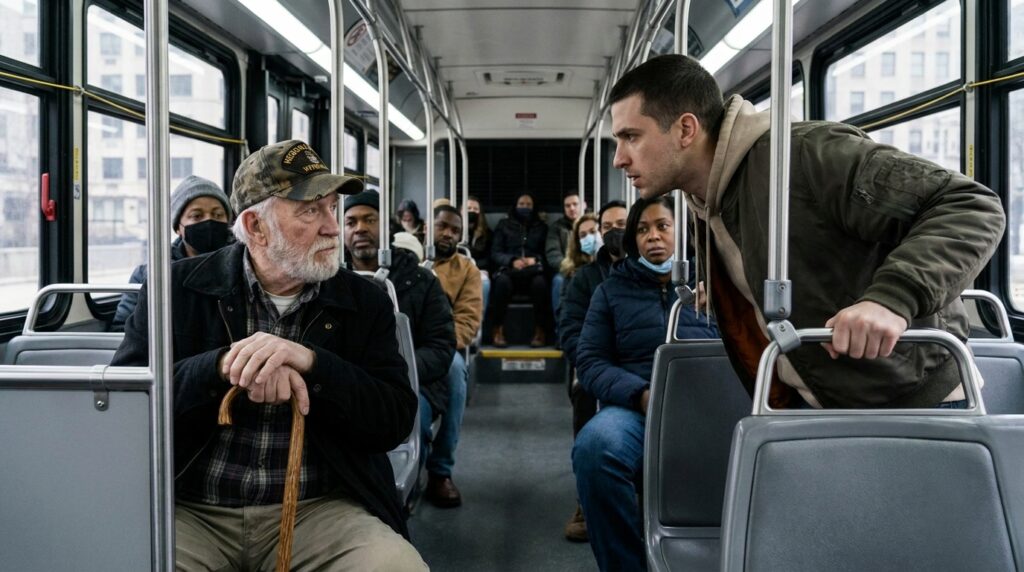
The leather of the bomber jacket creaked like a straining bulkhead as the young man pulled his right shoulder back. It was a macro-movement, clumsy and telegraphed, shifting his entire center of gravity away from his base of support. To a civilian eye, it looked like an impending explosion of physical force; to Thomas, it was a sequence of structural errors occurring in slow motion. The vectors of the aisle had narrowed to a critical choke point, the heavy silver stanchion bar acting as a rigid boundary behind the young man’s left heel.
Thomas did not flinch as the space between them vanished. Instead, his left hand slid two inches up the grain of his oak cane, his thumb resting firmly against the cold, angular edge of the brass collar. Every muscle in his slender frame remained completely loose, a state of calculated kinetic readiness that allowed him to absorb the mechanical vibrations of the bus without wasting structural energy.
“You talk too much for an old man who’s about to get broken,” the young man hissed, his fist rising to the level of Thomas’s jaw line. As his arm retracted, the heavy lining of his unzipped sleeve pulled open, exposing a small, sharp object caught loosely in the interior mesh pocket. It was a tarnished brass military insignia pin—a crossed-rifles infantry design with one bent clutch-back, deeply scratched and worn down to the base zinc. The sharp edge of the brass caught the pale yellow light from the ceiling, a silent, incongruous detail that matched the silver crescent scar on the kid’s thumb joint.
The discrepancy locked into place with a cold weight. Thomas’s mind processed the visual data with transactional speed. The insignia pin belonged to the 1971 domestic logistics command—the exact unit Thomas had structurally audited and disassembled four decades ago. The kid wasn’t just a random transit predator following a blind impulse; he carried a fragment of a specific, broken lineage. But there was no time to track the genealogy of the artifact. The fist was accelerating.
The young man didn’t deliver a clean, straight strike. He lunged forward, using his athletic bulk to crowd Thomas against the plexiglass window, his left hand reaching down aggressively to grab the collar of the utility jacket. He wanted a submission, a public display of dominance that would force the elderly passenger to cower in front of the silent perimeter of observers.
Across the aisle, the silver surface of a passenger’s smartphone rose by two inches, the dark glass lens reflecting the sharp angles of the confrontation. The witness layer was adjusting its tracking, their breathing suspended as the physical threshold was crossed. No one screamed. No one called out for the driver. The isolation of the row was absolute.
Thomas felt the cold air from the window pane press against the back of his neck as the young man’s fingers brushed the top fabric of his collar. The proximity was exactly six inches. The weight distribution was seventy percent forward on the aggressor’s left knee. It was the precise moment where momentum becomes an inescapable trap for the person who unleashes it.
Thomas didn’t pull back. He allowed his head to tilt slightly to the left, a micro-adjustment of three centimeters that caused the young man’s sweeping grasp to miss the solid zipper line and snatch instead at the loose, unyielding denim of the shoulder seam. The grip was tight, but it lacked a skeletal anchor.
“Go on then,” the young man snarled, his breath hitting Thomas’s cheek as he pulled his right fist down into the striking arc. “Let’s see what that attitude is worth.”
Thomas’s right hand stayed flat on his knee, his fingers relaxed. His entire focus was concentrated on his left palm, where the oak handle felt solid, heavy, and balanced. The mechanical rattle of the diesel engine seemed to fade into a background hum, replaced by the internal clarity of a combat theater where every surface is either a weapon or an anchor. He could feel the precise point where the rubber tip of his cane was wedged into the floor mat’s rubber ribbing. The structural geometry was complete. The kid had committed his weight entirely to the descent, his balance locked into a vector that offered no route for a recovery move.
Through the fabric of his jacket, Thomas felt the tension of the young man’s knuckles locking onto his shoulder. The leather of the bully’s jacket was cold, stiff, and smelling of old rain, its sharp edges pressing against the veteran’s chest as the space between them completely ran out.
Thomas’s chin lifted, his unblinking eyes meeting the bloodshot glare of the young man with a stillness that was entirely devoid of human malice or fear. It was the look of a machine calculating a tolerance limit.
“Your wrist alignment is off, son,” Thomas murmured, his voice cutting through the space between them like a cold steel wire just as the young man’s arm locked into the final downward plunge.








