
CHAPTER 5: THE KINETIC REVERSAL
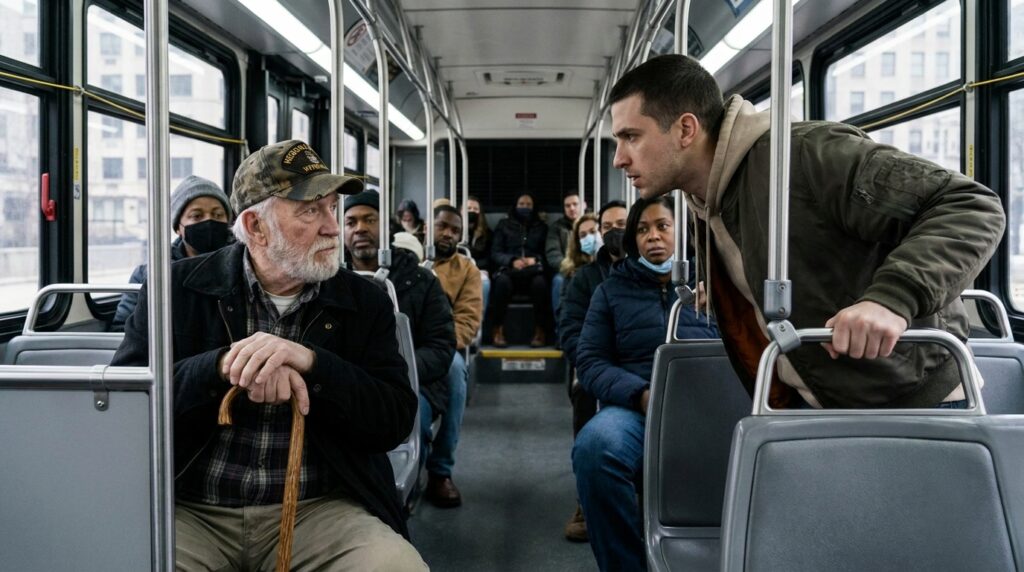
The pneumatic hiss of the bus’s air brakes rasped through the dark cabin like a heavy blade drawing across dry slate. Outside, the rain-slicked concrete of the industrial terminal platform blurred past the scratched glass windows, reflecting fractured neon greens and cold whites from the overhead stadium lights. Inside the central aisle, the spatial geometry remained completely rigid. Thomas maintained the downward vector of his leverage, his thumb pressing hard into the nerve cluster behind the young man’s right wrist joint while his left forearm remained an unbending structural brace across the kid’s pinned collarbone.
The boy did not struggle now. His athletic frame had gone completely hollow, his knees anchored to the wet rubber floor matting while his gaze remained glued to the water-damaged square of military cardstock resting between their feet. The name Corporal Marcus Vance stared up through a thin laminate of pooling condensation, the ink of Thomas’s own historic signature a clean, unyielding line of judgment that had survived forty-five years of storage.
“You’re his son,” Thomas stated. It was not an interrogation; it was the flat, clinical registration of a file tab dropping into its designated slot. He did not let his voice lift above the rhythmic, mechanical vibration of the idling diesel engine. “You have his wrist structure. You have the exact same lateral instability in your base stance when the ground shifts.”
The young man’s mouth opened slightly, his lower jaw trembling as the cold air from the front doors hit his damp skin. “He died three months ago,” the kid muttered, the tight, mocking bravado of his earlier urban cadence completely evaporating into a flat, regional rust-belt drawl. “In a county facility. He had nothing left but an old trunk and a box of logistics records with your name stamped on every page.”
Thomas felt a cold, familiar calculation spin through his chest. The strategic pursuit model required him to ignore the emotional bait of the boy’s confession and look strictly at the anomalies in the field. A common revenge grievance would dictate a targeted strike at Thomas’s home or a private approach—not a calculated piece of transit harassment designed to look like a spontaneous act of public entitlement on a municipal route. The kid had been tracking this specific transit run.
Thomas shifted his gaze by two inches, looking past the pinned shoulder of the leather jacket to the narrow space underneath the blue vinyl seat cushion. There, tucked securely into the right angle where the iron piping met the floor rail, a small, obsidian-faced electronic tracker widget hummed with a faint, periodic pulse of infrared light. It was an active, commercial-grade transponder, its magnetic housing coated in a fresh layer of grey industrial grease.
The realization hit Thomas with the sharp, geometric force of a tactical ambush. The boy wasn’t the architect of this trap; he was the component. He had been directed to this vehicle to force a highly visible public escalation, using his father’s old court-martial papers as a personal justification while someone else utilized the tracking signal to map Thomas’s precise operational movements through the urban transit grid. The decoy secret—the familial military grudge—was a perfect, functional mask designed to cover a far deeper, ongoing surveillance deployment. The ultimate reality was still locked down, but Thomas’s status as a passive retiree had just been structurally compromised.
Across the aisle, the witness layer began to move. The two teenagers lowered their smartphones entirely, their faces showing a sudden, sharp transition from amusement to visceral discomfort as the boy’s confession spilled into the public space. The perimeter of apathy was gone, replaced by a tense, nervous energy as the remaining commuters gathered their bags, their eyes darting toward the front doors as the bus came to a final, shuddering halt at the terminal bay.
“He told me you broke him,” the boy whispered, his left fist clenching against the rubber floorboards as he tried to find a sliver of leverage. “He said you signed the order that took his pension before he even hit twenty-four. I came to take something back.”
“Your father broke his own lineage when he removed three crates of field medicine from the logistics depot at Chu Lai,” Thomas said, his voice dropping into a razor-thin register that made the young man’s shoulders instantly stiffen. “He left thirty-two men in the third battalion without basic surgical prep before the monsoons hit. I didn’t break him, son. I merely recorded the precise depth of his failure.”
The boy’s eyes went wide, the historical reality of the record striking him with a physical force that left him completely paralyzed. The moral logic he had built to justify his entitlement collapsed beneath the weight of the veteran’s flat memory.
Thomas slowly released the tension in his left hand, sliding his fingers away from the kid’s wrist and returning his palm to the smooth, curved head of his oak cane. He did not jump or move quickly. He maintained his seated posture, his dark utility jacket straight, his brushed-cotton service cap tilted forward to keep his brow in absolute shadow.
“Stand up,” Thomas commanded, his voice carrying the quiet, absolute authority of a command room that had never known civilian compromise. “The doors are open. Get off my bus.”
The young man scrambled backward, his heavy leather boots slipping on the wet floor matting as he broke the physical proximity. He snatched the water-damaged manifest from the floor with a trembling hand, his eyes locked on Thomas with a mixture of terror and unmitigated confusion as he stood up into the full clearance of the aisle. He didn’t look at the passengers. He didn’t look back at the seat frame. He turned and lunged down the metal exit stairs, his athletic silhouette vanishing instantly into the grey, rain-swept concrete of the terminal platform.
Thomas did not watch him run. He reached down with his right index finger, his knuckles brushing the cold iron piping beneath his seat cushion until his skin made contact with the small, vibrating square of the obsidian tracker. He did not pull it off. He left it exactly where it was, his mind already calculating the cause-and-effect loop of the next three stops. They wanted to know where the old commander was going; Thomas was about to show them exactly how an old decoy operates when the field parameters turn hostile.








