
CHAPTER 2: THE INTERSECTION OF APATHY
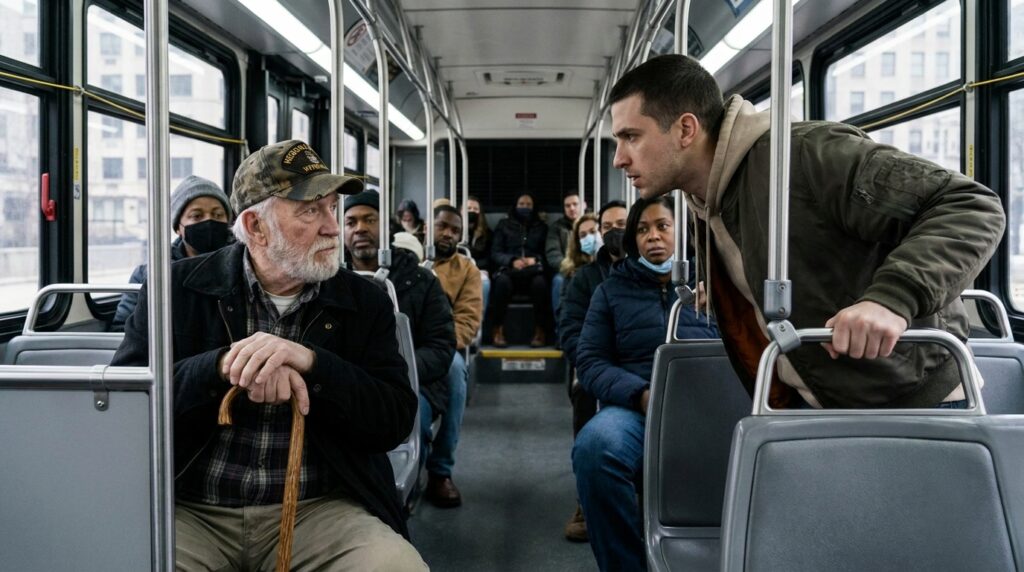
“You’re in the wrong seat, old man,” the voice rasped over the heavy thrum of the diesel engine, dropping down from a shadow that smelled of cheap tobacco and damp synthetic leather.
Thomas did not move his head. His eyes remained locked on the single bright fleck of raw iron where the blue paint had chipped away from the handrail. In his periphery, the broad chest of the young man shifted, the heavy bomber jacket pulling taut across his shoulders as he leaned deeper into the aisle-side clearance. Thomas could read the precise physics of the posture—the weight distributed entirely on the balls of the feet, the left hand gripping the vinyl seat cushion to anchor a sudden, downward lever. It was a stance built for sudden intimidation, an unrefined projection of civilian mass that relied entirely on the target flinching first.
“I’m talking to you,” the young man muttered. His breath carried the sharp, sour tang of artificial energy drinks and stale grease. He shifted his grip on the seatback, his knuckles turning a bloodless, sharp white against the dark blue vinyl. “The cap doesn’t buy you a pass today. Move down the bus. I need the room.”
The bus swerved slightly as it navigated the standing water near the industrial railway crossing, the sharp right angles of the metal window frames rattling against their rubber seals. A low, collective murmur passed through the cabin—the sudden rustle of synthetic winter coats, the rhythmic tapping of a damp umbrella tip against the floorboards—but no one raised their eyes. The silence of the fourteen commuters was a thick, palpable pressure, a calculation of self-preservation that Thomas recognized instantly. They were building a perimeter of apathy, ensuring that whatever occurred within the two-foot boundary of his row remained safely isolated from theirs.
Thomas slowly let his eyes slide upward, tracking the sharp edge of the young man’s zipper up to the aggressive line of his jaw. He did not look at the eyes yet; he looked at the throat, noting the rapid, shallow pulse just beneath the skin of the carotid artery. The boy was riding a wave of chemical confidence, his adrenaline spikes unregulated by discipline.
“There are empty rows in the back, son,” Thomas said. His voice was low, dry, and perfectly flat, carrying the mechanical cadence of a retired instructor who had spent thirty years projecting over the roar of helicopter rotors. He did not use an inflection of complaint; it was a baseline assessment of available space.
The young man let out a short, dry breath that was half-laugh, half-snarl. He leaned in further, his athletic frame blocking the dim yellow light from the overhead fixtures, throwing Thomas’s lap into absolute shadow. “I don’t go to the back. And don’t call me son.”
As the young man adjusted his stance, his right hand came up to rest on the polished silver stanchion bar running vertically from the floor to the ceiling. It was then that Thomas saw it—a small, jagged scar shaped like a precise crescent moon tucked directly into the meat of the lower thumb joint. The tissue was old, silvered by years of healing, but its clean, crescent shape was the distinct signature of a military-issue utility blade slip. Thomas’s left index finger twitched slightly against the smooth oak handle of his cane, a cold, long-buried filing system in the back of his mind clicking open with an audible internal snap. It was a minor discrepancy, a fraction of a detail that didn’t belong on a common street thug.
“You’ve got five seconds to take your hand off my seat,” the young man whispered, his jaw tightening until the muscle fibers bunched into hard, visible knots near his ears. He let his right hand drop from the stanchion bar, his fingers curling into a heavy, thick fist that hung loose but loaded near his hip. “Before I help you find another place to sit.”
Thomas looked at the fist. He evaluated the distance between the young man’s knuckles and the edge of his own collarbone—exactly twenty-two inches. The angle of attack would be descending, a clumsy, top-heavy right hook designed to rely on gravity and shock. Thomas’s fingers remained wrapped around the curved head of the oak cane, the brass collar beneath his palm cold and unyielding. He could feel the precise tension of the rubber tip where it met the ribbed floor matting. It was a perfect pivot point.
The bus hit a deep pothole, the suspension groaning as the frame listing hard to the right. The young man’s balance wavered for less than a quarter of a second, his weight shifting onto his left heel to compensate for the momentum of the vehicle.
Thomas didn’t look up to check if the driver was watching in the wide rearview mirror. He knew the driver wasn’t. He knew the woman with the sleeping child had already turned her shoulder completely away. The space had shrunk down to the two of them—an old man with an antique piece of timber and a broad-shouldered boy who believed that history began the day he turned eighteen.
Thomas lifted his chin just half an inch, the edge of his faded service cap catching the pale gray light from the scratched windowpane. “You’re making a very poor tactical decision, young man,” he said, his voice dropping an octave into a cold, transactional register that made the broad chest across from him suddenly freeze.
The young man’s eyes widened slightly, a momentary flicker of uncertainty crossing his face before the unchecked entitlement flooded back, his leather coat creaking as he pulled his right arm back to break the boundary.








