
CHAPTER 4: THE THRESHOLD OF FORCE
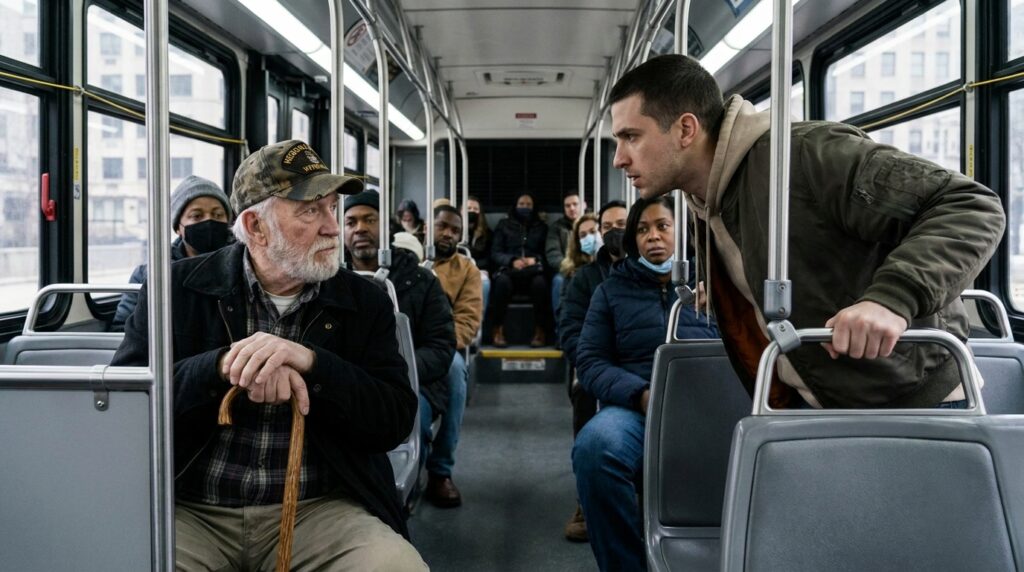
The downward plunge of the young man’s fist didn’t meet the soft resistance of flesh. It met a sudden, geometric vacuum.
In the precise microsecond that the knuckles cleared the lip of Thomas’s utility collar, the veteran shifted his entire weight down into the iron seat frame. His left arm cut upward, an unbending lever of bone and sinew that intercepted the young man’s extended right forearm from the blind inside track. The collision was a sharp, flat crack—the friction of heavy leather slamming against dense utility canvas.
Thomas did not push against the strike; he redirected the momentum. His fingers, curved and hard from a lifetime of structural maintenance, snapped around the young man’s thick wrist with the precision of a high-tensile clamp. At the exact same instant, Thomas’s right hand came down on the brass collar of his oak cane, jamming the rubber tip deeply into the ribbed floor matting directly behind the young man’s leading left heel. The cane became a rigid, unyielding pivot point—an external skeleton anchoring the geometry of the aisle.
The young man’s eyes widened, the bloodshot veins expanding as his forward weight encountered an absolute wall. He tried to pull back, his massive shoulder muscles bunching under the leather of his bomber jacket, but his own forward velocity had already crossed the center line. Thomas simply twisted his torso five degrees to the left, using the kid’s tight grip on his shoulder seam to pull the larger body down into the exact trajectory it had initiated.
There was a wet, heavy slap as the young man’s knees hit the ribbed rubber floorboards. The impact shook the metal partition behind the driver’s seat, a dull vibration rattling through the silver handrails. The aggressor’s arm was pinned across Thomas’s lap, his wrist locked in a reverse flexion that kept his shoulder completely immobilized. He was frozen, brought to his knees in the center of the narrow aisle, his chest heaving as the raw physics of leverage held him in place without a single punch being thrown.
A sharp, collective intake of breath cut through the cabin. Across the aisle, the two teenagers with the glowing smartphones lowered their hands by three inches, their faces dropping their expressions of digital detachment as the reality of the physical reversal hit the space. The perimeter of apathy had fundamentally collapsed. The commuters leaned forward, their gazes locked on the broad-shouldered boy now trapped beneath the small, unmoving frame of the elderly passenger.
“Let go,” the young man wheezed, his voice losing its tight, mocking edge, replaced by a raw, breathless panic. He strained against the wrist-lock, his boots sliding against the wet floorboards, but every micro-movement only tightened the pressure of the brass cane collar against his leverage points. “Let go of me, you old bastard.”
“You’re shouting, son,” Thomas said. His voice was a calm, low-frequency hum that didn’t rise above the mechanical rattle of the idling engine. His expression remained entirely flat, his eyes fixed on the small crescent scar on the kid’s lower thumb joint. “And your center of gravity is completely unmanaged.”
As the young man made a desperate, violent surge to break the restraint, his left jacket sleeve caught the sharp edge of the seat rail. The sudden friction tore open the damp interior lining, and a folded, water-damaged square of heavy cardstock slipped from the hidden mesh pocket, fluttering onto the blue rubber matting between them.
Thomas’s eyes dropped to the paper. The document was an official Department of the Army service manifest from October 1971, its edges stained with dark grease and stamped with a faded red classification marking. Written in crisp, typewritten characters near the bottom of the roster was a name Thomas had not seen in forty-five years: Corporal Marcus Vance. Beneath it, a handwritten note in blue ink detailed a summary court-martial for the theft of logistical field supplies—a file Thomas himself had signed off on before closing the command log forever.
The young man noticed the document on the floor, his face draining of its remaining color until his skin matched the pale gray light filtering through the bus windows. He stopped struggling, his fingers going entirely slack against Thomas’s shoulder.
The bus began to decelerate, the air brakes hissing loudly as the vehicle pulled toward the rain-slicked concrete platform of the upcoming terminal. The timing was precise, a mechanical punctuation mark that signaled the evolution of the incident from a private clash into a public consequence. Thomas did not loosen his grip on the wrist. His mind was already moving down a darker, strategic corridor, realizing that the artifact on the floor had completely shattered the illusion of a random transit encounter. The decoy secret was out, but the ultimate reality behind why this specific boy was tracking this specific bus line remained locked behind a wall of cold, calculated silence.








