
CHAPTER 1: THE GEOMETRY OF PRESSURE
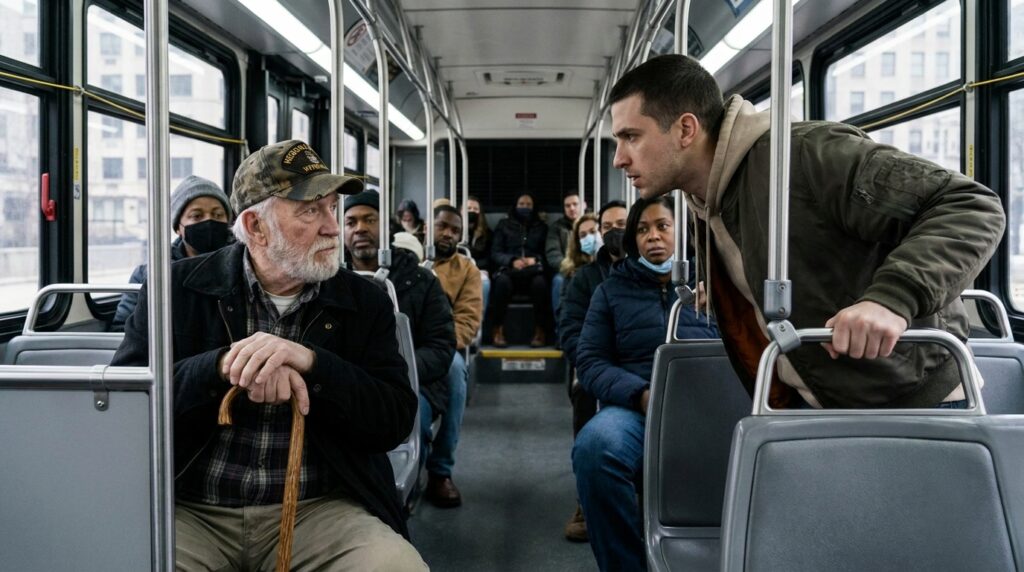
The low, rhythmic vibration of the municipal bus engine hummed directly through the worn soles of Thomas’s boots, a dull mechanical rattle that vibrated the brass collar of the oak cane resting between his knees. To his left, the scratched plexiglass window offered a desaturated view of the rainy American avenue—gray brick facades blurring into dark asphalt under the late afternoon downpour. Thomas did not look at the streets. His chin remained tucked into the collar of his utility jacket, his gaze fixed three feet ahead on the blue non-slip flooring of the aisle.
He calculated the environment out of a half-century habit that civilian life had never managed to erode. Fourteen passengers occupied the forward rows. Nine were staring down into the glowing screens of their mobile devices, their faces washed in a cold, artificial light that made them blind to the physical space around them. Two rows back, an exhausted woman in a damp grocery apron held a sleeping child, her shoulders slouched with a fatigue that slowed her reaction time to near zero. The bus was a closed container moving at forty-five miles per hour, its metal handrails polished smooth by thousands of transient hands, creating a precise grid of obstacles and leverage points.
Thomas adjusted his grip on the curved handle of the oak cane, feeling the deep grain of the wood press against the calluses of his palm. Beneath his low-brimmed brushed-cotton cap, his eyes remained steady, watching the front doors hiss open at the corner of 4th and Industrial.
A cold gust of wind swept into the cabin, carrying the smell of wet pavement and exhaust. A young man stepped up the metal stairs, his boots hitting the rubber treading with an intentional, heavy stomp. He was broad-shouldered, mid-20s, with short dark hair cut close to an aggressive jawline. A heavy leather bomber jacket bunched at his shoulders, a dark hoodie pulled up just far enough to shadow his brow. He didn’t drop a token into the slot; he merely stared at the driver until the older worker looked away, adjusting his mirrors with a sudden, tense focus.
The newcomer moved down the aisle with an unstable, top-heavy stride, his shoulder intentionally clipping the seatback of an office worker, who immediately shrunk back into the window panel. The young man was looking for friction. He was assessing the room for compliance, his chest pushed out to maximize the visual weight of his athletic build.
Thomas didn’t shift his position. He kept his slender frame centered in the aisle-adjacent seat, his hands resting loose but aligned over the top of his cane. He noticed the slight tremor in the young man’s right hand—not from fear, but from the raw adrenaline of a predator accustomed to unearned deference.
The heavy leather jacket stopped directly parallel to Thomas’s row. The shadow fell over the veteran’s lap, cutting off the dim overhead light. The young man didn’t look down at the cap or the service ribbons embroidered into the fabric; he only saw an obstacle with white hair and a thin, lined face. He planted a thick, calloused hand onto the vinyl seatback directly in front of Thomas, leaning inward until his breathing was audible over the engine’s drone.
Thomas felt the shift in air pressure. He did not blink. From the periphery of his vision, he saw three passengers across the aisle rigidly freeze, their eyes darting to their phones as they withdrew into a protective silence.
A dry flake of gray paint peeled from the handrail near Thomas’s left knuckle, exposing a bright, clean glint of raw iron beneath the surface.








