
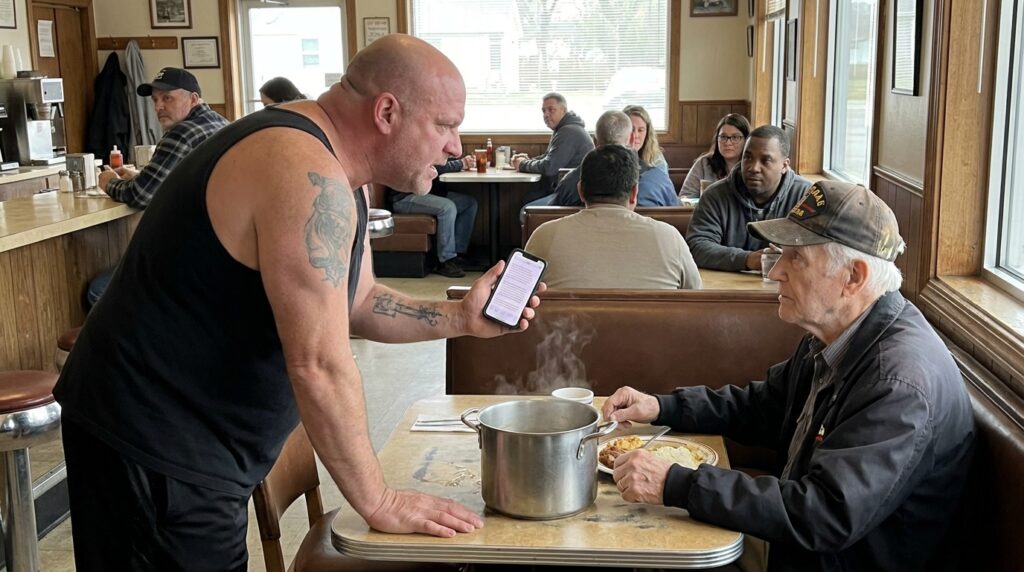
CHAPTER 8: THE SHADOW INVESTIGATOR
The radio didn’t broadcast words; it emitted the steady, rhythmic click of a tactical transceiver checking a directional bearing. Five quick bursts of static, then an unbroken hiss that matched the low, mechanical rattle of the diesel idling outside the warehouse’s western wall.
The veteran reached down and cut the power toggle on the shortwave unit. The hiss died, but its absence only hollowed out the cavernous silence of the iron rafters above them. He did not ask the challenger questions. He did not waste time looking at the large man’s sweating face. His strategic pursuit logic was already tracing the spatial boundaries of the floor plan, tracking potential paths of ingress.
“Get off the pallet,” the veteran said. His gravelly voice was a low, vibrational warning that stayed below the noise of the rain thudding against the iron ceiling trusses. “They didn’t find this grid by luck. They followed the active transmission signature from your tracking key before you buried it.”
The challenger stood up slowly, his large muscular frame casting a jagged, elongated green shadow against the brickwork behind the iron barrel. His eyes remained anchored to the single line of glowing text on the monitor. The name—Marcus Vance—pulsed under the cursor. Beside it, the active routing code for an address near the river loop was marked with a tiny, blinking red asterisk.
“They’re moving on him tonight,” the challenger muttered. His large hands curved into tight, defensive blocks against his sides. The raw, territorial aggression he had brought into the diner had completely flattened out, replaced by the desperate clarity of a man who realizes he is a move behind his opponent. “My brother was the logistics dispatcher who signed the fuel requisition logs for that valley. He didn’t leak anything, Frank. He’s just a name that connects the dates.”
“The oversight office doesn’t sort by guilt, son. They sort by proximity,” the veteran said.
He reached out and yanked the portable aluminum casing from the field terminal’s expansion bay. The green phosphorus screen went dark instantly, plunging the immediate radius back into the desaturated gray shadow of the rafters, save for the faint red glint of the storm through the high glass windows. He slid the casing into the hidden internal pocket of his jacket, letting the heavy iron weight of the utility wrench rest against it to serve as a physical shield.
He turned toward the dark interior of the floor, his eyes tracking a line of old, grease-filmed forklift chassis parked near the central storage lane. The air was heavy with the smell of wet rot and oxidized iron, a sensory landscape he had navigated across three different staging zones before his official retirement. He knew the layout of these old municipal hubs; they were always built with a secondary maintenance tunnel running beneath the primary tracking scales to allow for structural repairs without shutting down the yard.
A sharp, high-velocity click resonated from the warehouse’s eastern loading bay. It was the sound of a spring-loaded hydraulic bolt cutter cleanly biting through a hardened iron pad eye.
Entry element has reached the threshold, the veteran calculated, his thumb tracking the silver indentation of his watch. Sixty-five beats per minute. The cadence was automatic. Two operators on the bolt. One marksman holding the lane from the rear bumper of the idling diesel. They aren’t rushing because they assume our tactical visibility is zero.
The challenger reached into his pocket, his hand tightening around the deactivated tracking key as if he wanted to smash the light. “We have to break through the western doors. If we can reach the loop road before they deploy the secondary element—”
“If you clear the western door, the marksman on the diesel has your torso aligned before your boot hits the gravel,” the veteran interrupted, his whisper cutting through the younger man’s panic like a wire. “He’s using a passive infrared frame. He isn’t looking for your tank top; he’s looking for the ninety-eight-degree heat bloom of your lungs against the cold rain.”
He grabbed the challenger’s left bicep, his calloused fingers locking around the muscle with enough force to halt the man’s forward momentum. He dragged him forty-five degrees to the right, toward the concrete pit where the old floor scales had been removed.
The concrete edge was jagged, the iron reinforcing bars rusted into black, pitted spikes that reached out from the mortar like teeth. Beneath the lip lay a narrow, black trench filled with three inches of stagnant rain runoff and old hydraulic oil. It was tight, filthy, and completely invisible from both the eastern doors and the high window tracks.
“Get in,” the veteran commanded.
“Frank, if we get pinned in a ditch—”
“In a ditch, your heat signature is masked by four inches of reinforced aggregate and three feet of groundwater,” the veteran said. He didn’t wait for compliance. He applied downward pressure, using the challenger’s own forward lean to drop the large man into the trench. The water splattered against the concrete walls with a dull, muffled slap that was immediately buried by a massive crack of thunder outside.
The veteran slid into the trench beside him, his dark jacket absorbing the black grease film of the wall. He reached up with his left hand and pulled a rotting section of a cedar shipping crate over their heads, leaving a two-inch gap that aligned perfectly with the base of the iron barrel where the terminal had been sitting.
Through the crack in the wood, the veteran watched the eastern door frame.
The heavy iron door didn’t swing wide. It slid open three inches on its tracks, a silent, grey hand in a matte-black puncture glove slipping inside to test the internal air resistance. A second later, a thin, needle-like probe extended from the gap, its tip spinning silently as it sampled the room’s electromagnetic frequencies, searching for the green phosphorus signature they had left on the wire less than ninety seconds ago.
The equal intellect of the oversight office was visible in the deliberate patience of the search. They weren’t soldiers looking for a fight; they were investigators conducting a forensic extraction, and they knew exactly how a veteran of the 104th calculated distance in the dark.








