
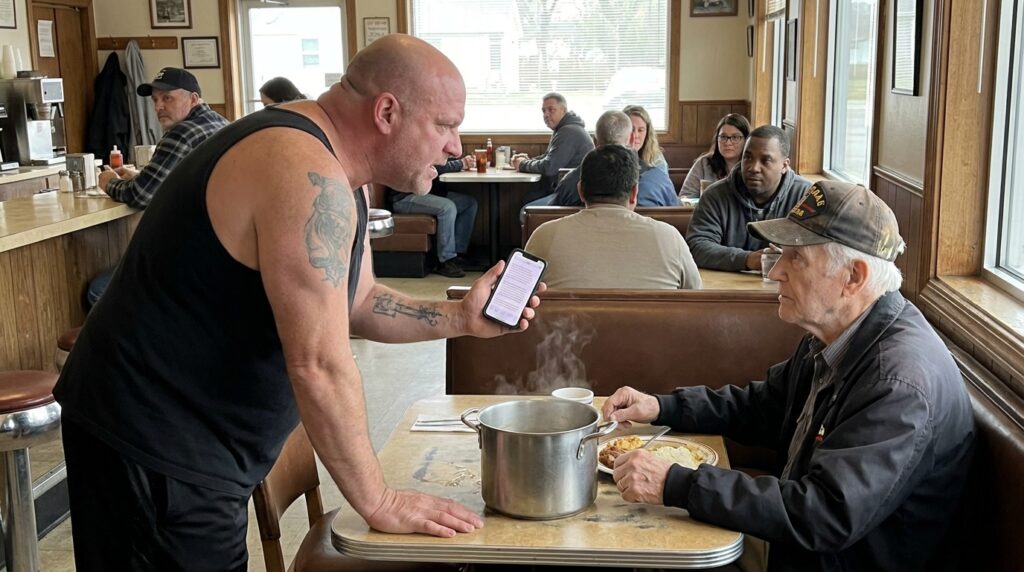
CHAPTER 3: THE BACKBOOTH ATTRITION
The bald man did not sit down immediately. He stood at the edge of the rear corner booth, his broad shoulders blocking the narrow corridor that led toward the emergency exit doors. When he finally dropped his weight onto the vinyl bench, it was a structured, tactical movement. He chose the seat that kept his back strictly against the wood paneling, his face angled forty-five degrees to maintain a clear line of sight through the dirty glass partition separating his table from the rest of the floor.
From his original position by the counter, the veteran watched the reflection in the wet windowpane to his right. The storm outside had intensified, thick sheets of June rain striking the plate glass and blurring the neon sign across the highway into jagged streaks of red and amber. Inside, the ambient noise of the diner was slowly reconstituting itself like water closing over a stone. The waitress’s boots squeaked as she moved toward the kitchen, her breath escaping in a sharp, defensive exhale as she passed the counter.
The challenger was checking his watch. It was an unpolished, military-issue tactical piece, strapped tightly over the thick ridges of his tattooed wrist. His fingers tapped a rhythmic four-beat cadence against the laminate surface of his new table.
He is waiting for a synchronization window, the veteran noted. He took a slow sip of his black coffee, letting the bitter, over-boiled liquid burn his tongue. The pain was small, sharp, and focused. It kept his senses from drifting into the gray fatigue that always threatened to settle into his joints when the weather turned cold and wet.
The room was still operating under a false premise. The challenger thought the package was missing because someone had stolen his drop, but he still believed the perimeter of the diner was secure. He didn’t know that the ledger wasn’t beneath the iron pillar anymore. He didn’t know that the game had shifted from a simple recovery contract into a containment operation.
The veteran’s eyes drifted toward the stainless-steel pass-through window. The line cook, a quiet man named Miller who had worked the early shift for seven years, was currently scraping the flat-top grill with a heavy iron stone. Each stroke produced a harsh, metallic rasp that filled the gaps between the thunderclaps outside. Right beside Miller’s grease-stained apron, half-hidden by a stack of clean kitchen towels on the secondary warming shelf, sat the manila packet.
It was thick, sealed with yellow packing tape that had begun to lift at the corners due to the ambient humidity of the kitchen. The veteran had observed it an hour ago, long before the large man walked through the front doors. He had recognized the distinct, blocky hand-lettering on the spine—the standard alphanumeric routing codes used by the logistics tracking offices before the division was dissolved and its records burned in the yard behind the warehouse.
The challenger’s gaze snapped toward the counter. His hyper-vigilance was expanding. His eyes swept over the napkin dispensers, the chrome sugar shakers, and finally anchored on the kitchen doors. He was noticing the irregularities. A man with his training would eventually realize that the cook wasn’t just working; he was guarding the line.
The veteran set his coffee mug down. The ceramic base clicked against the laminate tabletop, a precise, intentional sound. He didn’t look at the rear booth, but he knew the challenger’s eyes would track the movement. He needed to keep the man’s attention anchored strictly to this section of the room. If the challenger moved toward the kitchen before the rain stopped, the local employees would become collateral.
“You need a warm-up on that, Frank?” the waitress asked, her voice cracking slightly as she stopped three feet away, the glass coffee carafe hovering between them. Her nametag said Claire, her fingers trembling against the handle. She was looking at his veteran cap, searching for the familiar safety of an old regular, but her eyes kept drifting toward the large, silent figure in the back.
“No, Claire. I’m fine,” the veteran said, his gravelly voice dropping into that quiet, rhythmic lower register that had once commanded an entire motor pool during a fuel depot mortar attack. “Go check on the couple in booth four. They’ve been waiting on their check.”
“Are you sure?” she whispered, her eyes pleading for a reassurance he wasn’t about to give her.
“I’m sure. Just keep your distance from the rear door.”
She nodded once, a quick, jerky motion, and retreated toward the cash register. The veteran kept his hands flat on the table. Through the cold metal frame of his chair, he could feel the faint vibration of an engine idling in the gravel lot behind the building. It wasn’t a standard delivery truck. The frequency was too low, the diesel exhaust hitting the air intake valve on the diner’s roof with a heavy, rhythmic thrum.
The challenger heard it too. His head tilted toward the rear exit. His hand slid off the table, disappearing completely beneath the shadow of the bench.
The veteran knew that movement. It was the reach for a concealed sidearm, tracking the safety release by feel through the thin fabric of a waistband. The decoy secret—the assumption that this was an isolated drop recovery—was about to disintegrate. The challenger wasn’t just waiting for a clock to hit a number; he was waiting for his extraction team to clear the alleyway.
The veteran shifted his weight, his left hand dropping to the side of his dark jacket, his fingers brushing against the heavy, blunt iron utility wrench tucked inside his deep internal pocket. It wasn’t a gun, but at three feet, against a man whose center of gravity was caught beneath a fixed booth table, it would be enough to break a knee and reset the distance.
The kitchen door swung open two inches. The cook, Miller, didn’t look out. He simply reached back, his calloused fingers sliding the manila packet off the warming shelf and dropping it into the empty space inside a clean, galvanized grease trap bucket sitting on the floor.
The challenger stood up. His large frame uncoiled from the back booth, his boots hitting the linoleum with a dull, heavy thrum that silenced the room for the second time.








