
CHAPTER 7: THE COLD ARCHITECTURE OF THE WAREHOUSE
The rusted corrugated iron of the roof shrieked as the wind caught the loose western edge. Inside the abandoned logistics warehouse, the darkness was vast, hollow, and smelled of decades of decomposing pine crates and dead oil.
The veteran didn’t stop until his boots cleared the greasy tracking pad of the old freight elevator. He released his grip on the challenger’s wet canvas collar, letting the younger man stumble forward onto a stack of rotting wooden pallets.
“Get your breath,” the veteran said. His gravelly voice didn’t echo; the immense volume of the empty structural space swallowed the sound instantly. He reached into his coat pocket and pulled out a small, heavy aluminum casing no larger than a cigarette pack—the true ledger he had pulled from the manila packet at dawn. He snapped it onto the housing of a portable field terminal sitting on a rusted iron barrel.
The field terminal flickered to life, its low green phosphorus glow casting sharp, desaturated shadows across the deep lines of his face and the faded fabric of his veteran cap. The cooling fan inside the machine whined, a thin, high-pitched mechanical squeal that sounded like an old radar unit warming up on a cold runway.
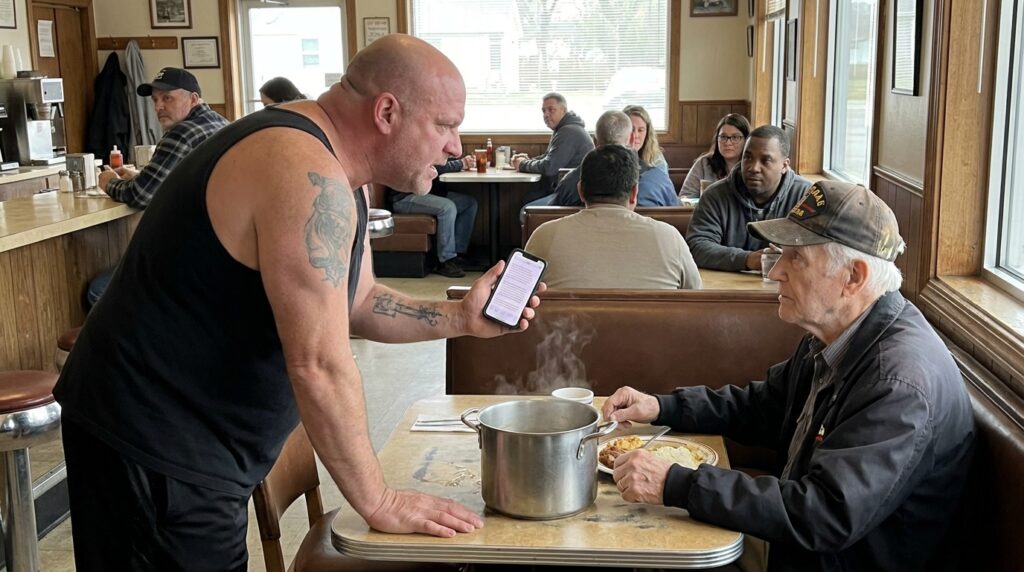
The challenger pushed himself up from the pallets, wiping a streak of black iron dust from his bald head. His black tank top was torn at the shoulder, the pale, branded circle of the 104th Logistics Division glistening with rain under the green light. He stared at the glowing monitor, his large chest heaving as his hyper-vigilance dialed back into a cold, desperate focus.
“You had it the whole time,” the challenger rasped, his teeth chattering against the drop in temperature. “You let me walk into that diner thinking I was pulling a live drop.”
“If you didn’t think it was live, your posture would have given it away the second you crossed the threshold,” the veteran said. He didn’t look up from the screen. His calloused fingers hit the heavy mechanical keys with a rhythmic, unhurried cadence, entering the bypass codes he had kept memorized since the winter of ninety-four. “The oversight office doesn’t deploy field operators for data. They deploy them to clean the perimeter of anomalies. You were the anomaly, son. I was the anchor.”
The screen flashed once, a horizontal line of white code cutting through the green phosphorus background before stabilizing into a dense vertical column of names, dates, and alphanumeric designators.
The veteran’s thumb rested flat against the silver bezel of his wristwatch, his nail catching the deep indentation in the steel. His pulse held firm at sixty-five beats per minute. He knew the structural layout of the file; he had helped catalog the original manifest before the logistics units were systematically dismantled. But as the third sub-directory opened, the strategic pursuit logic of his mind detected a fatal discrepancy in the file size.
There was a secondary data string attached to the routing codes—an active tracking sub-protocol that was currently updating its target metrics in real-time.
The challenger took a heavy step toward the barrel, his large frame leaning over the green glow of the screen. His eyes dilated as he tracked the movement of the cursor down the column of names. He wasn’t looking for a corporate ledger. He wasn’t even looking for the operational history.
His thick, tattooed finger shot out, stopping less than an inch from a single line of text near the bottom of the registry.
“There,” the challenger whispered, his voice cracking into a jagged, broken register that completely destroyed his previous bravado. “That’s not a list of survivors. That’s a target manifest.”
The veteran didn’t answer. He watched the screen as a small, amber icon began to pulse next to the name the challenger had targeted. The alphanumeric designation code beside it didn’t belong to an old supply sergeant or a retired motor pool mechanic. It belonged to an active residential address less than four miles from the county line bridge.
The ultimate final reality of the second phase was bleeding through the green light. The challenger hadn’t come to the diner to sell the ledger to the highest bidder; he had come to steal it before the cleanup team could execute the next line on the list.
A low, static-filled hiss erupted from an old shortwave radio receiver sitting on a shelf behind the iron barrel. It wasn’t a standard emergency broadcast. It was an unencrypted, military-grade secondary frequency, and through the white noise, the low thrum of a heavy diesel engine began to pulse in perfect synchronization with the storm outside.








