
CHAPTER 2: THE GRAVELLY LINE IN THE SAND
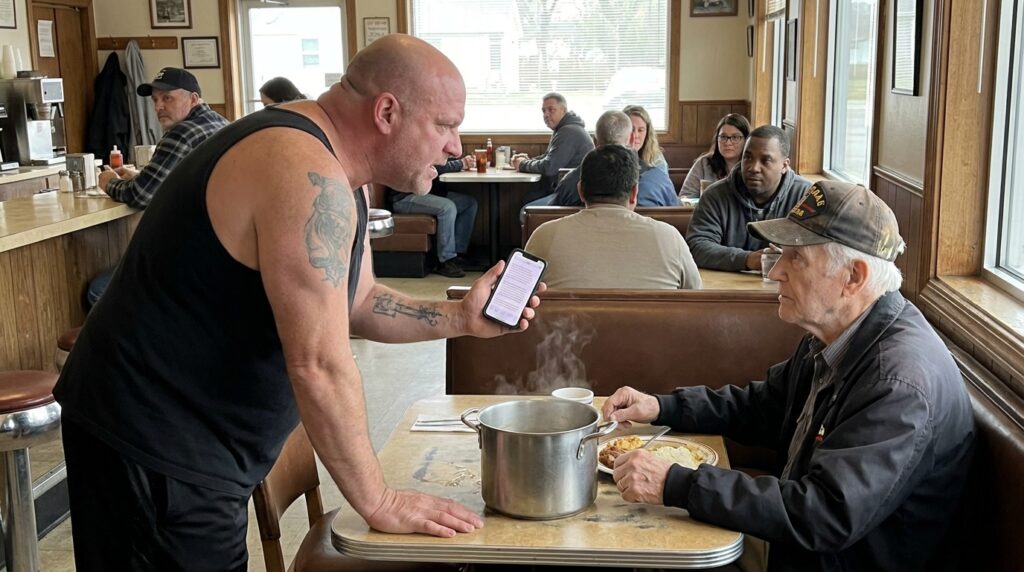
“You’re making a mistake, son,” the veteran said. His voice didn’t carry the trembling register of an old man begging for quarter; it was flat, dry, and carried the specific, unhurried cadence of an officer who had spent half his life speaking over the low rumble of idling diesel engines. “Leave while you still can.”
The challenger’s hand remained flat on the laminate table, but the skin across his knuckles went white. His gaze, previously locked on the empty space near the table’s central iron support pillar, snapped back to the veteran’s face. The raw malice in his expression flickered, replaced by a sudden, razor-sharp hyper-vigilance. His eyes tracked the absolute stillness of the old man’s shoulders, then dropped to the right hand resting beside the plate—motionless, fingers loose, mere inches from the steaming lip of the steel stock pot.
The small-town diner had entered a state of arrest. In the midground booths, a local mechanic slowly lowered his coffee mug back to its saucer, his eyes darting toward the counter. The waitress held a glass pitcher of iced tea two inches above a table, her knuckles locked around the handle. Nobody breathed. In an environment defined by predictable local routines, the sudden introduction of professional tactical posturing was a foreign antibody.
The veteran watched the younger man’s chest. The respirations were still shallow, but the cadence had shifted from blind, aggressive panic to a calculated evaluation of risk. The shadow cast by the challenger’s bulk seemed to tighten, his center of gravity shifting slightly backward, away from the table’s edge. He was recognizing the geometry. He was realizing that the frail old man in the faded veteran cap wasn’t looking at his massive arms; he was looking at his throat, his balance point, and the branded circle on his forearm.
“Who the hell are you?” the challenger muttered, his voice dropping into a raspy whisper that barely cleared the ambient hum of the refrigeration units behind the counter. He didn’t lift his hand from the table, but the downward pressure was gone. His fingers curved slightly, ready to pull back or strike depending on the next shift in the room’s temperature.
“A man who knows what happens to people who come looking for things left by the 104th,” the veteran answered. He didn’t raise his voice. He didn’t need to. The subtext was a physical weight between them, sharper than the cold edge of the Formica booth. He kept his left thumb firmly anchored over the silver scar on his wristwatch, tracking the precise rhythm of the moment. The challenger was intelligent enough to calculate odds, which made him dangerous, but it also made him compliant when the metrics turned against him.
The challenger’s eyes dilated. The brand on his forearm—the fractured spearhead inside the broken circle—seemed to tighten as the muscles beneath it flexed. For three agonizing seconds, the silence in the diner was absolute, broken only by the steady, rhythmic hiss of steam escaping from the stock pot between them. The younger man’s jaw clamped shut, his teeth grinding as he balanced the immediate cost of a public brawl against the ticking clock of his true objective.
The calculation ended. The aggressive forward lean collapsed entirely. The challenger pulled his hand off the table, the black tank top shifting as he squared his shoulders and took a deliberate, heavy step backward. His boots scraped against the worn linoleum tiles, creating a wide, respectful distance between his torso and the boundary of the booth.
“Fine,” the challenger muttered, his eyes darting toward the kitchen doors before returning to the veteran with a cold, lingering threat. “I’ll back off. For now.”
He turned on his heel, his large frame cutting through the static air of the diner as he retreated toward a corner booth near the back exit, his eyes never truly leaving the central iron pillar beneath the veteran’s table.
The veteran didn’t watch him walk away. He kept his eyes fixed on the steaming stock pot, his hand remaining loose and ready by his plate, waiting for the ambient sound of the room to return. But as the tension faded into the background chatter of the patrons, his fingers drifted beneath the lip of his own table, his calloused skin searching for the exact seam where the old industrial adhesive met the iron support.
His fingertips brushed against the underside of the wood. The surface was smooth, except for a three-inch strip of thick, recently sliced duct tape hanging loosely from the center of the iron pillar. The space where a heavy manila envelope should have been secured was entirely bare.
His pulse didn’t change, but his mind rearranged the board. The challenger thought the data was still hidden beneath the booth.
The veteran slowly withdrew his hand, his eyes tracking across the diner to the far counter where the cook was leaning against the pass-through window. On the stainless-steel shelf behind the order wheel, half-hidden beneath a stack of clean kitchen towels, sat a thick, grease-stained manila packet that hadn’t been there when the rain started.








