
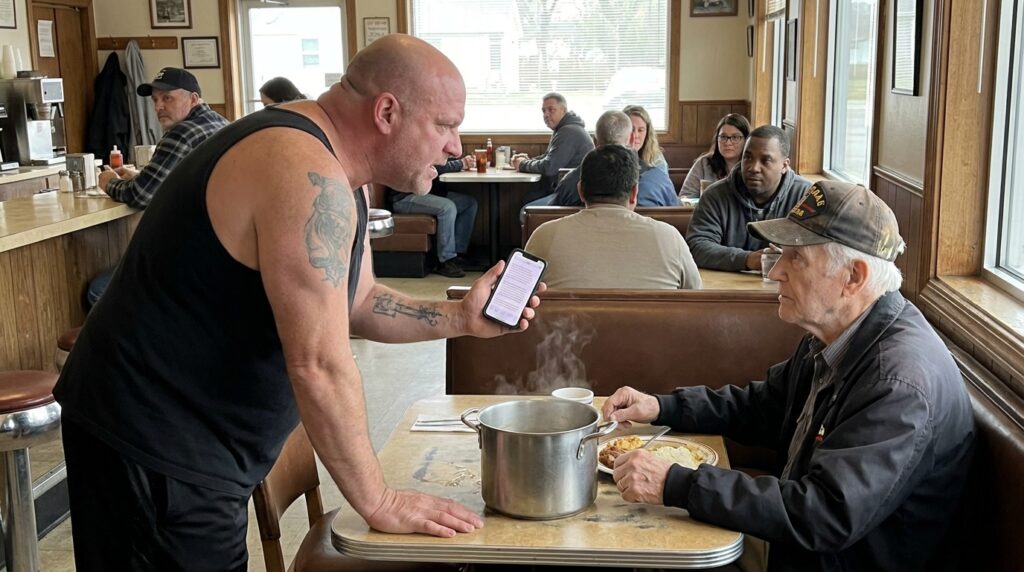
CHAPTER 4: THE COVERT CONVERT
The uncoiling of the large man from the rear booth took precisely zero point eight seconds. His center of gravity shifted cleanly over his heavy boots, his large muscular frame cutting through the dim, grease-laden atmosphere of the diner toward the swinging kitchen doors. He didn’t look at the veteran. His right arm was held in a stiff, guarded position against his flank, masking the distinct imprint of an iron utility frame beneath the black tank top.
From his counter stool, the veteran initiated his own counter-movement. He didn’t rise into a standing position that would broadcast tactical alarm to the rest of the room. Instead, he smoothly slid his boots off the chrome metal ring of the stool, his heels hitting the wet linoleum with measured weight. His right hand dipped into the internal lining of his jacket, fingers wrapping tightly around the cold, textured iron shaft of the utility wrench.
The decoy secret was unraveling in real-time. The challenger had completely abandoned the idea that the package was under the booth. His trajectory was locked directly on the stainless-steel pass-through where Miller had dropped the galvanized bucket.
The veteran stepped into the narrow interaction lane between the counter and the booth dividers, forcing his body into the younger man’s path. He didn’t use force yet; he used geometry. He leaned his left hip against the corner of booth three, cutting off the angles of approach.
“The kitchen’s closed to public foot traffic, son,” the veteran said, his gravelly voice flat and unyielding under the hum of the overhead lights.
The challenger didn’t slow his pace until his chest was less than two feet from the veteran’s shoulder. The proximity brought the sharp smell of rain-soaked canvas and industrial hydraulic fluid. His bald head tilted down, his neck muscles twisting into tight, thick ridges as he attempted to look over the old man’s head toward the swinging doors.
“Get out of the way, old man,” the challenger whispered. The transactional calmness was entirely gone from his tone, replaced by an abrasive, jagged desperation. “You don’t know what’s in that room. You don’t know who’s coming through that back door.”
“I know Miller’s got a hot grill, and I know you’ve got no business past the threshold,” the veteran answered. He kept his posture entirely loose, but his thumb remained locked over the silver scar of his wristwatch. His mind calculated the distance. If the challenger’s right arm cleared his flank, the response would have to be defensive and instantaneous—a sweeping wrist release followed by a hard, lateral balance shift into the heavy iron support pillar.
The equal intellect of his adversary showed itself in the next micro-second. The challenger didn’t swing. He didn’t try to use his bulk to push through the line. Instead, his left hand shot out in a lightning-fast, highly disciplined redirection maneuver, his thick fingers grabbing the veteran’s right lapel while his body weight shifted downward to lock the old man’s hips against the laminate table edge. It was a precise tactical restraint, designed to clear a path without throwing a loud punch.
But the veteran had spent three winters in the motor pools of the 104th predicting physical failures under stress. He didn’t pull back against the lapel grab. He went with the momentum.
As the challenger pulled, the veteran allowed his upper torso to rotate cleanly into the pressure. He brought his left forearm up in a sharp, defensive wedge, striking the inside of the challenger’s left elbow with the hard bone of his wrist. The friction was immediate and mechanical. The alignment of the younger man’s arm shattered, his fingers slipping off the dark jacket fabric as his balance point was pulled violently forward over the steaming stock pot on the table edge.
The environmental disruption was instant. The challenger’s hip struck the metal side of the stock pot, sending a heavy splash of boiling water across the laminate surface. He let out a sharp, guttural hiss as the heat penetrated his black tank top, his boots sliding six inches across the wet linoleum as he fought to restore his center of gravity.
The victory, however, was a false flag.
Before the veteran could close the distance to establish an immobilization lock, the external pressure system broke wide open. The heavy diesel engine that had been idling in the rear gravel lot suddenly surged. The rear emergency exit doors of the diner didn’t just open—they were violently breached from the outside, the metal lock system snapping with a sharp, high-velocity crack that echoed through the kitchen.
Through the two-inch gap in the swinging kitchen doors, the veteran saw a flash of dark rain-gear and the matte-black barrel of an industrial tracking unit. It wasn’t an extraction team for the challenger. It was something else entirely.
The line cook, Miller, didn’t even have time to lift his iron scraping stone. A heavy, gloved hand slammed into his chest, forcing his frame backward into the grease traps. The galvanized bucket containing the grease-stained manila packet was kicked sideways, sending the thick document sliding across the greasy tile floor directly toward the base of the dishwashing station.
The challenger looked at the kitchen door, then back at the veteran, his face pale beneath the fluorescent lights as the ultimate final reality began to bleed through the margins of the room.
“They tracked the signature,” the challenger muttered, his hand finally clearing his waistband to reveal a heavy, serialized tracking key instead of a gun. “They didn’t come for the drop. They came for the person who intercepted it.”
He didn’t mean himself. His eyes were locked directly on the veteran cap.








