
CHAPTER 7: THE BREAKING WEIGHT
The manila envelope tore along its glued seam with a short, fibrous hiss that was swallowed entirely by the deep growl of the transport truck. Aaron Vance slid the small, square token into his palm. It was thick, machined from unanodized titanium, lacking any serial markings or standard institutional engravings—just a dull gray wafer with a single, inset black-silicon magnetic array. It felt cold against the skin of his thumb, colder than the weathered silver ring resting against his knuckle.
He stepped out of the office threshold and back into the midday glare of the staging compound. The air had turned thick with the heavy odor of combusting low-grade diesel and the sharp, copper-and-solvent tang of fresh packing grease being stripped from operational hardware.
The three fire teams were no longer standing in a loose instructional formation. They moved around the flatbed with the quiet, non-verbal synchronization of a deployment-locked element. Private First Class Miller was leaning into the bed of the transport, his arms wrapped around an olive-drab transit container, his face glistening with gray lanes of sweat that had cut through the limestone dust on his cheeks. He didn’t look at Vance as the contractor reached the edge of the platform; his attention was pinned to the heavy iron handles of the military lockers.
“Vance,” a voice grated from the left flank.
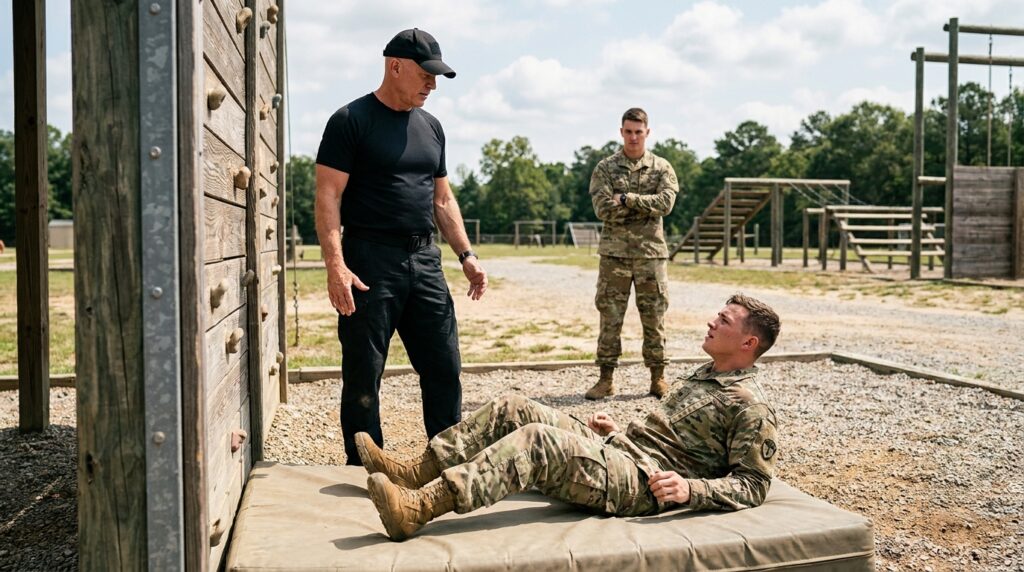
Specialist Kincaid was standing beside the main hydraulic rack, his unbadged black tactical vest pulled tight against his frame, the straps adjusted down to the millimeter. He was holding a short, gray-parkerized carbine frame, checking the bolt seat with a flat, mechanical click of his thumb. The marks from his fall beneath the climbing wall were still visible as a pale, smeared stain across his shoulder tabs, but his eyes had completely settled into a hard, professional coldness. The performance was gone. The true baseline of the machine was exposed.
“The manifest has three open slots for the support element, sir,” Kincaid said, his voice flat, dropping the casual insubordination from before as if it had been nothing more than an assigned code. He didn’t look up from the chamber of his weapon. “The Sergeant Major said you still keep your field rig in the corner locker of the maintenance bay. We clear the gate in seven minutes, and the perimeter wires are already detached from the main grid.”
Vance stopped by the iron wheel of the flatbed’s secondary hitch, his fingers resting on the oxidized metal surface. He looked past the truck toward the climbing wall, where the empty safety mats sat beneath the timber frame like large, square scars on the parched Virginia soil. The decoy of his termination had worked cleanly; the young Rangers in the barracks would talk about the old civilian who got pushed out by the regional budget boards, a standard institutional retirement story. But the real line had nothing to do with retirement. It was a mobilization disguised as a erasure.
“You’re missing the alignment pin on your primary optic, Specialist,” Vance said softly, his voice cutting under the rumble of the engine without an ounce of force. “If you take that frame onto a wet deck, the vibration from the rotor is going to drift your hold two inches to the left before you find your baseline. Fix it.”
Kincaid’s fingers went entirely still against the receiver. He slowly lowered the weapon by an inch, his eyes locking onto Vance’s face with a heavy, unblinking focus. There was no mockery left in his jaw, only the deep, dangerous recognition of an asset who realized he was still being parsed by a master craftsman.
“The coast transport doesn’t wait for technical adjustments, sir,” Kincaid replied, his tone transactional, probing. “We run with the gear we have on the deck.”
“Then you’ll run with a broken lead,” Vance said. He turned the silver ring around his finger once, the metal catching the noon sun like a small, blunt shield.
Before Kincaid could reset his grip on the weapon, the main gate’s pneumatic lock fired with a loud, high-pressure exhaust blast that shook the dry brush along the chain-link boundary. A second logistics truck, unpainted and covered in thick, dark mud from the low country coastal routes, backed through the wire with its lights blacked out. The rear canvas flap was thrown back, revealing three figures dressed in plain, unbadged gray flight suits, their helmets resting on the steel floor beside an open crate of live-coded communication nodes.
Vance watched Thorne walk past the flatbed, his hand already pinning the gray cardboard folder inside his uniform jacket. The entire staging area was changing its shape in real-time, the institutional skin of Fort Walker peeling back to reveal the dark, operational core that lay beneath the budget paperwork. Vance looked down at the titanium square in his hand, then out toward the marsh lanes that led toward the Atlantic. The narrative was moving out of the classroom, and every step taken from this micro-second forward would be paid for in the raw physics of survival.
“Vance,” Thorne called out from the back of the second vehicle, his arm outstretched toward the dark interior. “The clock is done.”
Vance didn’t look back at the timbers of his old instructional deck. He ground his boot into the gravel, his fingers closing tight over the metal token as he took his first step toward the idling line.








