
CHAPTER 5: THE COLD RUN
The sound of Specialist Kincaid’s breath catching in his throat stayed trapped between the gravel floor and the high timber beams of the tower. It was a wet, rattling noise, the sound of a baseline engine losing its compression under a sudden load. Aaron Vance stepped out of the active lane, his boot heels leaving short, shallow half-moons in the white limestone dust.
He didn’t check the stopwatch. The numbers on the small digital display were irrelevant when the structural mechanics of the squad had collapsed before the third marker. He walked toward the iron-braced administrative crate resting at the end of the staging bench, his hand sliding across the coarse grain of the wood until his fingers grazed the corner of the gray folder.
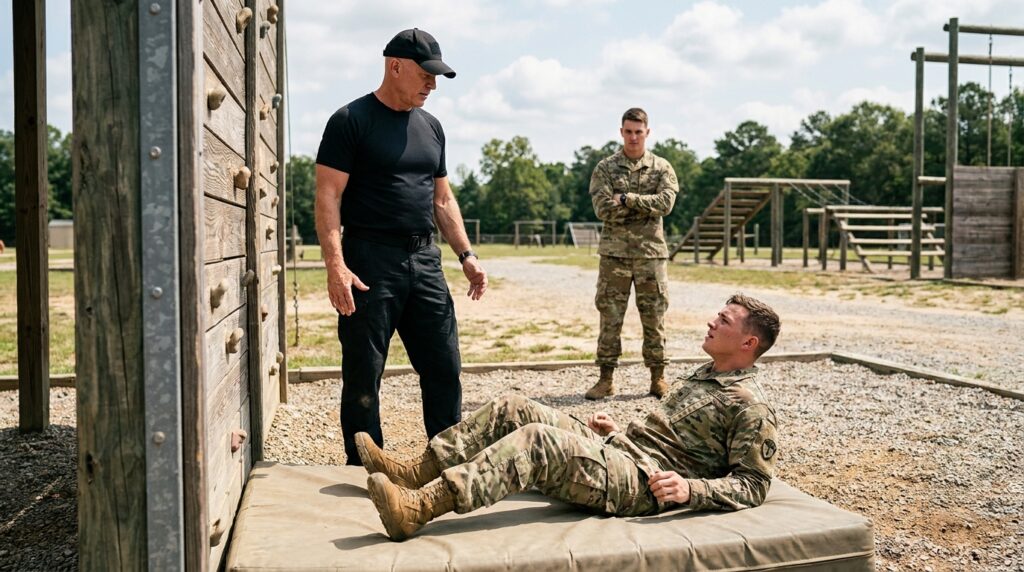
The thirty trainees along the line didn’t move. Their green and brown camouflage patterns seemed to dissolve into the desaturated gray of the treated timber wall behind them. They stood with their weight thrown onto their heels, their shoulders rigid beneath the stiff nylon webbing of their plate carriers, their eyes tracking Vance’s knuckles with the quiet, intense focus of men watching an unexploded shell on a live deck. Private First Class Miller lowered his head an inch, his jaw tightening until the muscle beneath his cheek bone went white under the noon glare.
Vance pulled the folder completely clear of the crate. The red ink of the Defense Logistics Agency stamp was dry, but the edges of the top form lacked the micro-perforations that always marked a standard regional draw-down notice. There was no routing number in the upper right margin. There was only a three-digit functional identifier: T3-A.
He turned the page. Below the cancellation notice lay a secondary sheet of heavy, unlined rag paper, crisp and smelling faintly of industrial ink. It wasn’t an inventory log. It was a roster of names—sixteen active-duty operators, all from tier-one elements, currently listed as detached on training leave from their primary commands. At the very bottom of the columns, printed in the clean, block typography of a terminal printout, was Kincaid’s service identification code, marked with an open bracket that had no closing date.
Vance closed the cardboard folder with a short, deliberate snap of his wrist. The sound was flat, like a pistol primer failing to ignite in a closed pit.
“Vance,” a voice called from the shadow of the command shack.
Command Sergeant Major Thorne was standing in the doorway, his large frame silhouetted against the dim, yellow light of the interior corridor. He wasn’t holding his administrative cap. His sleeves were rolled up past his forearms, exposing the thick, graying hair and the old shrapnel scars that marked his skin like rusted iron wire. He didn’t look at Kincaid, who was now standing three paces from the mat, his uniform covered in gray dust, his head fixed straight ahead.
“Leave the log sheets on the bench,” Thorne said. His tone carried the dead, uninflected weight of a senior clerk finalizing a terminal manifest. “The truck from the transport pool just cleared the main gate. They’re running thirty minutes ahead of the schedule.”
Vance didn’t answer immediately. He turned the silver ring around his left finger, feeling the smooth, worn metal click against his knuckle. He looked back at Kincaid, noting the way the young soldier’s fingers were locked against his trousers, the knuckles white, the pulse in his neck jumping in three-second intervals. The arrogance had been drained from the specialist’s face, but behind the humiliation, there was a sharp, calculating intelligence that Vance had seen in a hundred rooms before the line moved. Kincaid wasn’t looking at a civilian contractor anymore. He was looking at a barrier he hadn’t been trained to bypass.
“The second element hasn’t cleared the blind corner on the lower run, Sergeant Major,” Vance said, his voice dropping into the quiet space between the benches. “If they don’t tighten the transition before the transport arrives, they’re going to drift on the entry.”
“The entry is cancelled,” Thorne replied. He stepped out onto the gravel path, his low-quarters grinding into the limestone until he stood within two feet of Vance’s shoulder. He reached down and took the gray folder directly out of Vance’s hand, his fingers pinning the cardboard against his thigh. “The line belongs to the division now, Aaron. Get your personal gear out of the locker. We’re locking the floor at thirteen hundred.”
A sudden, sharp vibration shook the ground—the deep, rhythmic thrumming of a twin-axle logistics transport shifting down as it negotiated the gravel turn behind the security wire. The dust rose up through the chain-link mesh, coating the parched leaves of the scrub oaks in a fresh layer of pale gray silt.
Vance stood motionless under the midday glare. The decoy secret was in his hands—the budget cut, the cancellation, the bureaucratic end of a graying career. It was a clean story, a logical explanation that the trainees along the line could understand and carry back to their barracks. But as the truck’s engine died in the compound, leaving only the sound of hot iron cooling in the wind, Vance looked at the unbadged folder in Thorne’s grip and realized the final truth was still buried deep below the gravel.
“Miller,” Vance called out, his voice sharp enough to make the private’s shoulders snap straight. “Take the first stick and load the training blocks into the transport. Use the rear straps.”
He didn’t wait to see them move. He turned toward the dark interior of the command shack, his boots tracking the pale limestone dust onto the clean, black linoleum of the floor.








