
CHAPTER 4: THE BREACH
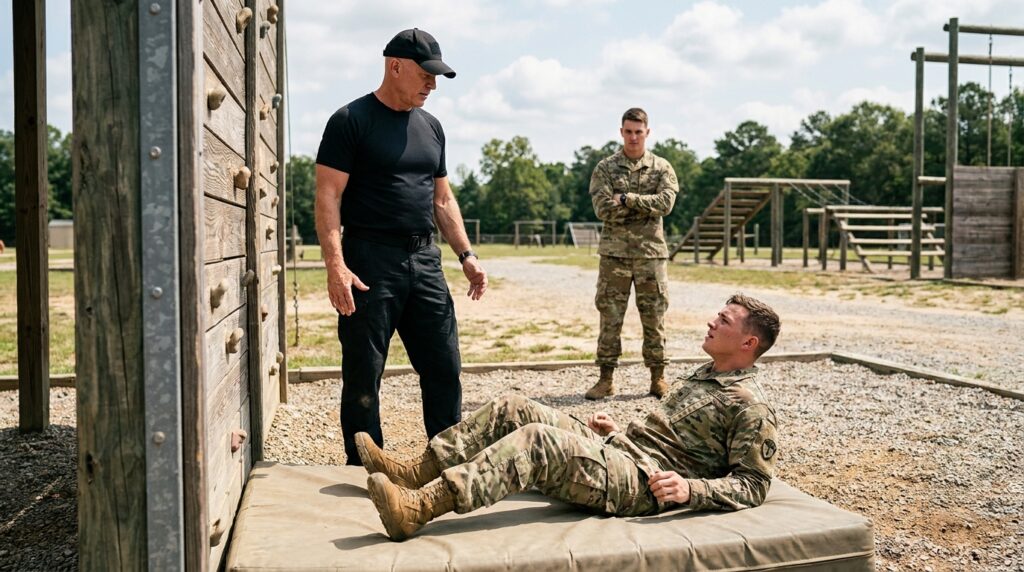
“Step back, Specialist,” Vance said. He did not pull his shoulders back or change the drop of his thumbs against the aluminum clipboard. The air between them had grown tight, smelling of the sun-baked zinc coating on the chain-link perimeter fence and the sharp, chemical heat of Kincaid’s sweat.
Kincaid didn’t drop his chin. The dust from the safety mat was still caked into the seams of his primary shoulder tabs, but his posture had hardened again, driven by the quiet, watching presence of the three other fire teams lined up along the gravel rim. He took an additional half-step forward, his boot grinding a limestone pebble into white paste against the edge of the rubber impact zone. His chest rig, heavy with three inert training magazines, brushed the lower border of Vance’s unbadged black shirt.
“The Sergeant Major isn’t out here right now, sir,” Kincaid said, his voice dropping below the volume of the distant range clear-signals. His right hand was hovering two inches above his side belt line, his fingers curved into a loose, twitching arc. “And the word down from the company office says your contract doesn’t run past the fifteen-hundred hours logistics check. We don’t need a civilian holding a stopwatch to tell us how to clear a frame when our deployment orders are already stamped.”
Vance watched a single drop of sweat trace a dark line through the dust on Kincaid’s temple. He didn’t look back toward the command shack where Thorne was working through the carbon logs. The world had narrowed to the three feet of space between his heels and the young soldier’s boots—a simple equation of mass, friction, and the mechanical limits of an unweighted spine.
“Your contract doesn’t concern the line, Specialist,” Vance said. His voice was level, almost gentle, the cadence he used when correcting a loose sling or a dragging heel before a night run. “The line only cares about leverage. Right now, your heels are two inches inside your shoulder pocket. If I take your wrist, you have no platform to anchor against the drop.”
A quiet, dry rustle passed through the trainees behind Kincaid. Miller shifted his feet, his hand dropping down to his cargo pocket as if looking for something to steady his own weight against the heat. None of them spoke. They were active-duty Rangers, conditioned to the strict hierarchies of the regiment, but they were also young men who lived by the primitive logic of physical dominance. They wanted to see if the old man’s redirection in the previous drill was a fluke of momentum or a permanent architecture of control.
Kincaid’s jaw muscle jumped. He reached out with his left hand, his fingers spreading into a wide, heavy clamp meant to trap Vance’s right collarbone and force him back against the heavy timber uprights of the climbing wall. It was a street-level movement, raw and uncoordinated, but it carried the full weight of a two-hundred-pound athlete who had spent his youth moving heavy iron in a gym.
Vance didn’t move his head. He didn’t drop the clipboard.
His left elbow rose four inches, his forearm pivoting along an internal axis that had been wired into his marrow before Kincaid’s birth. The edge of his wrist caught the inside of Kincaid’s advancing forearm at a precise forty-five-degree angle, deflecting the hand upward and away from his shoulder line. At the same instant, Vance stepped his right boot back three inches, his sole finding a pocket of packed clay between the loose gravel stones.
The contact was dry and loud—the sound of dense bone striking dense bone through layers of hot cotton fabric. Kincaid’s momentum carried him forward into the empty space Vance had just vacated. His shoulder dipped, his center of gravity shifting over his forward toes until his spine lacked the vertical structure to support his gear.
Vance’s right hand didn’t strike. He simply placed his open palm against the center of Kincaid’s ballistic vest, his thumb locking against the iron zipper pull of the main plate carrier. With a short, concentrated push that used the leverage of his anchored back leg, he directed Kincaid’s remaining forward weight down toward the mat.
The specialist didn’t fall flat this time. He caught himself on one knee, his boot dragging a deep furrow through the limestone dust before his palm hit the synthetic rubber. The impact rattled the inert magazines in his pouches, a sharp, metallic clatter that broke the silence of the staging lane. He stayed there for two seconds, his breath coming in short, wet gasps, his face turning a deep, dark red under the brim of his camouflage cap.
“That’s twice you’ve given away your base for a short reach,” Vance said softly. He turned his silver ring around his finger once, the metal cold against his skin despite the glare of the noon sun. “If you don’t fix the left strap on your rig, the next transition will pull you three inches off the sight line. Clean your uniform and get back in the stack.”
Vance turned his back to the specialist, his eyes tracking the administrative crate sitting at the end of the staging bench. The unbadged gray folder was still peeking out from beneath the field manuals, its frayed edges soft from the rising humidity. He could feel the eyes of the entire fire team on his shoulder blades—a heavy, silent pressure that had nothing to do with the budget cancellation orders sitting on Thorne’s desk. They were looking at his hands now, tracking the way he held the clipboard, looking for the secret that allowed a gray-haired contractor to dictate terms to the active-duty line.
He ground his boots into the gravel, his gaze fixed on the green plywood door of the command shack. The first layer of the trap was already open, but the real line was still moving in the dark behind it.








