
CHAPTER 2: THE ANCHOR LINE
The knuckles of Specialist Kincaid’s right hand came forward in a flat, heavy line, the fabric of his camouflage sleeve snapping like a wet towel against the humid Virginia air. Aaron Vance didn’t shift his heels. To the thirty younger men watching from the perimeter of the gravel pit, the old man appeared frozen—a static target pinned against the sun-baked timbers of the climbing wall.
But Vance’s world had already slowed to the predictable physics of mass and friction. He felt the dry heat radiating off the rubber safety mat beneath his boots, felt the weight of the stopwatch iron clipping against his sternum, and noted the exact trajectory of Kincaid’s center of gravity. The young soldier was leaning too far into his strike, trusting his youth and his cross-trained mass to carry through the older man’s perimeter. It was the common error of the uninitiated: believing that aggression could compensate for a broken base.
Vance’s left hand rose three inches. It was a short, untelegraphed movement that didn’t clear the shoulder. His calloused thumb caught the inside of Kincaid’s wrist right at the soft junction where the tendon met the bone. He didn’t push back; he didn’t try to match the active-duty soldier’s brute strength. Instead, Vance rotated his own hips backward by two degrees, sinking his weight into his right heel and allowing Kincaid’s forward momentum to overextend.
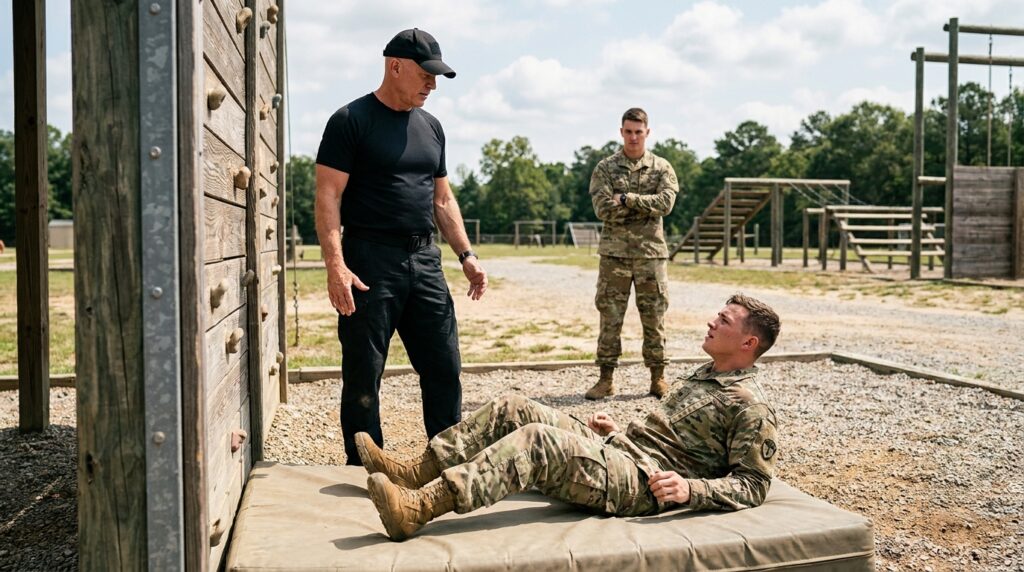
The redirection was instantaneous. Vance applied a downward pressure on the lever of Kincaid’s forearm while using his right palm to check the specialist’s advancing shoulder. The young man’s boots lost their purchasing on the loose gravel. With a dull, hollow thud that vibrated through the boards of the climbing wall, Kincaid hit the synthetic rubber safety mat flat on his back, the air escaping his lungs in a sharp, wet gasp.
The surrounding pit went dead. The small, private smirks on the faces of the trainees along the line evaporated, their postures freezing into rigid, awkward columns of green and brown fabric. Private First Class Miller dropped his hand from his cargo pocket, his fingers going stiff against his seam. The regular hum of the base—the distant, rhythmic thudding of heavy machine-gun fire from Range 4 and the drone of a fuel truck on the perimeter road—seemed to recede behind the sudden wall of absolute stillness.
Vance settled back into his upright stance. His hands stayed open, palms slightly turned inward, his fingers relaxed. He didn’t look down at Kincaid with anger; his face remained as flat and unreadable as the gray sky over the treeline. The sun caught the edge of his smoothed silver ring as he reached down to adjust the brim of his black cap.
“Your left heel was off the deck before you initiated contact,” Vance said, his voice dropping into the quiet space between them without a single tremor of exertion. “You gave away your leverage for an extra inch of reach. In a five-second pocket, that inch belongs to the man who keeps his footing.”
Kincaid lay on the rubber mat for three seconds, his jaw clenched so tight the muscle beneath his ear throbbed against the dust. His OCP uniform was coated in a fine layer of gray polymer residue from the matting. His chest rose and fell in ragged, shallow jerks as his nervous system tried to process how sixty pounds of dynamic force had been neutralized without a struggle. His eyes, tracking upward toward Vance, were wide with a volatile mixture of humiliation and tactical shock.
Vance didn’t offer a hand to help him up. To do so would be an act of performative ego, a violation of the professional distance he required to keep the training line functional. He simply stepped back two paces, clearing the impact zone and leaving the space open for the specialist to recover his posture or break entirely.
Behind the formation, the dry grass rustled as a pair of heavy, standard-issue low-quarters ground into the stones. The trainees shifted their eyes toward the administrative lane, their shoulders squaring instinctively as Command Sergeant Major Marcus Thorne stepped through the gap in the wire. Thorne’s uniform was immaculate, the star and wreath on his chest catching the high noon glare like polished iron, his face set in the hard, dark lines of a man who had spent thirty years watching soldiers fail the standard.
Thorne didn’t look at Kincaid, who was now scrambling to his knees, his hands digging into the grit as he tried to find his footing. The Command Sergeant Major stopped exactly one pace from Vance, his eyes fixed forward, his chin tucked into his collar. He didn’t salute—regulations forbade it on a live tactical floor—but his entire posture carried the unmistakable weight of senior institutional deference.
“Master Sergeant,” Thorne said, his voice cutting through the thick heat like a cold blade. “The division commander wanted to ensure your equipment specs were meeting the current transition parameters. I see the candidates are already familiarizing themselves with the baseline.”
Vance nodded once, his thumb sliding over the top edge of his clipboard, checking the corners of the papers. “The specialist was just verifying his center of gravity, Sergeant Major. We were about to reset the clock for the group ingress.”
Thorne finally turned his eyes down to Kincaid, who was now standing at an awkward, dust-covered attention, his chest still heaving. “Specialist Kincaid,” Thorne said, the drop in his tone low enough to make the trainees along the line shift their eyes back to the front. “If you ever put your hands on the man who wrote the close-quarters integration manual for the third special forces group again, I will personally ensure your remaining time in this regiment is spent inventorying cold-weather gear in Alaska. Do you follow my trajectory?”
“Sir, yes, sir,” Kincaid managed, his voice tight, the arrogance completely drained from his face, leaving only the pale skin around his nose.
“Get back in the block,” Thorne commanded. He didn’t wait for the movement. He turned back to Vance, his eyes dropping for a fraction of a second to the administrative crate sitting near the bench—where a gray, unbadged folder was peeking out from beneath the standard field manuals. “We have an update on the facility allocations, Aaron. When the line finishes this run, we need to speak in the office.”
Vance watched Thorne turn and walk back toward the command tent, his boots tracking straight lines through the loose sand. He felt the cold iron of the ring against his skin again. The decoy was already moving into place, but the weight of the actual line was still theirs to carry.
Vance lifted his whistle. “First stick. On the box. Three seconds to target.”








