
CHAPTER 3: THE TIMED DRILL
“Reset the clock,” Vance said, his left index finger pinning the split-second split trigger on the metal casing of the timer. He did not look at the squad as they scrambled back into their four-man cells, their boots creating a dry, collective hiss across the limestone dust. “You spent four extra seconds calculating your entry because you were looking at the mat instead of the corner. The corner doesn’t move. The mat doesn’t shoot back. Again.”
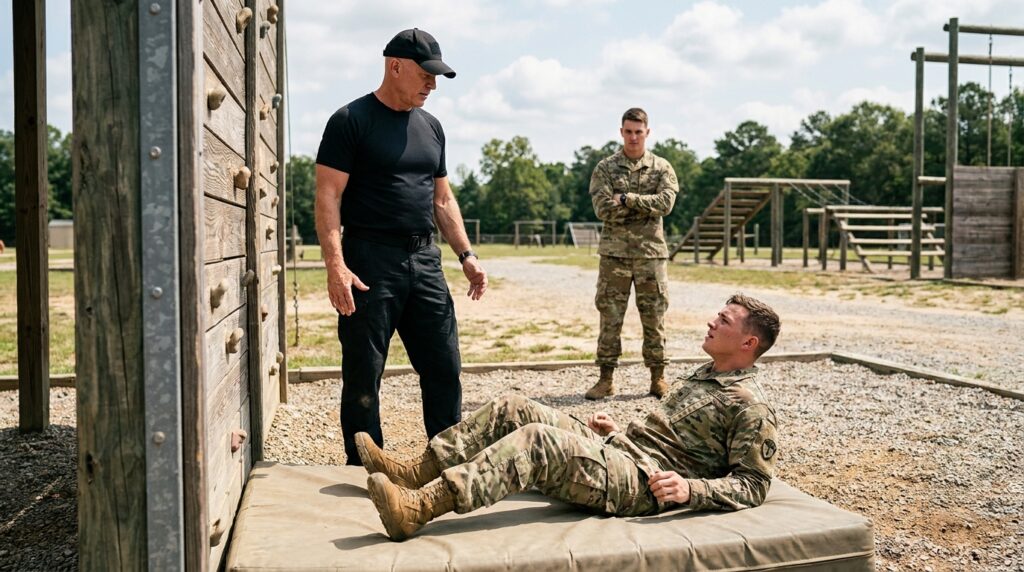
The noon heat had begun to cook the pine sap out of the timber uprights supporting the climbing wall. It rose in thin, oily ribbons, distorting the sharp geometric edges of the secondary tower fifty yards down the range lane. Vance kept his palm flat over the unbadged clipboard, feeling the corrugated iron bench beneath it vibrate slightly each time a heavy logistics truck shifted gears on the access loop behind the wire.
Specialist Kincaid was back in the stack, his position fixed as the number three man in the primary element. The dust on his camouflage trousers had turned a dull, streaked charcoal where it had mixed with the sweat on his knees. His shoulders were completely square now, his chin pinned low into the protective ballistic collar of his vest, his eyes locked entirely on the unpainted wood of the target frame. The performative swagger had been hammered out of his stance, replaced by the rigid, mechanical tension of a soldier who had suddenly realized the ground beneath his boots was monitored by someone who could see the microscopic flaws in his skeletal alignment.
“Go,” Vance said. He did not shout the command. He released it like an exhaust valve.
The four men cleared the threshold with a heavy, rhythmic sequence of impacts—three quick steps, a sliding pivot, and the metallic slap of a defensive shield clearing the frame. Vance’s eyes didn’t follow the muzzle directions; they tracked the heels. He watched the subtle weight shifts, the small, desperate adjustments the ankles made when the balance point drifted more than an inch away from the spine.
“Two hundredths slow on the second transition, Miller,” Vance noted, his pencil scratching a small, precise diagonal mark across the grid lines of the log sheet. “You’re letting your vest ride up against your throat because your strap tension is loose on the left. Fix it before the third run.”
He stood by the iron bench for twenty minutes, his boots motionless on the gravel, a quiet hum of mechanical assessment running through his mind while the candidates pushed their bodies against the clock. Every movement they made was paid for in friction—the rubber of their soles grinding against the limestone, the nylon webbing sawing against their collarbones, the hot metal of their weapon receivers clattering against the plastic buckles of their slings. To the squad, it was a test of raw physical endurance. To Vance, it was an exercise in removing the unnecessary mass from a machine that had to function in the dark.
When the final stick cleared the lane, their chests heaving under the stiff weight of their body armor, Vance capped his pen. He didn’t offer a summary of their performance. He didn’t tell them they had improved. He simply turned his back to the sun-bleached timbers and walked toward the administrative crate sitting at the end of the staging bench.
His fingers reached past the standard field manuals, his knuckles brushing the rough, unvarnished edge of the plastic container until they found the corner of the unbadged gray folder Thorne had looked at earlier. The cardboard was old, the edges slightly frayed and soft from humidity, but it lacked the standard Department of the Army tracking bar codes that marked every other piece of paper on the installation.
He pulled it out by an inch. The top sheet inside was a standard three-part carbon form, but the text printed across the header wasn’t a training schedule. It was a programmatic deletion order, stamped with the red ink of the Defense Logistics Agency’s budgetary review board, listing his own contract code under the heading: Phased Discontinuance of Non-Essential Civilian Instructional Services.
Vance didn’t change his breathing. He pushed the folder back into the dark gap between the manuals, his thumb lingering for a second on the rough plastic tab of the crate. A man who had spent thirty years watching the borders of the state move didn’t panic when a piece of paper told him he was no longer necessary. He simply calculated the cost of the next step.
He looked back toward the training lane. Kincaid was standing near the water Lister bag, his head down, his hands resting flat against his hips while Miller poured a stream of clear, lukewarm water over the back of the specialist’s neck. The water ran down the camouflage fabric, turning the green and brown patterns into a dark, uniform sodden black. Kincaid looked up as Vance’s shadow crossed the gravel line, his jaw tightening slightly, but he didn’t break his stance. He remained completely motionless, waiting for the older man to pass.
“Get your gear cleared from the platform,” Vance said to the squad as he walked past the water station toward the command shack. “The Sergeant Major wants the lane clear by thirteen hundred. We’re moving to the interior floor for the logistics breakdown.”
He didn’t wait for their response. He ground his boots into the gravel path leading toward the green-painted plywood door of the office, the sound of the trainees’ quiet, rhythmic movement behind him fading into the general roar of the base’s diesel generators. The air inside the office corridor was thick with the smell of scorched electronic components and old floor wax, a stagnant heat that stayed trapped behind the reinforced windows.
Thorne was waiting at the end of the desk, his active-duty cap sitting flat on the green blotter, his large hands holding a pair of unsealed orders that looked exactly like the sheets hidden in the administrative crate outside.
“They’re pulling the funding for the regional active-duty integration cycles, Aaron,” Thorne said without looking up from the text. He rubbed his thumb over the black ink of the signature block. “Effective at the end of the current micro-cycle. They’re saying the modern line doesn’t require contract oversight from the retired roster anymore.”
Vance stopped two paces from the desk, his hands dropping naturally to his sides, his eyes tracking the slight, mechanical twitch in Thorne’s jaw. “The squad isn’t done with the corner transitions, Marcus. If they go back to the division with that left-side drift, someone’s going to lose an edge during the winter deployment.”
“It’s already signed,” Thorne said, finally lifting his eyes. His gaze was steady, but there was a hard, guarded flatness behind it—the specific look a commander gives when he is executing a directive he hasn’t been cleared to explain. “The papers are in the crate. You’ve got four hours to finalize the log sheets before the transport arrives to clear the floor.”
Vance reached out and turned his silver ring around his finger, the metal cold against his skin despite the stale heat of the room. The trap was moving fast, but he could still feel the real weight of the line waiting behind the wall.








