
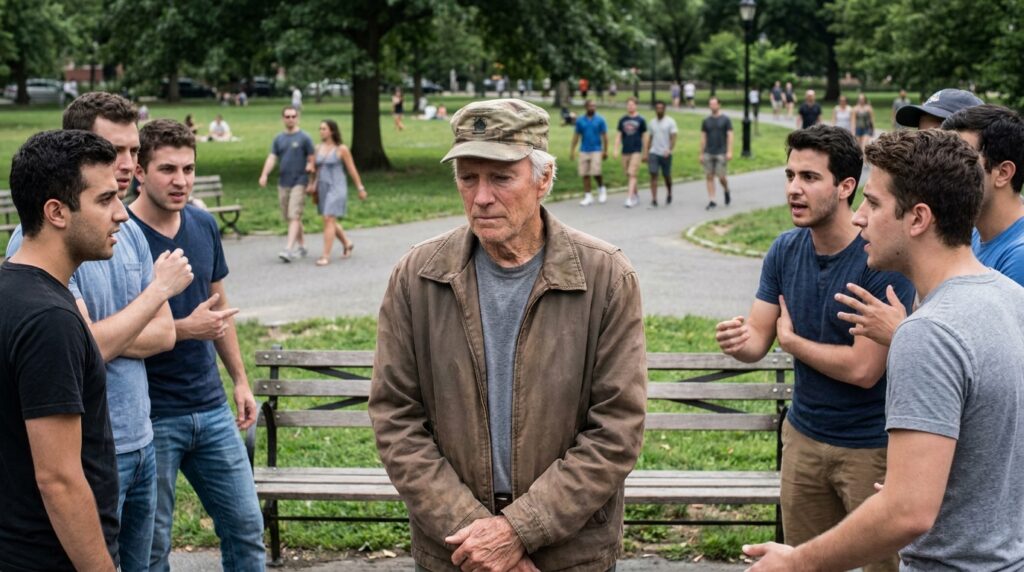
CHAPTER 7: THE WEIGHT OF THE BRASS
Marcus stared at his empty, trembling palm. The deep, intersecting lines of his palm were pale, washed clean of the grit and oil of the city by the freezing river water. For the first time in thirty years, the heavy, familiar weight of the dead brass watch was gone, swallowed by the black silt at the bottom of the flooded stairwell. Without it, his left hand felt strangely hollow, untethered from the invisible anchor that had kept his heart rate steady through decades of civilian noise.
The roar of the collapsed storm sewer had receded into a rhythmic, hollow churning beneath the granite floorboards. The pavilion’s grand hall was steeped in a heavy, bruised twilight. Outside, the torrential downpour was finally softening into a steady, gray mist, the violent energy of the storm bleeding out into the saturated earth of the park.
A ragged cough broke the silence.
Marcus turned his head, the movement slow and agonizingly stiff as the cold settled into the worn cartilage of his neck. Ten feet away, the girl in the yellow windbreaker was huddled on the dusty floorboards. The boy in the oversized gray hoodie had stripped off his soaked fleece and wrapped it around her trembling shoulders, leaving himself in a thin, shivering white t-shirt. He was rubbing her arms frantically, his own teeth chattering in the damp air.
Leo sat slumped against the opposing granite column. He looked entirely broken. The aggressive, performative posture that had commanded the concrete path an hour ago was washed away, leaving only a terrified, exhausted older brother. His sleeveless jersey clung to his ribs, dark with silt and rust. The gold chain hung crookedly against his collarbone, no longer a symbol of street dominance but just a cold piece of metal pulling at his neck.
Marcus didn’t move toward them. He remained braced against his column, his bad knee throbbing with a dull, rhythmic heat that warned of days of swelling to come. He allowed his eyes to close for a fraction of a second, his lungs expanding against the heavy, wet canvas of his brown jacket. They had survived the water. The decoy was safe. But the sanctuary of the basement, and the iron plaque buried beneath the mud, were gone.
“I saw it,” Leo’s voice whispered through the gloom. It was a fragile, scraping sound, stripped of all posturing.
Marcus opened his eyes. Leo wasn’t looking at his sister, nor at the ruined stairwell. He was looking directly at Marcus.
“When you lifted her,” Leo continued, his chest heaving as he swallowed the metallic taste of the river water. “My boot hit the bottom. I felt the iron plate under the mud. I wiped the silt off when I pushed off the floor.” The young man pulled his knees up toward his chest, his hands trembling as he rested them on his kneecaps. “It had a crest on it. An eagle, and a number. One-oh-one.”
Marcus kept his expression perfectly flat, though the mention of the numbers sent a ghost of a tremor through his jaw. He looked out the high arched window toward the green bench, now standing alone in a shallow lake of gray runoff.
“One-hundred and first Logistics and Support,” Marcus said. The words tasted like dry ash, spoken aloud for the first time in a decade. “Company B. They deeded this acreage to the city in the winter of forty-six. The municipality didn’t build the pavilion. The division built it, as a memorial for the boys who didn’t come back from the Ardennes. We kept the ledger in the basement. It was our ground before it was a public park.”
The silence that followed wasn’t the tense, watchful silence of a street confrontation. It was the heavy, absorbent silence of shared understanding. The Kintsugi logic of the moment settled over the granite hall—two generations of broken men, sitting in the ruins of a forgotten sanctuary, recognizing the overlapping shapes of their respective wars. Leo hadn’t claimed the park out of pure malice; he had claimed it because the city had abandoned them, and he needed a fortress for a sister who had nowhere else to hide. Marcus hadn’t defended the bench out of stubborn pride; he was holding the last visible marker of a burial ground the world had paved over.
Leo slowly pushed himself up from the floor. His legs shook, his sneakers squeaking against the wet stone as he crossed the distance between the two columns. He didn’t invade Marcus’s space with the aggressive swagger of a neighborhood warlord. He approached with the hesitant, careful steps of a subordinate entering a command tent.
When he stopped in front of Marcus, Leo didn’t speak. He simply reached into the soaked, muddy pocket of his shorts. His fingers emerged holding a small, tarnished object.
“It hit my boot,” Leo said softly, his voice barely carrying over the sound of the rain. “When you dropped it. I grabbed it before the current sucked it into the drain.”
He extended his hand. Resting in the center of his young, dirt-stained palm was the brass watch casing. The frayed canvas strap hung limply between his knuckles, dripping a mixture of river water and old silt.
Marcus looked at the watch, and then up into Leo’s eyes. The boy’s gaze was steady, stripped of all arrogance, filled instead with a quiet, profound respect. It was the absolute acknowledgment from an unexpected witness—the ultimate status reversal, not earned through violence or humiliation, but through the shared, devastating crucible of survival and sacrifice.
Slowly, fighting the stiffness in his joints, Marcus reached out. He didn’t snatch the object. He let his thick, arthritic fingers brush against Leo’s cold hand as he took the watch. The heavy, familiar brass settled perfectly into the hollow of his palm. He closed his fingers over it, the deep ridges of the winding crown pressing into his skin, grounding him instantly.
“Thank you, son,” Marcus said, his gravelly voice dropping into a tone of quiet grace.
Leo gave a single, sharp nod, stepping back to give the elder his space. “My cousin has a truck,” the boy muttered, turning back toward his shivering sister. “We can get her out of here. Get her someplace warm.”
“Use the north gate,” Marcus advised, his thumb beginning its slow, mechanical rotation over the dead brass crown. The phantom ticking had returned to his pulse, steady and unshakeable. “The avenue will be flooded, but the service road sits on a higher grade. The gravel will hold.”
As the three youths gathered themselves, moving slowly toward the splintered plywood exit, the boy in the hoodie paused. He looked back at the old man standing tall in the shadows of the granite column, the faded military cap still sitting squarely on his white hair. The boy didn’t say a word, but he offered a brief, unmistakable dip of his chin—a silent salute before slipping out into the mist.
Marcus remained in the pavilion for a long time, listening to the rain soften against the slate roof. The park belonged to the city, and the basement belonged to the river, but as the cold brass pressed deep into his steady palm, he knew the boundary lines were finally secure.








