
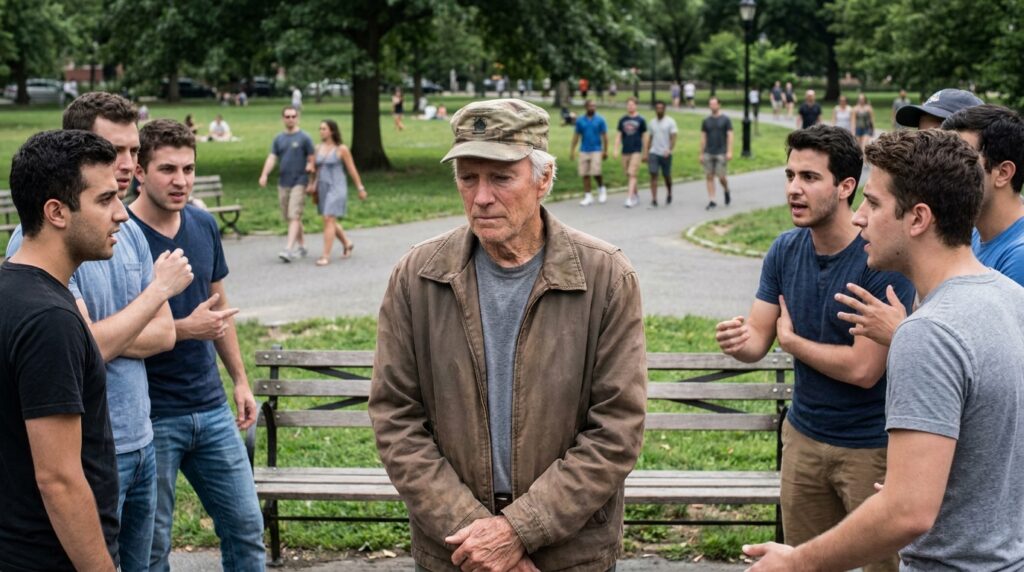
CHAPTER 1: THE WEIGHT OF THE TIMELESS PALM
“Hey old man, what’s with the ancient hat? You lost, or just waiting around for history class to start?”
The words cut through the heavy, humid air of the park like a dull blade through wet cardboard. Marcus did not look up immediately. Instead, his eyes remained fixed on the frayed edge of his left canvas jacket sleeve, tracing the loose threads where the hem had given way to years of friction. In his left hand, buried deep inside the pocket, his fingers curled around the smooth, tarnished face of a brass watch casing. The internal gears had rusted tight three decades ago during a monsoon season he no longer named, but the thumb knew exactly how many ridges were etched into the winding crown. He pressed his nail into the metal, counting imaginary beats. One. Two. Three.
The shadows on the cracked concrete walkway shifted, lengthening as three figures stepped between him and the late afternoon sun. The air smelled of stale tobacco and ozone, the distinct, pre-storm pressure that made the city’s concrete hold its heat. The young man in the center—the one with the gold chain tucked beneath a sleeveless jersey—took another half-step forward. His sneakers scraped against the grit of the path, a deliberate, dragging sound meant to signal presence.
Marcus let his gaze rise slowly, not to the boy’s face, but to the position of his feet. The boy’s weight was entirely on his back heel, his posture loose, performative. It was the stance of someone who had never seen an baseline shift, someone who believed a public square belonged entirely to the loudest voice in the room. Behind them, twenty yards out near the rusted swings, a mother pulled her toddler’s stroller toward the gate with an unnatural, hurried stride. A jogger slowed to a rhythmic, heavy-footed trot, his eyes tracking the circle but his body moving away from the friction.
Marcus adjusted the brim of his navy-blue service cap. The fabric was thin, faded by decades of laundry detergent and sunlight until the embroidered insignia was more a shadow than a statement. He felt the cool metal of the park bench’s wrought-iron armrest beneath his right forearm. The paint was peeling in thick, brittle flakes that looked like dark scabs against the gray wood.
“This bench has four slats,” Marcus said, his voice a low, gravelly rasp that seemed to catch on the dust in his throat. He didn’t raise his pitch to compete with the rumble of a passing transit bus on the avenue behind them. He kept it flat, transactional, like a logistics report delivered in an empty tent. “Two of them are split near the bolts. If you lean that far left, the grain is going to catch your shirt.”
The ringleader blinked, his smirk fracturing for a micro-second before his chest rose with a quick, shallow breath. He looked down at the wood, then back at Marcus, his face hardening as he realized his weight had been calculated. He reached out, his hand hovering two inches above the iron armrest, his fingers twitching as if deciding whether to grab the old man’s shoulder or simply block his view.
It was exactly then, through the narrow gap between the boy’s hip and his folded arm, that Marcus saw it—a small, familiar leather satchel dropped carelessly into the deep weeds behind the bench, its brass buckle stamped with an identification number that belonged to a family name Marcus hadn’t spoken since the winter of 1994.








