
CHAPTER 2: THE ANATOMY OF FRAYING EDGES
“Whose bag is that?”
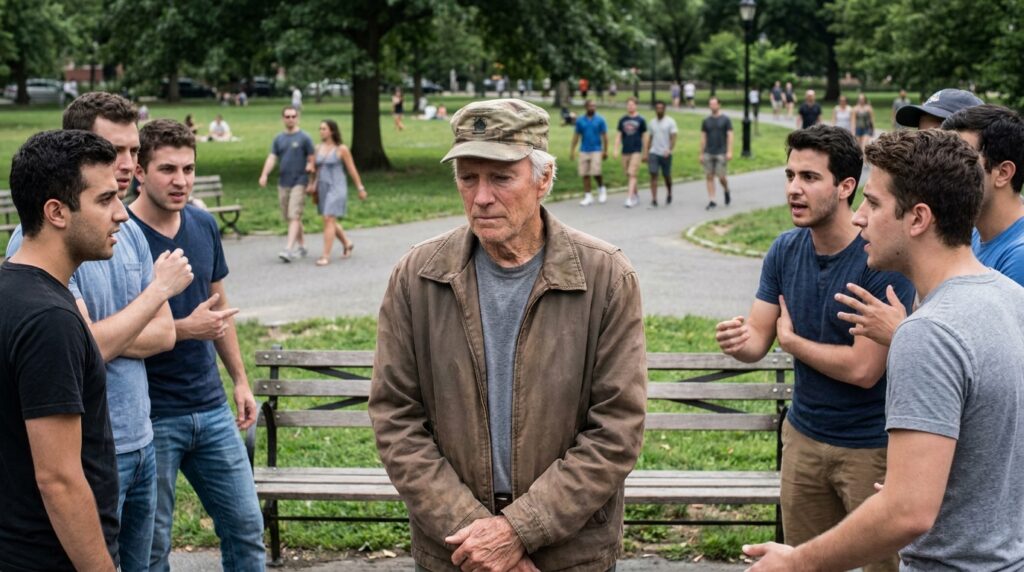
Marcus did not point. He didn’t lift his fingers from the pocket of his canvas jacket, nor did he break his watch on the back heel of the young man standing in front of him. He simply shifted his eyes down toward the deep dandelion weeds pushing through the cracked footing behind the bench. The movement of his head was minimal—less than an inch—but the precision of the focus drew the ringleader’s attention downward like a weighted plumb line.
The young man with the gold chain hesitated. His hand, still suspended two inches above the rusted iron armrest, dropped a fraction. His weight remained momentarily caught between his heels, his performative swagger interrupted by a question that didn’t fit the script of a standard park-bench shakedown. “What?” he muttered, his eyes darting toward the grass. “The hell you talking about, old man?”
“The leather satchel,” Marcus said. His voice remained in that low, flat register, a sound like gravel being dragged across dry oak. “The one with the double-stitched oilcloth strap and the dull brass buckle. The buckle has a stamp on the inner tongue. 101-B-94. That’s an ordnance supply mark from the winter of ninety-four. It doesn’t belong in the weeds.”
The two boys flanking the ringleader shifted their feet. The one on the left, wearing an oversized gray hoodie despite the June humidity, looked from the bag to his leader’s face. The performative smirks were beginning to sag, replaced by the distinct, heavy silence of an unexpected vulnerability. They weren’t just looking at a piece of discarded luggage; they were looking at something they recognized, something that had been hidden with specific intent.
Marcus watched the skin around the ringleader’s jaw tighten. The boy’s chest took in a deep, sharp breath, the fabric of his sleeveless jersey straining against his collarbone. He wasn’t looking at Marcus with simple, territorial malice anymore. The expression had shifted into something far more dangerous because it was grounded in a primitive, defensive panic. The boy stepped sideways, his sneaker fully flattening a cluster of wild chicory, attempting to obscure Marcus’s line of sight to the weeds.
“You don’t see anything,” the boy said. The tone was sharp now, the calculated arrogance of his first mock inquiry replaced by a hurried, transactional threat. He leaned closer, his shadow completely swallowing Marcus’s lap. “You’re an old man with a broken hat who’s about to get his walk shortened. You take your little history cap, you get off this bench, and you walk toward the avenue. Right now.”
Marcus didn’t move. He let the shadow settle over him, feeling the humid warmth of the boy’s proximity, a heat that carried the sharp, chemical tang of cheap energy drinks and nervous sweat. Through the weave of his gray shirt, Marcus felt the hard, ridges of his own ribs against his lungs. He was seventy-nine years old. His knuckles were thick with arthritic deposits that throbbed whenever a low-pressure system rolled off the river, and his left knee required a deliberate mechanical rotation before it would lock into a weight-bearing stride. To these boys, he was an anomaly—a piece of urban driftwood that had failed to float away with the rest of the neighborhood’s old stock.
But they didn’t see the texture of the silence he lived in. They didn’t understand that when you spend three decades listening to the precise interval between an outgoing mortar ignition and an incoming impact, the loud posturing of a twenty-year-old on a concrete path sounds like nothing more than wind through a broken screen door.
“The strap is dry-rotted,” Marcus observed, his thumb continuing its rhythmic circle over the dead crown of the brass watch in his pocket. “If you pick it up by the handle, the rivets are going to pull clean through the backing. Whoever put it back there was in a hurry. They didn’t want the weight on their shoulder while they were climbing into the old pavilion.”
The ringleader froze. The phrase old pavilion seemed to drop into the space between them like a solid iron ingot. Fifty yards behind the bench, the park’s historic stone pavilion stood like a gray tooth against the green canopy of the oaks. Its arched windows were boarded up with weathered exterior plywood, the edges gray and furry from years of rain, but one of the lower panels had been pried back just enough to leave a four-inch black grin at the foundation level.
The boy in the gray hoodie grabbed the ringleader’s shoulder, his fingers digging into the jersey fabric. “Leo,” he whispered, his voice cracking with the sudden, sharp urgency of a kid who had realized they were standing on a live wire. “Leo, come on. The old man’s a cop. Or he’s one of them city inspectors. Look at the cap.”
Leo didn’t move. He kept his eyes locked onto Marcus’s lined face, searching the deep-set wrinkles around the veteran’s eyes for a sign of leverage, a hint of fear, or the standard bureaucratic tells of an undercover enforcement officer. He found none of it. Marcus simply sat there, a monument of faded canvas and white hair, his presence as immovable as the concrete footer beneath the bench.
A sudden gust of wind rattled the leaves of the overhanging oak, dropping a small, dead twig onto Marcus’s shoulder. The air was turning cooler now, the sky above the tree line bruising into a deep, metallic violet as the storm front finally reached the city limits.
Leo slowly slid his right hand into the pocket of his loose shorts. His knuckles formed a sharp, angular bulge against the thin fabric—a shape that didn’t have the curve of a phone or the flat edge of a wallet. It was a weighted, uniform mass.
“You think you’re smart because you can read numbers off a piece of trash, old man?” Leo said, his voice dropping into a dangerous, quiet rattle that matched the sound of the dry leaves above them. “You don’t know who’s in that pavilion. You don’t know what we’re keeping out of the dirt.”
Marcus let his thumb stop on the watch crown. For the first time since the confrontation began, he allowed his right hand to leave his lap. He placed his palm flat against the weathered green wood of the bench slat, feeling the deep, longitudinal splits in the grain where the winter frost had expanded the moisture. The texture was rough, familiar, and ancient.
“I know exactly what’s in that pavilion,” Marcus said, his eyes rising to meet Leo’s with a cold, unhurried clarity that made the boy’s hand inside his pocket go completely still. “And I know who left the lock off the back basement door twenty years before you were born.”
Marcus began to shift his weight forward, his heels planting into the cracked concrete with a deliberate, bone-deep finality.








