
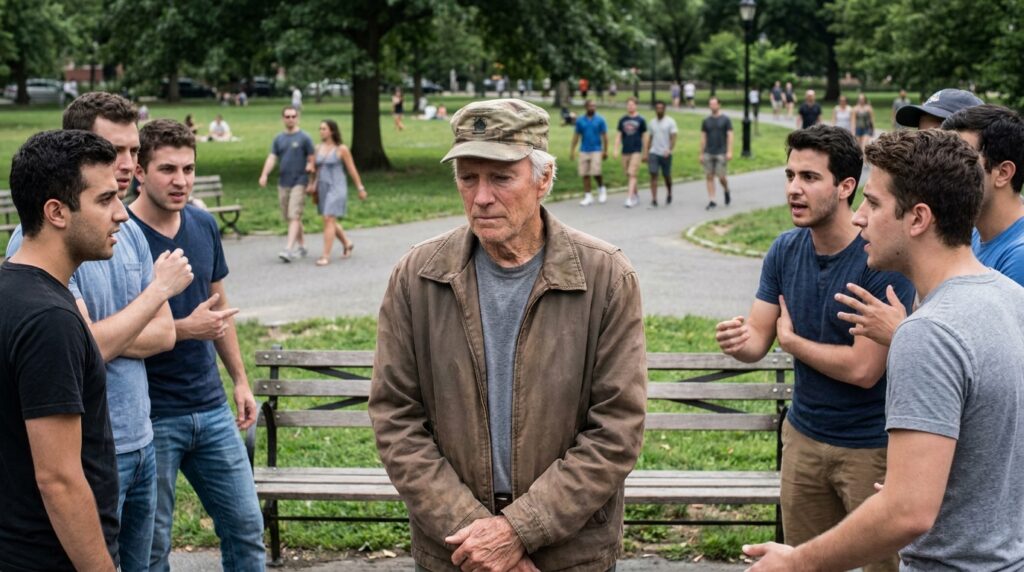
CHAPTER 4: THE THRESHOLD OF STORM AND STONE
The sky did not leak; it split. The gray sheets of summer rain hammered the concrete path with a sound like throwing small gravel against a tin wall. Within ninety seconds, the dry chicory and dandelion weeds behind the bench were entirely submerged, the muddy water swirling around the oilcloth satchel until its dry-rotted leather strap floated like a drowned water moccasin.
Leo did not look down as his shoes filled with runoff. The rusted padlock in his palm slipped through his slick fingers, dropping into the gray puddle between his feet with a soft, hollow plop. He didn’t pick it up. His eyes remained fixed on the line of Marcus’s shoulders, which had finally locked into their full, upright alignment. The old man stood entirely tall now, his lean frame cutting through the curtain of descending water like a rusted iron surveyor’s stake.
“Get the bag,” Leo told the boy in the hoodie, his voice thin and stripped of the rhythmic cadence he had used to claim the path. He didn’t look at his friend. He kept his face tilted slightly downward to keep the rain from blind-siding his vision, but his chin remained pointed toward Marcus. “Get it out of the dirt before the seam splits.”
The boy in the hoodie dropped to his knees, his hands splashing blindly through the flooded weeds until his fingers caught the brass buckle of the satchel. He pulled it up against his ribs, his oversized gray fleece soaking through instantly, turning a heavy, dark slate-color. “Leo,” he grunted, shaking the gray water from his eyes. “The bottom’s rotted out. The grease paper inside is wet.”
“Move toward the arch,” Marcus said. He didn’t wait for them to decide. His boots took the first step forward, the rubber heels striking the concrete with a heavy, predictable rhythm that left two clean ovals of compressed water in the gray silt. He didn’t look back to see if they were following him. In a public park during a June flash flood, authority didn’t belong to the person with the local name; it belonged to the person who knew where the drainage gates cleared.
The three young men fell in behind his brown canvas jacket like a small, disorganized platoon entering a trench. The bravado had completely washed into the storm sewers along the avenue. The park was entirely empty now, the joggers and families long since scattered to the dry interiors of the brick duplexes lining the horizon. The only sounds were the thunder rolling across the river and the steady, rhythmic slap-slap of Marcus’s boots leading them up the incline toward the old stone pavilion.
The stone structure grew larger through the gray haze of the downpour. Built during an era when the city used granite blocks instead of poured concrete, the pavilion’s columns were thick, square, and pitted with sixty years of exhaust soot and river moisture. The arched entryway was blocked by two sheets of half-inch exterior plywood, fixed to the stone with heavy tapcon screws, but the lower right-hand corner had been systematically worked with a crowbar until the wood fibers had splintered into a raw, jagged flap.
Marcus reached the threshold first. He didn’t squeeze through the opening like a boy hiding from the police. He reached his right hand into the gap, his thick knuckles catching the raw edge of the plywood, and pulled back with a slow, mechanical rotation of his shoulder. The wood groaned, the screws stripping another eighth of an inch out of the soft mortar joint between the granite blocks.
“Inside,” Marcus commanded, his voice striking the stone lintel and bouncing back down into the rain.
The boy with the hoodie went first, sliding sideways through the dark slit while holding the oilcloth satchel above his head like an unexploded shell. Leo followed him, his sleeveless jersey catching on a wood splinter with a sharp rip that he didn’t even turn to check. He stood just inside the dark, dry air of the interior vestibule, his chest heaving as he wiped the cold rainwater from his gold chain with a trembling thumb.
Marcus stepped through last, letting the plywood flap snap back into place behind him. The sudden silence of the interior was like a heavy wool blanket dropped over his ears. The rain was still there, but it was a distant, hollow drumming on the slate roof above them, secondary to the deep, cavernous stillness of the granite hall.
The air smelled of dry rot, bat guano, and the distinct, vinegar-sharp odor of damp cardboard. In the dim light that filtered through the cracks in the plywood, Marcus could see the grand hall—a long room filled with broken green park benches stacked like cordwood and old iron trash receptacles from the mid-nineties.
“She’s in the old supervisor’s locker,” Leo said from the darkness near the stairs. He wasn’t looking at Marcus; he was looking down at his own sneakers, his hands tucked into his empty pockets as if he were trying to remember how to look dangerous. “We brought the blankets from my cousin’s basement. We didn’t think the water would come through the lower ventilation line.”
Marcus walked toward the center of the floor, his boots leaving dark, wet prints on the thick layer of grey dust. He stopped beside a small iron casting set into the floor—a circular drain plate with five holes arranged in a star pattern. He knelt down, his brown jacket straining across his shoulder blades, and pressed his bare palm against the metal. The iron was dry, but through the small openings, he could hear the distinct, rhythmic gurgle-gasp of air being pushed upward by an rising column of water.
The lower sump was already full. The river had crossed the secondary levee line ten minutes ago.
“The locker is three feet below the grade,” Marcus said, his eyes tracking a thin line of dampness that was already creeping across the basement stairs from the lower dark. He didn’t look at Leo. He reached into his pocket and pulled out the broken watch casing, using the flat edge of the brass rim to scrape away a thick crust of dried mud from the center of the drain grate. “The city didn’t weld the door to keep people out, son. They welded it because the structural columns are hollow. When the basement fills, the water uses the stone itself like a siphon.”
He rose back to his feet, his left knee popping with a sound like a dry branch snapping underfoot. In the dim light, his eyes looked like two gray stones set deep into his lined face.
“Get the keys out of the satchel,” Marcus told them, his voice dropping into the precise register of a command post during an active mortar sweep. “The inner door has a three-pin barrel lock that hasn’t seen oil since the division gave the keys to the city clerk in ninety-six.”
Leo stared at him, his face going completely gray through the shadows. “The division? What division?”
Marcus didn’t answer. He turned his back on the boys and began walking down into the dark of the stairs, his thumb tracing the worn insignia on his cap as the first black puddle of river water reached the top riser.








