
CHAPTER 3: THE SEED IN THE CRACKED EARTH
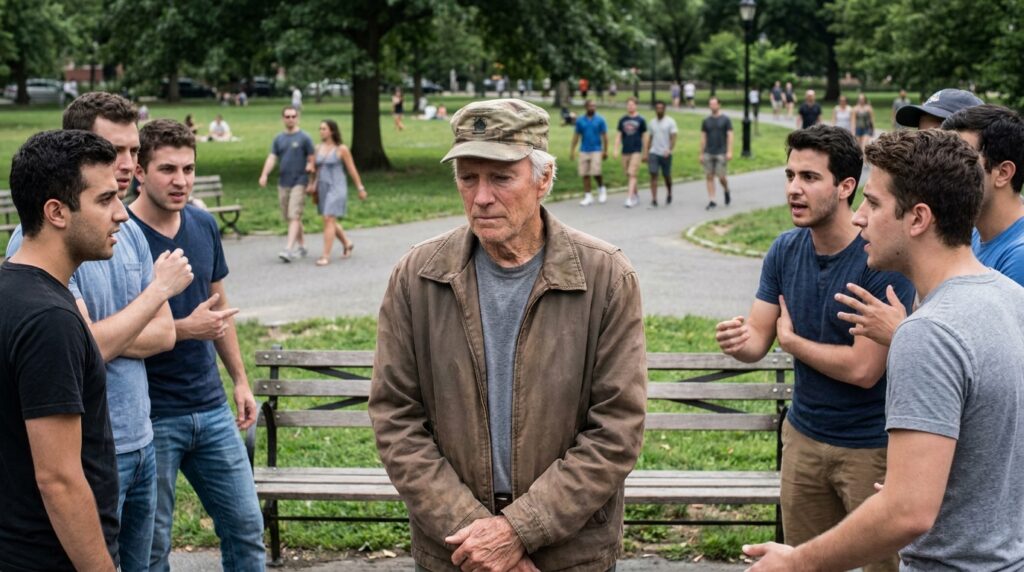
Marcus’s boots did not slide. The thick rubber soles, worn smooth at the heels but still rigid through the arches, bit into the grit of the concrete footer. His old brown jacket groaned slightly at the shoulders as his center of gravity crossed his knees. It was a slow, deliberate levering of bone and sinew—an old man’s movement that carried the strange, unhurried mass of a stone retaining wall giving way.
Leo did not pull his hand out of his pocket. Instead, his knuckles went white against the thin fabric of his shorts, his arm locking straight down as if the weight inside had suddenly tripled. The boy in the gray hoodie stepped back a full yard, his heel striking the iron leg of the next bench with a sharp, metallic clink that sounded like a loose horseshoe on pavement. The bravado that had filled the path three minutes ago was thinning out, draining down into the longitudinal splits of the gray wood beneath them.
“You don’t know nothing about the basement,” Leo said, but the rattle in his voice had lost its edge. It was lower now, defensive, the sound of a kid trying to convince himself that his perimeter wall was still intact. “That door’s been welded since before my brother was born. The city did it.”
“The city brought the torch,” Marcus said, his white hair catching the first dim, blue reflection of the thunderclouds cracking open above the treeline. He didn’t stand all the way up yet. He remained balanced at that threshold where an elder looks either ready to fall or ready to strike. “But they didn’t know the hinge pins on the north grating were set into soft lime mortar. A six-inch iron bar and forty seconds of leverage will drop the whole plate into the drainage well. It’s been that way since seventy-five.”
Marcus let his right hand slide an inch along the bench slat. His skin left a faint smear of old sweat and salt on the dry green paint. He wasn’t looking at Leo’s pocket anymore. He was watching the boy’s eyes, specifically the way the pupils dilated every time the wind rattled the loose plywood sheeting on the pavilion behind them. The boy wasn’t acting like a drug courier or a gang sentry; he was acting like a stray dog guarding a wet blanket under a porch. There was no professional coldness in his stance, only the raw, exhausting friction of a kid trying to carry a secret that was too heavy for his shoulders.
The silence that followed was heavy with the smell of the coming storm—that sharp, metallic scent of ozone mixed with the damp, sour odor of old beer cans rotting in the park trash bins. A single drop of rain, cold and heavy as a lead shot, struck the center of Marcus’s navy-blue cap, soaking instantly into the faded twill.
“Leo,” the boy in the hoodie muttered again, his voice dropping into a flat, frightened whisper. “Leo, look at his hand. He’s got something in his pocket.”
“It’s an old watch,” Marcus said simply, before Leo could shift his weight. He pulled his left hand slowly from his jacket pocket, exposing the dead brass casing resting in his palm. The canvas strap trailed between his thick knuckles like a frayed gray reins. He didn’t lift it like a weapon; he just held it open, letting the grey daylight hit the scratched crystal. “The spring broke when the division crossed the river outside of Da Nang. It doesn’t tell the time, but the weight keeps my wrist from wandering when the wind blows.”
Leo looked down at the brass, his jaw dropping a fraction. His shoulder lost its tension, dropping two inches as the phantom shape of an undercover cop evaporated into the reality of an old man with a pocket full of junk. “You’re crazy,” the boy whispered, though his hand remained buried in his own shorts pocket, his fingers still wrapped around whatever uniform mass he was holding. “You’re just a crazy old bastard who sits in the dirt.”
“I am,” Marcus agreed, his gaze drifting past Leo’s shoulder toward the black opening at the base of the pavilion. “But the girl in the cellar isn’t going to survive the night if that storm drainage line backs up into the foundation. The sump hasn’t run since the city cut the power grid in twelve. When the river rises three feet, that whole lower deck becomes an anchor.”
The ringleader’s entire body seemed to shrink. The sleeveless jersey went slack against his ribs, his mouth opening as if to deny the statement, but no sound came out. The boy in the hoodie didn’t wait for a command; he turned his back entirely on Marcus, his eyes wide and fixed on the gray stone arches fifty yards away.
“How do you…” Leo started, his voice cracking on the first syllable before he clamped his teeth together. He took his hand out of his pocket. There was no gun, no knife—just a heavy, rusted padlock with a snapped shackle that he had been holding like a pair of brass knuckles. His fingers were covered in orange rust dust that mixed with his sweat. “Who told you she was down there?”
“Nobody tells me anything,” Marcus said, his thumb resuming its slow, mechanical rotation against the brass watch crown. “But I know the sound of a ventilation pipe when the screen is pulled out. A girl’s voice doesn’t carry like a boy’s when she’s trying to stay quiet. It rings higher against the iron.”
He looked at Leo then, not with the cold distance of an old soldier, but with the heavy, unblinking empathy of a man who had seen too many small things crushed because someone forgot to check the water level in the trenches. The rain was beginning to come down in earnest now, a steady, gray curtain that blurred the houses across the avenue into gray boxes.
“The leather bag in the weeds,” Marcus said, nodding toward the dry-rotted satchel. “The strap is gone, but the oilcloth will keep the biscuits dry for another hour. You should take it inside before the cellar floor starts to slick.”
Leo didn’t answer. He stood in the downpour, his gold chain plastered to his collarbone, looking at the old man as if Marcus were an ancient oak that had suddenly started speaking English. He didn’t reach for the bag, and he didn’t move toward the bench. He just stood there, his false territory dissolving around his ankles in the grey runoff of the path.
Marcus watched him, his own palm absorbing the damp chill of the wood beneath him, knowing that the first circle had broken, but the water was still rising.








