
CHAPTER 6: THE FINAL DRAIN AT THE FRONT
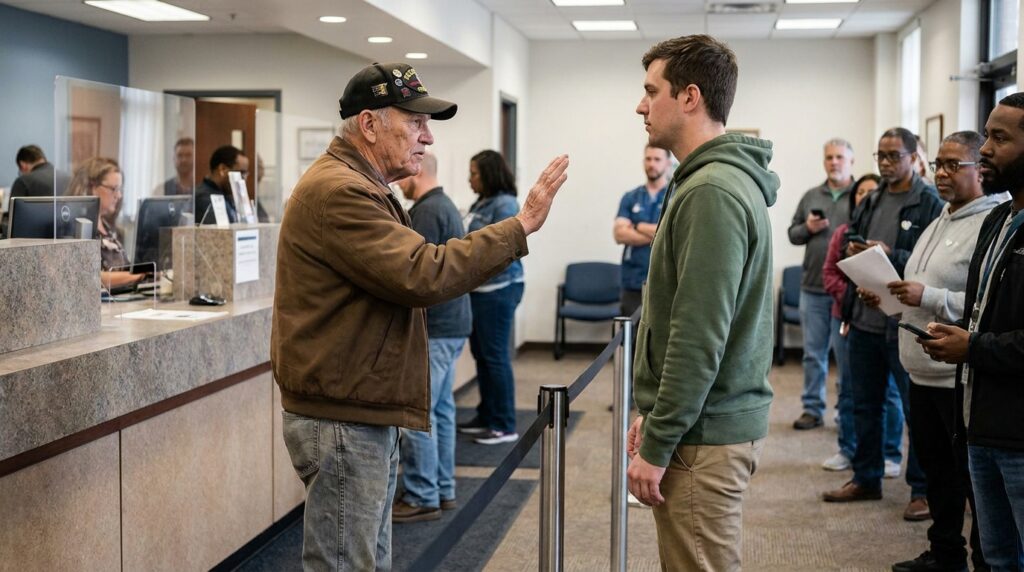
The amber light on the modem did not click; it settled. It cast a dull, sulfurous glare across the dust-filmed glass separating Arthur from the administrator who shared his last name. With the outbound line severed, the faint, high-frequency whistle of the local servers died, leaving only the sound of eighty people behind the stanchions discovering how to hold their collective breath.
Arthur did not reach for the brass cylinder. He left it sitting in the center of the stainless steel pass-through drawer, an unpolished wedge of industrial truth that had frozen the gears of the entire room. His eyes were small, dark slits beneath the brim of his veteran cap, tracking the rapid, rhythmic pulse at the hollow of the administrator’s neck. The gray wool suit jacket was damp at the armpits now. The man behind the glass wasn’t an operator executing a policy anymore; he was a machine whose main bearing had just seized from dry friction.
“The lot is clear,” Arthur said. His voice was lower than the drone of the dead fans, yet it reached the boy on the tile with the clean impact of an iron rod. “Your sedan won’t start, Vance. I pulled the distribution lead from the block before I took my position behind the yellow stripe.”
The youth in the green hoodie let out a small, clicking noise from his teeth. His fingers dug into the scuffed linoleum, his boots kicking uselessly at the base of the plastic stanchion as he tried to pull himself further from Arthur’s vertical frame. “Dad,” he choked out, his throat dry and rough with salt. “Dad, the terminal’s logging an unvalidated manual override. It’s writing to the local platter.”
The administrator didn’t look down at his son. His hand, still flat against the aluminum clipboard, began to shake, the metal edge chattering against the wooden desktop with a tiny, frantic vibration. “You don’t understand the scale of the distribution, Arthur,” he whispered through the speaking grate. The practiced, civil neutrality had evaporated, leaving behind the raw, brittle panic of a man who had built a career out of hiding behind forms. “The atmospheric exposure fund wasn’t a standard legislative appropriation. It was an off-book settlement for the down-winders from the primary intake block. The state level registry was never supposed to authorize local cash vouchers. If those serial numbers clear this desk, the system drains the entire municipal contingency reserve.”
“It’s not an adjustment,” Arthur said, his eyes drilling into the name on the red-stripe sheet. “It’s a debt. And the people standing in this room have been waiting forty years for the registry to open the valves.”
He leaned closer to the glass, his forehead nearly touching the pane, his breath leaving no moisture this time. The surface was too cold. “You took the comptroller seat to ensure the ledger stayed balanced in favor of the county’s infrastructure budget. You used the kid to bridge the telemetry because you knew if the outbound signal went dark during an active transaction, the fault would look like a line failure from the sealed tunnels. But the record doesn’t lie in the wire, Vance. It lies in the brass.”
Arthur tapped his index finger once against the cylinder in the tray. The sound was flat, final, and absolute.
Behind the partition, the clerk who had been frozen over her keyboard suddenly moved. Her hand went to her blouse, her fingers catching the edge of her laminated badge and ripping it from the safety pin. She didn’t speak. She didn’t look at the resident comptroller. She simply stepped backward out of the blue glow of her monitor, her boots clicking twice on the rear concrete floor before she vanished into the shadow of the open vault doorway. She was a civil servant, and she knew exactly when a building had ceased to belong to the state.
The young man on the floor finally found his feet. He scrambled upward, his oversized green hoodie catching the hook of the stanchion belt and tearing a six-inch seam through the pocket fabric. He didn’t look back for the blue-bordered proximity card. He ran toward the heavy side exit, his palms striking the panic bar with a loud, metallic clang that let the raw winter air into the grey interior. The door stayed open, the sleet blowing across the threshold to melt into small, clear pools on the tile.
The administrator stayed behind his glass. He looked at the sheet on his clipboard, then at the amber modem light that indicated total isolation from the state network. His empire had shrunk to the four feet of desk beneath his hands and the old man standing on the other side of the safety stripe.
“They’ll audit the local drive within the hour,” the administrator said, his shoulders dropping into the same rounded, defeated posture his son had taken on the floor. “They’ll see the entry was forced from this counter.”
“Let them audit,” Arthur murmured. He reached down and picked up his brass cylinder, dropping it back into the deep canvas pocket of his jacket, where it settled with a familiar, heavy thump against his thigh. “The line is still here. And we’re still waiting our turn.”
He turned his back on the security partition. The eighty citizens in the queue did not move to let him through. They parted slowly, creating a wide, clean lane through the center of the nylon ropes, their faces silent and grave as they looked at the dark cap and the frayed sleeves of the man who had held the front. Nobody spoke. Nobody checked their phone. They simply stood at attention, their shoulders square, their alignment perfect, as Arthur walked past the stanchions and into the cold grease of the city rain outside.








