
CHAPTER 3: THE PRECISION OF LEVERAGE
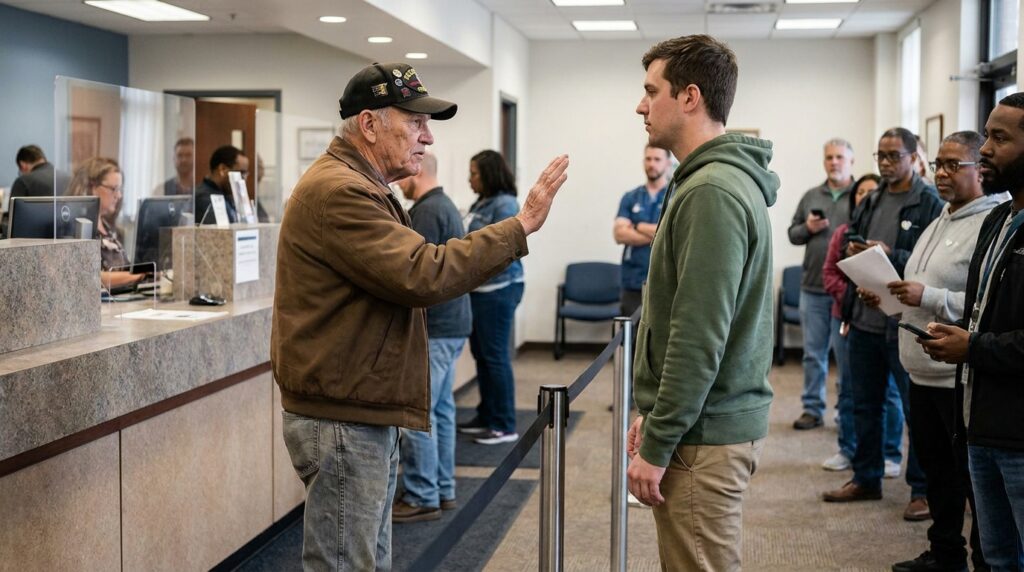
The slap of Arthur’s palm against the youth’s forearm was not an ending; it was a pivot. Before the sound could dissipate against the reinforced polycarbonate window, the young man’s reach died in mid-air. Arthur’s skin felt cold, dry, and split like treated canvas, but beneath the surface, the structural alignment of his radius and ulna formed a perfect brace. He didn’t push back against the mass. He allowed the younger man’s momentum to spend itself against the lock of his bones.
The youth’s eyes widened, the pupils contracting into tiny black points under the harsh overhead fluorescent grid. He tried to yank his arm back, his shoulder dropping to gain leverage, but Arthur had already closed the gap. His left hand moved in a short, four-inch arc from his jacket pocket, his thumb finding the soft, vulnerable junction between the younger man’s thumb and wrist. It was a precise, measured application of pressure—not violence, but an exact mechanics lesson delivered in real time.
Arthur turned his hips exactly fifteen degrees to the left. The motion was small, almost invisible beneath the heavy hang of his brown canvas jacket, but it removed his centerline from the youth’s trajectory. The young man’s own forward velocity became his undoing. With his left wrist secured and his center of gravity pulled forward by his own entitlement, his balance failed. The rubber sole of his sneaker slid through a slick of melted gray sleet on the tile.
The drop was mechanical. There was no theatrical struggle, no exchange of blows, no cinematic drama. The youth simply ran out of feet. His knees buckled under the sudden, downward acceleration of his own weight, and his hip struck the edge of the service stanchion before he hit the linoleum floor with a heavy, hollow thud that shook the plastic base of the divider line.
The office fell into a dead, airless freeze. The low-frequency rattle of keys and the quiet murmur of waiting citizens ceased completely. A child’s toy—a small plastic truck—dropped from a numbed hand three rows back, its wheels clicking twice against the floor before rolling into a floor drain. Behind the safety glass, the clerk stood entirely still, her mouth slightly open, her breath fogging a small white circle onto the polished surface of the partition.
Arthur stood over him. He did not look down with anger; his face remained a map of gray, lined indifference, the brim of his dark veteran cap casting a sharp, angular shadow across his cheekbones. His breathing hadn’t altered by a single cycle. His hands went back to his sides, the fingers loosely hooked into the oil-stained canvas of his pockets, re-establishing his baseline posture as if the interruption had been nothing more than a glitch in the room’s machinery.
On the grey linoleum between the youth’s outstretched boots, an object slid out from the deep pocket of the green hoodie. It was the white rectangle Arthur had noted earlier—a heavy, matte-laminate proximity card bordered in high-visibility municipal blue. The face of the card was stamped with a gold city seal and an expiration overlay that hadn’t been punched. Beneath the laminate, the bold black letters read: DEPARTMENT OF PUBLIC WORKS – MAIN INFRASTRUCTURE CONDUIT – LEVEL 4.
The young man sat on the floor, his palms pressed into the salt-rimed tile behind him, his chest heaving as he stared up at Arthur. The aggression had been shocked out of him, replaced by the pale, greasy sheen of sudden adrenaline and social displacement. His mouth opened, but no sound came out—only a dry, breathy gasp as he tried to reconcile the speed of his descent with the frail appearance of the man who had ordered it.
Arthur’s eyes caught the name printed beneath the security seal on the dropped badge: M. VANCE – CHIEF OPERATOR. The young man on the floor was barely twenty-two. His hands were smooth. He was not Chief Operator Vance. He was a boy holding a key that could open every subterranean high-voltage junction and valve locker beneath the civic center, and he had tried to force his way to a window that wasn’t supposed to be processing public funds. Arthur looked from the card to the youth’s pale face, realizing the decoy of the long queue was beginning to fracture.
“You dropped something,” Arthur said, his voice dropping below the acoustic threshold of the glass speaker grate. He didn’t reach for the card. He kept his boots planted, locking the space.
The youth looked down at the blue-bordered badge, his skin turning from pale to a dull, blotchy red. His hand twitched toward the laminate, but he didn’t dare lean forward into the vertical space Arthur commanded. The silence of the eighty people behind them had changed; it was no longer avoidant. It was expectant, a heavy weight pressing down on the front of the line.
Behind the security partition, a heavy steel door clicked. The latch didn’t sound like a standard office lock. It was a multi-point mechanical throw, the deep clunk of an armored vault gate being unseated from its frame.








