
CHAPTER 4: THE RECKONING OF THE WEIGHT
The mechanical throw of the door behind the security glass was a dry, heavy sound—the specific thud of triple-hardened locking bolts sliding back into a steel lintel. The dense, climate-controlled air of the inner facility surged through the speaking grate, smelling sharply of static electricity and unboxed paper. The clerk didn’t return to her keyboard. She stood with her arms pinned straight against her sides as a shadow fell across her terminal from the rear office corridor.
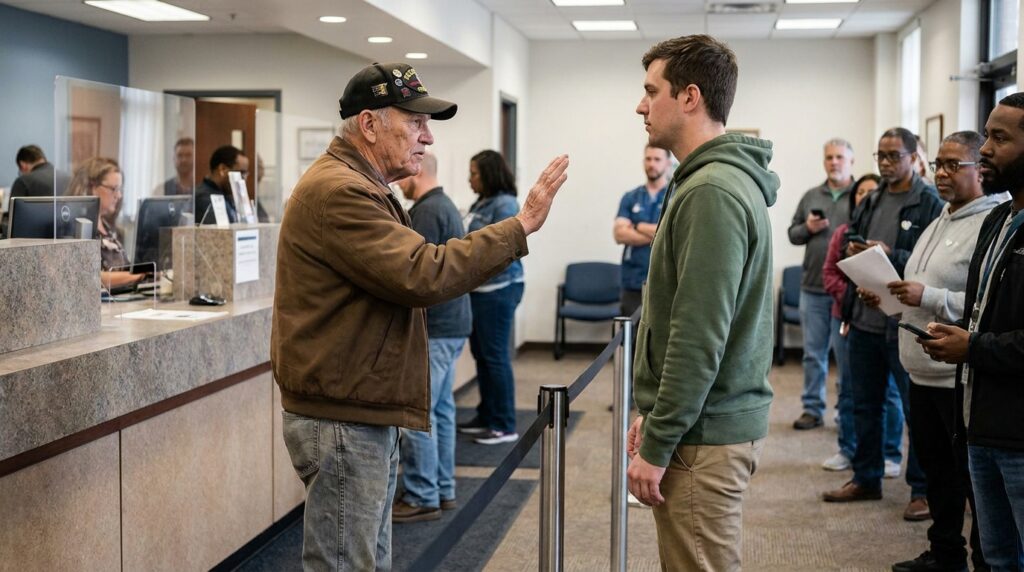
Arthur didn’t pull his eyes away from the floor where the blue-bordered proximity card lay between the youth’s sneakers. His mind logged the parameters of the room’s geometry. Eighty people at his back remained entirely fixed, their breathing shallow, their collective weight shifting forward as they watched the space around the front of the line. The young man on the tiles had stopped moving his fingers toward the card. He sat frozen, his chest rising and falling against the tight fabric of his green hoodie, his gaze locked on the lower edge of Arthur’s brown canvas jacket.
“Next time respect the line,” Arthur said, breaking the silence with the same level, unhurried cadence he had used since the first skip of the nylon stanchion. “That’s how this works.”
The youth did not respond with words. He swallowed hard, a visible ripple passing down the strained muscle of his neck. His shoulders lost their artificial width, rounding forward into a protective hunch that made him appear smaller, his age finally matching his smooth hands. He was looking at the brass emblem on Arthur’s cap now, not with the dismissive arrogance of a minute ago, but with the hollow, tracking look of someone who had just hit a wall he couldn’t see.
“Alright,” the young man muttered, his heels sliding an inch backward through the gray slush as he abandoned his trajectory toward the service counter window. “Alright, I get it.”
He didn’t make a move to stand. His fingers twitched once against the cold tile, his skin pale where the salt from the floor had transferred to his palms. He looked at the blue laminate badge, then at Arthur’s boots, waiting for a clearance that wasn’t being granted.
The glass partition did not slide open. Instead, a secondary pass-through drawer at the base of the counter clicked forward, its stainless steel tray scraping against the frame. A man stepped into the space behind the frozen clerk—not an officer in blue wool, but a senior administrator wearing an unpressed gray wool suit and a security clearance pass that bore the same gold municipal seal as the card on the floor. His face was weathered, his skin carrying the sallow discoloration of someone who lived under fluorescent tubes, his left hand gripping a heavy aluminum clipboard.
He didn’t look at the young man on the floor. His eyes went directly to Arthur, scanning the dark veteran cap, the oil-creased canvas of the jacket, and the flat, unyielding placement of his boots behind the safety stripe.
“Arthur Vance?” the administrator asked. The voice was thin, practiced in the neutral tone of state-level notifications, but there was a distinct fracture in his delivery—a slight hesitation on the surname.
Arthur kept his hands in his pockets. He let the silence stretch for three full beats of the wall clock before he nodded. “That’s correct.”
The administrator turned his clipboard over, revealing a laminated sheet with a red diagonal strip across the header—the specific mark of a federal asset disbursement holding order. He didn’t use the desk microphone. He leaned close to the glass speaker grate, his breath clouding the lower left corner of the pane.
“The voucher you submitted for the Class-4 atmospheric exposure settlement is being held for manual secondary verification,” the administrator said. His fingers tightened on the edge of the aluminum board until the metal groaned. “The automated approval issued by the regional registry was flagged twenty minutes ago. We cannot process the instrument at this counter.”
A dry murmur rippled through the front rows of the waiting line behind Arthur—a low wave of frustration from those who recognized the distinctive vocabulary of a bureaucratic freeze. They didn’t see the connection. They only saw an old man being turned away from a window after defending the space.
But Arthur’s eyes were tracking the administrator’s left hand. The thumb was covering a secondary signature line at the bottom of the red-stripped form. Beneath the edge of the administrator’s glove, a single printed line was partially visible: AUTHORIZED BY: RESIDENT COMPTROLLER M. VANCE.
Arthur didn’t look back at the young man on the linoleum, but his internal calculation shifted into a cold, dark alignment. The badge on the floor read M. VANCE – CHIEF OPERATOR. The signature on the freeze order bore the same initial and name. The young man in the green hoodie hadn’t been trying to cut the line out of simple, youthful impatience; he had been trying to reach the window before Arthur’s voucher could clear the terminal, carrying the exact Level-4 clearance card required to override an automated local asset distribution.
The youth on the tiles let out a low, ragged breath, his knees drawing up toward his chest as he realized the administrator had already moved the documents out of the desk frame. He looked from the window to the badge on the floor, his face completely empty of the entitlement that had driven him across the nylon lines.
“You need to step out of the queue, Mr. Vance,” the administrator said through the glass, his voice dropping into a flat, procedural demand. “There’s an issue with the funding origin code. Security has been notified.”
Arthur stood perfectly still. The cold weight of the iron stanchion against his ankle felt heavier now, an anchor in a space that had just ceased to be a simple public waiting room. He didn’t look at the eighty people watching his back, nor at the clerk whose fingers were now trembling against her desk blotter. He reached into his left pocket, his fingers closing around the cold, brass edge of his original service record cylinder, realizing the line he had been holding wasn’t an order sequence at all. It was an ambush.








