
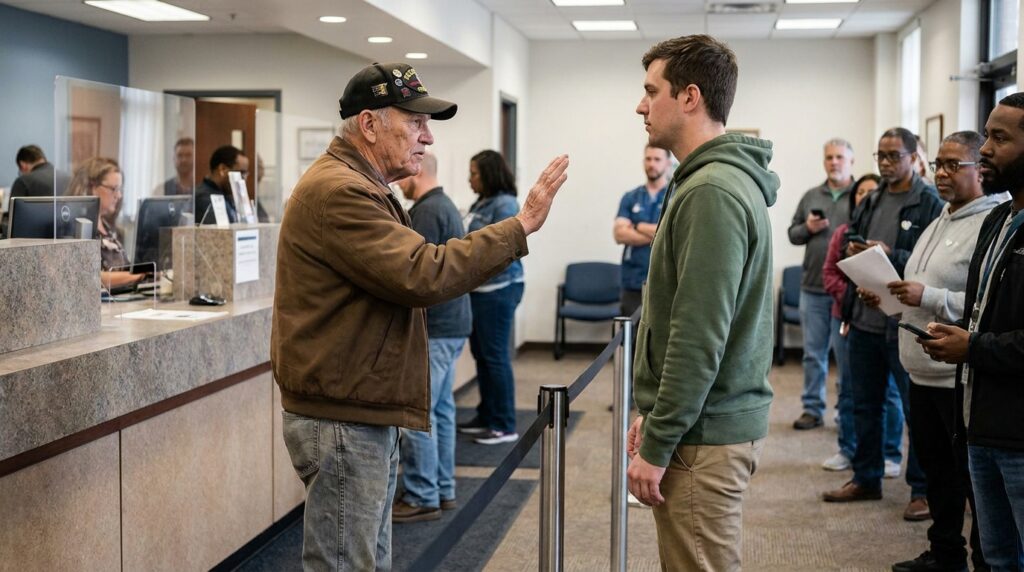
CHAPTER 5: THE ANCHOR IN THE SEAM
“Security isn’t coming,” Arthur said.
He didn’t say it loud. He didn’t have to. The words carried the flat, rhythmic density of an old machine settling into its foundation. His right hand remained submerged in the canvas pocket of his jacket, fingers wrapped securely around the cold brass of the service cylinder. He could feel the fine, precision-lathed threads of the end-cap pressing into the meat of his thumb.
The administrator behind the polycarbonate glass didn’t blink. His left hand remained clamped over the aluminum clipboard, the metal warping slightly under the steady leverage of his thumb. But his eyes dropped for a fraction of a second, tracking the micro-movement of the young man still sitting on the grey linoleum floor. The boy in the green hoodie had grown small, his heels pulled tight against his thighs, his gaze fixed entirely on the blue-bordered proximity card that sat between them like an unexploded shell.
“The registry was flagged at the state level, Mr. Vance,” the administrator repeated. His mouth left a greasy grey halo of moisture on the speaker grate with every syllable. “This office is merely a collection node. We don’t make the policy. If the resident comptroller places a hold on a voucher origin code, the transaction locks. Automatically. You need to clear the lane before the terminal logs a refusal.”
“The resident comptroller didn’t place the hold,” Arthur murmured. He stepped closer, his chest nearly touching the glass, his movement so smooth it didn’t even stir the air around the stanchion ropes. “M. Vance didn’t sign that red-stripe sheet twenty minutes ago. Because M. Vance isn’t in the back office.”
Arthur shifted his gaze down to the youth on the tiles. “The boy has his badge. He had it in his pocket when he tried to clear the front of the line. Your chief operator didn’t flag the voucher from a terminal behind that vault door. He flagged it from a sedan in the south lot before he gave his kid the key to the main infrastructure conduit.”
The administrator’s face didn’t go pale; it went gray—the dead, unventilated color of ash left inside a cold stove. His fingers loosened on the aluminum clipboard, and the laminated ledger slid two inches down the metal face, revealing the full signature block that had been obscured by his glove. The ink was fresh, the ballpoint strokes leaving deep, sharp ridges in the paper that caught the blue glare of the CRT monitor.
The eighty people in the queue behind Arthur didn’t murmur this time. The silence had expanded, growing so thick that the dry, mechanical hum of the central air ventilation system sounded like iron tracks grinding together under a heavy load. They were listening now, not to a dispute over a place in line, but to the slow, physical unravelling of the authority that kept the room ordered.
“You’re making assumptions that don’t align with the municipal code,” the administrator said, though his voice had lost its flat, institutional weight. It was thin now, whistling through the speaker grate like wind through a cracked pane. “The Level-4 infrastructure clearance has nothing to do with the atmospheric exposure fund. This window processes civil standard adjustments.”
“This window hasn’t processed a standard adjustment since the fiscal year turned,” Arthur said. He pulled his right hand out of his jacket pocket. He didn’t drop a weapon; he placed the brass cylinder down on the stainless steel pass-through tray with a soft, metallic clink that sounded like a latch dropping into place. “The exposure fund isn’t civil. It’s a closed-circuit federal draw. That’s why the vault door has three mechanical throws instead of an electronic strike. And that’s why the boy here needed the conduit badge to ground the terminal’s outbound telemetry before the regional network noticed the volume of the transfer.”
The youth on the floor let out a sharp, wet hiss through his teeth, his sneakers barking against the tile as he tried to find traction to stand. He didn’t look at Arthur. He looked at the administrator behind the glass, his eyes wide and slick with a panic that had nothing to do with the physical fall he had just taken.
“He knew,” the young man whispered, his voice cracking on the syllable. “Dad, I told you he’d know the code layout. He was the supervisor at the primary intake block before they sealed the underground lines.”
The word hung in the static air between the counter and the floor, stripping away the final layer of the office’s bureaucratic pretense. The administrator—the resident comptroller whose name matched the signature on the asset freeze—did not correct the boy. He stood behind the glass partition like a specimen inside a jar, his hand still frozen over the slipped clipboard, his mouth slightly open as he looked at the brass cylinder sitting in the metal tray.
Arthur reached out with one finger and rolled the cylinder ninety degrees. The rotation revealed a series of five-digit serial numbers stamped into the brass casing, their edges blackened by decades of contact with machine oil and storage vaults. On the clerk’s terminal display, reflected in the mirror-finish of the glass, a matching string of five-digit figures was blinking in red text at the top of the frozen voucher entry.
The decoy of the security breach was gone, broken by the simple physics of the record Arthur had carried into the room. But the absolute truth of the hub remained locked behind the armored steel door behind the desk—a reality that had nothing to do with standard civic paperwork, and everything to do with the names written on the red-stripe lines.
The heavy steel door didn’t open. Instead, the red light on the terminal’s peripheral modem went out, replaced by a steady, solid amber that meant the local system had completely severed its connection to the outside world.








