
CHAPTER 2: THE MEASURE OF THE GAP
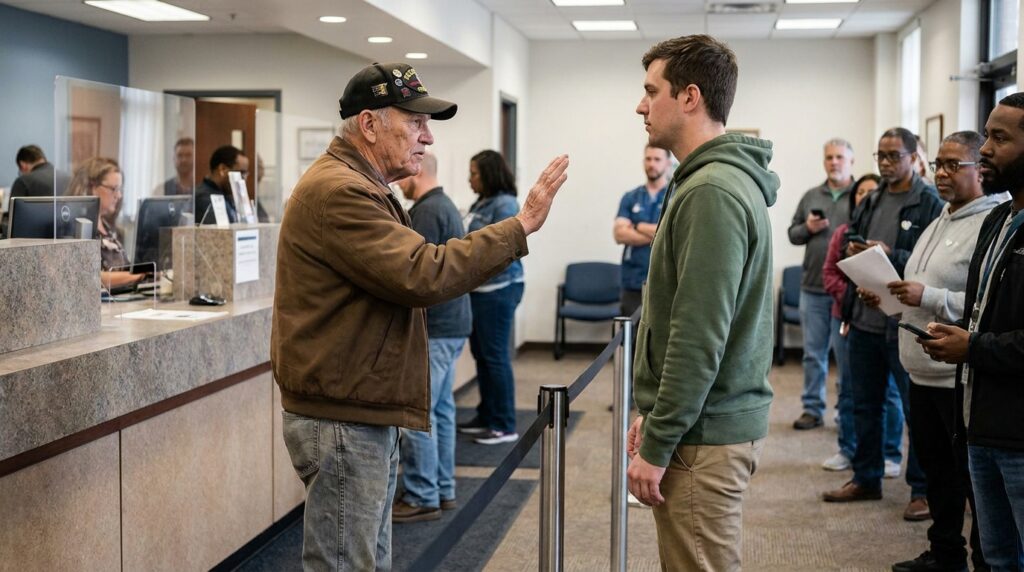
“You think that little brass pin makes you bulletproof, old man?”
The words came hot, smelling faintly of stale energy drinks and cold grease. The young man shifted his hips, his weight transferring to the balls of his feet. To an untrained eye, it was a display of aggressive dominance—the widening of the chest, the chin thrust forward like an iron wedge. To Arthur, it was an invitation. The youth was off-balance, his right heel slightly elevated, leaving his entire left flank vulnerable to a simple trip if he chose to drive his mass forward.
Arthur kept his hands low, fingers lightly hooked into the pockets of his canvas jacket. The fabric was stiff with years of embedded oil and shop grime, providing a small shield against a sudden slash or grab. He didn’t look at the young man’s eyes; he watched the notch where the collarbone met the throat. A man could lie with his eyes, could blink away fear or telegraph a punch he didn’t intend to throw, but the tension in the sternocleidomastoid muscle never lied. It was tightening now, a hard cord drawing the head down into a protective huddle.
“I asked you to step back,” Arthur said. The rhythm of his speech remained flat, a steady metronome against the erratic clicking of the office’s automated ticket dispenser fifty feet away.
“I’m not stepping anywhere.” The youth leaned in, his green hoodie bunching at the shoulders. “You’re going to let me through to that window, or I’m going to put you through the damn glass myself.”
The threat was public, loud enough to cut through the low-frequency murmur of the eighty-odd people waiting behind the stanchions. A woman three places back let out a small, sharp intake of breath, her keys rattling against her thigh as she pulled her child closer to her wool coat. The rest of the line did what crowds in the city always did—they became small. They narrowed their gaze, looked down at their phones, or focused on the scuffed grey tile between their shoes. They were treating the violence like bad weather, hoping if they didn’t acknowledge the storm, it wouldn’t wet them.
Arthur felt the hard line of the service counter counter-weighting his hips. There was no escape route to the rear; the security partition was thick, reinforced polycarbonate anchored into steel channels. The clerk behind the window, a middle-aged woman with a laminated county badge pinned to her blouse, had already stopped typing. Her fingers hovered over her keyboard like frozen spiders, her face pale against the blue glow of her monitor. She didn’t call for security. Her eyes were fixed on the green sleeve of the hoodie.
Arthur didn’t need security. He was tracking the white corner of plastic protruding from the young man’s pocket. As the youth shifted his weight forward, the material caught the harsh glare of the overhead fluorescent tube. It wasn’t a standard credit card or a driver’s license. The edges were too thick, the laminate too matte. It was a high-frequency proximity card, the kind used to trip the electromagnetic locks on restricted municipal buildings. Arthur recognized the specific shade of security blue on the border—the color of the public works department, the group that held the master keys to the city’s underground infrastructure.
The young man didn’t look like a city worker. His knuckles were clean, devoid of the split skin and dark grease that came with handling valves or heavy rigging. The badge was a foreign object on his person, carried with the awkward care of something newly acquired and poorly understood.
“You’ve got ten seconds to get back behind the yellow line,” Arthur murmured, his eyes still locked on the tightening cord of the youth’s throat. “After that, the choice isn’t yours anymore.”
The youth laughed, a short, barking sound that lacked any real center. He reached out with his left hand, his fingers spreading into a claw, aiming for the collar of Arthur’s brown jacket. His movement was slow, heavy with the assumption that the elderly body before him would freeze, that the spine would buckle under the mere suggestion of mass.
Arthur didn’t buck. He felt the cold air of the room rush into the gap between them as the hand closed the distance. His right hand came out of his pocket not as a fist, but as a flat, unyielding blade of bone and sinew, rising inside the arc of the youth’s arm to catch the wrist before the fingers could latch onto the canvas.
The contact was dry and loud, the skin-on-skin slap echoing against the security glass like a small caliber round.








