
CHAPTER 6: THE FINAL LINE OF THE DEED
“Alright,” he repeated, his chest dropping another fraction of an inch against the rigid wooden partition. “I said I’m backing off.”
The words left his mouth like exhaust from a dying generator—wet, thin, and smelling of sour malt. He didn’t turn his back. A man who relies on bulk never turns his back when his leverage is snapped; he moves in reverse, testing the floorboards behind his heels with short, tentative stabs of his leather work boots. The fine layer of foundry grit groaned beneath his soles, a dry, grating whistle that marked his retreat out of my personal lane and into the deeper shadows near the pool table.
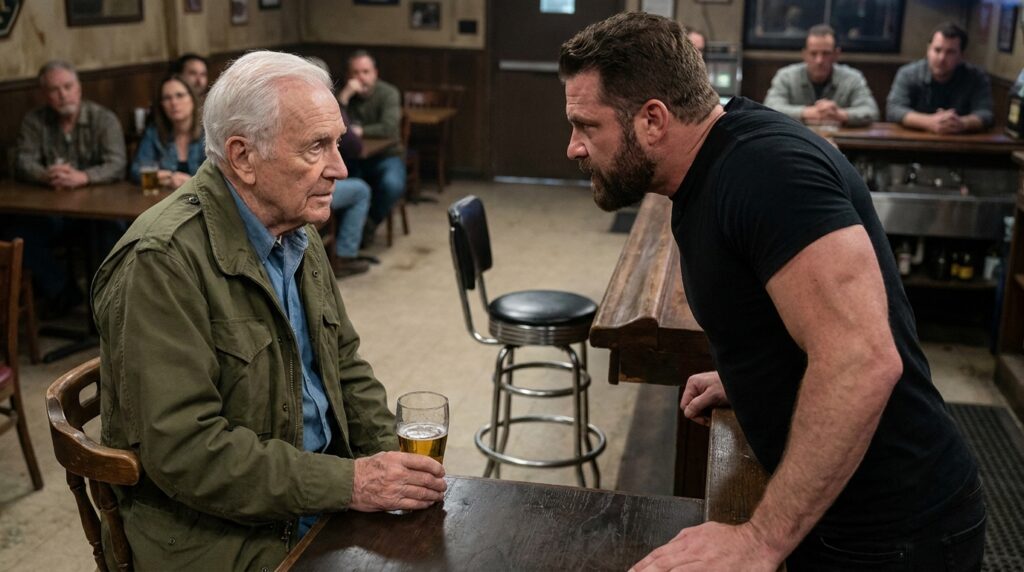
I didn’t let the stool drop. The timber remained locked in my right hand, the heavy base ring suspended six inches above the scuffed oak floor. My left fingers kept their anchor on the lower iron column, holding the three-inch play of the unbolted frame perfectly steady. Adrenaline was an old enemy; I could feel it trying to rattle the small muscles at the base of my neck, but I clamped down on the impulse, forcing my breathing to maintain the same flat, mechanical rhythm it had held since I first pulled up the chair.
Behind the bar, the bartender didn’t move to pull his order pad from the sink. The gray wash water had completely soaked through the cardboard backing, turning the scrawled case reference into a loose, dark smudge that ran toward the drain. He looked up, his face gray beneath the yellow oil lamps, his eyes drifting from the short beard of the retreating bully to the frayed olive canvas on my shoulder.
“Jerry,” I said, my voice cutting through the hum of the neon sign like a dry file across a rusted latch. I didn’t look at him. I kept my eyes fixed on the bully’s hands, ensuring his fingers stayed wide and clear of his belt line. “Get the document out of your apron.”
The bartender flinched, his boots shuffling against the rubber utility mat behind the counter. “Marcus… you don’t understand,” he whispered, his voice cracking like dry kindling. “They’ve got the city seal on it. The compliance office signed off on the fast-track clearance last Tuesday. His old man’s firm bought the structural lien from the tax receiver.”
The bully stopped his backward drift, his heels locking against the base of the cigarette machine. A small spark of the old arrogance flared in his eyes, his broad shoulders trying to reset themselves against the wood casing. “He’s telling you the truth, old-timer. The brick belongs to the demolition pool now. This whole block is coming down for the rail spur expansion. You can hold that chair until the diesel starts, but it doesn’t change the name on the county registry.”
I let the heavy iron base ring of the stool drop back to the floorboards. The impact made a solid, hollow thud that caused the spilled beer on the counter to jump, a small amber ripple cutting across the grain of the oak. I didn’t reach for my wallet, and I didn’t show them a piece of paper with a notary stamp. Instead, my left thumb drifted inside the torn interior lining of my jacket pocket, my skin finding the cold, flat edge of a small brass key attached to a heavy iron ring.
“The county registry doesn’t clear a structural lien unless the primary bond is paid,” I said, looking down at the dark, wet ring my glass had left in the dust. “And the primary bond for this foundation was signed in nineteen seventy-four, under the name of the veteran’s holding trust.”
The bartender froze, his hand remaining stuck halfway into his apron. The silence in the room became absolute, so deep that the rhythmic clank of the radiator in the corner sounded like an axe striking dry timber.
“The number stamped on the bottom ring of this stool column is one hundred and four,” I continued, my fingers keeping the brass key perfectly hidden within the canvas lining. “It matches the equipment schedule filed with the original commercial deed. The city can condemn a roof for peeling tar, but they can’t clear the timber underneath if the holder of the ground-lease refuses the buyout.”
The bully’s jaw shifted, his brow furrowing as he tried to trace the logic through the fog of his own miscalculation. He wasn’t built for title law; he was built for the friction of the yard, for the physical displacement of things that couldn’t talk back. He looked at the bartender, waiting for a denial, but Jerry’s face had gone completely hollow, his mouth opening slightly as his gaze dropped to the small brass tag riveted near my boot.
“The old man…” Jerry muttered, his fingers finally pulling the yellowed paper out of his pocket, his thumb tearing the edge of the official municipal seal without realizing it. “He’s not on the tenant list because he is the trust, Marcus. The company didn’t buy the lien. They just bought the interest on the back-taxes I couldn’t cover.”
I stood up from the stool, my spine straight, the olive jacket hanging from my shoulders with the same heavy, unyielding hang it had possessed forty years ago on the tarmac. I reached out, my hand closing around the untouched glass of beer. I didn’t drink it. I simply tipped the pint forward, letting the remaining sour foam pour directly onto the black, split grain of the oak counter, washing the dust toward the floorboards.
“Tell your father to check the storage vault at the county seat,” I said to the bully, my voice flat, dry, and entirely clear of emotion. “The iron stays exactly where it was dropped.”
The large man didn’t answer. He looked at the wet wood, then at the graying hair at my temples, his boots turning toward the door with a slow, heavy drag that lacked any of the weight he had brought into the lane. The front door scraped against the frame as he pushed it open, letting in a final gust of dry evening dust before the latch clicked shut behind him.








