
CHAPTER 3: THE FRICTION OF THE LINE
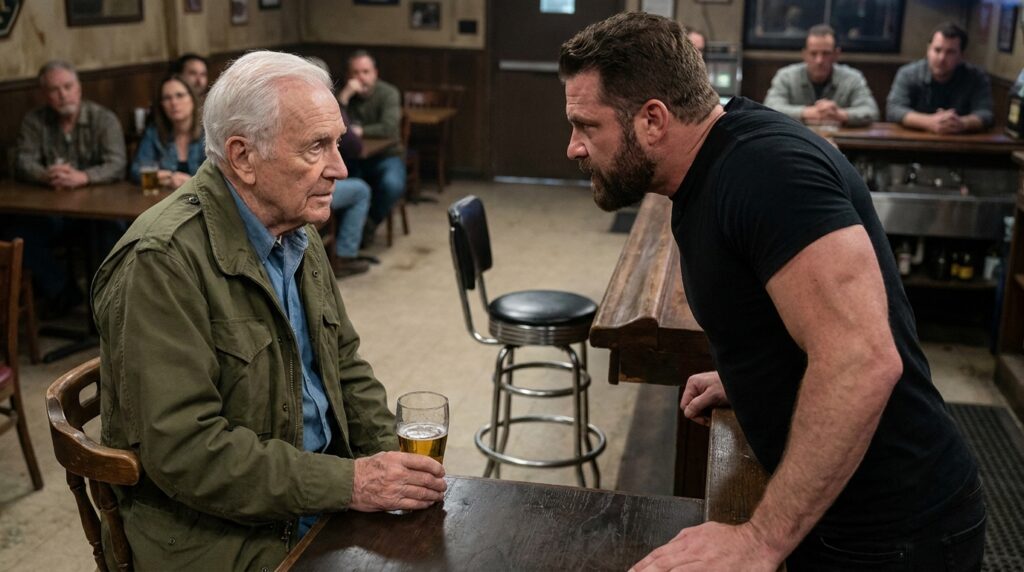
The knuckles of his hand didn’t soften. They remained the color of dry tallow, his broad fingers anchoring against the wet base of my beer glass with enough leverage to crush the rim if his thumb drifted an inch higher. I could see the fine grain of black sand and iron dust caught under his fingernails—the signature of the raw yard down by the train tracks where they crushed old engine blocks for scrap. He was breathing through his nose now, a low, rhythmic whistle that forced the smell of cold lard and wet asphalt across the two feet of air separating our faces.
“Torque is cheap when the foundation is rotten, old man,” he muttered. He shifted his weight forward, his heavy leather boot sliding another inch into my lane, his knee nearly brushing the rough weave of my trousers. “You talk like a man who still owns the ground he’s standing on. But the ground in this town changes hands while people like you are sleeping.”
Behind the counter, the bartender didn’t move the washing rag, but his breath caught. The rhythmic tapping of his finger against his denim apron had stopped. The edge of that folded yellow document was sticking out just far enough now for the low amber bulb above the sink to hit it. On the exposed corner of the paper, there was a purple ink stamp—a circular, official seal with three bold letters visible: M-U-N. It was a municipal field notice, the kind the city compliance officers slapped on buildings that had been condemned under the fast-track urban development codes. The bartender wasn’t just sweating from the heat of the glass washer; he was looking at the man who had likely delivered it, or whose father paid the salary of the man who did.
I kept my eye on that reflection in the glass, my spine perfectly straight against the lack of a backrest. My right hand remained in my lap, the fingertips staying light against my knee. “A foundation isn’t rotten just because the paint peels,” I said, keeping my tone within that flat, dead octave where no emotion could find a foothold. “The timber under these floorboards is white oak, six-by-fours, cured before the highway was paved. It takes more than a municipal stamp to rot wood like that.”
The bully’s jaw tightened. He didn’t like the word stamp. His eyes drifted down to the bartender’s pocket for a micro-second, a quick, transactional flicker that confirmed the link between them. Then his gaze snapped back to my face, his short beard twitching as his mouth pulled into a narrow, hard line. He didn’t know how an old man sitting in the dark could read the room without turning his neck, and the uncertainty was beginning to create a drag on his momentum. He was used to people shuffling their boots and looking at their watches when he closed the gap.
“You’ve got a lot of opinions for a guy who spends his afternoons staring at an empty glass,” he said, his voice dropping into a register that was meant to carry to the rear booths where the other regulars sat frozen. “But opinions don’t pay the property tax, and they don’t keep the roof over this bar. This place is done. The contract’s signed, and the clearing crew doesn’t check IDs before they drop the hammer. If you’re smart, you’ll crawl out of this hole while the door is still open.”
He let go of the glass pint with a sudden, intentional jerk, his palm striking the oak counter with a loud thud that caused the liquid inside to slosh over the rim, spilling a dark pool onto the wood. The moisture immediately began to sink into the old, dried-out cracks of the grain, turning the scuffed surface black.
I didn’t flinch from the sound. I watched the dark beer pool spread toward the edge of my jacket sleeve, tracking its path with the same detached calculation I used to monitor fuel lines under a five-ton transport truck. The liquid moved slowly, hindered by the accumulation of dirt and old wax in the wood’s pores. The room remained completely suspended; even the television bracket in the corner had stopped creaking. The regular in the second booth had put his fork down entirely, his hands flat on the laminated tabletop as he waited for the first swing.
“The door has been open for forty years,” I said, my fingers closing around the cold iron ring under my seat, stabilizing the three-inch play of the unbolted stool frame. “And the hammer usually hits the thing that’s making the most noise.”
The bully took a full breath, his chest expanding until the seams of his black t-shirt groaned against his shoulders. He didn’t look at his friends in the back. He didn’t look at the bartender. He was looking at the silver hair at my temples, calculating the exact amount of force required to shift a hundred and sixty pounds of old bone off the wood. He was a professional at this—the slow crowding, the deliberate mess, the verbal weight that forced the victim to make the first frantic move. He was waiting for me to reach for my pockets or pull my shoulders back. He wanted the justification of a struggle.
“Let’s see how much noise you make when you’re sitting on the asphalt,” he whispered, his shoulder dropping into the initial line of a shove.








