
CHAPTER 2: THE SCRAPE OF RUSTED IRON
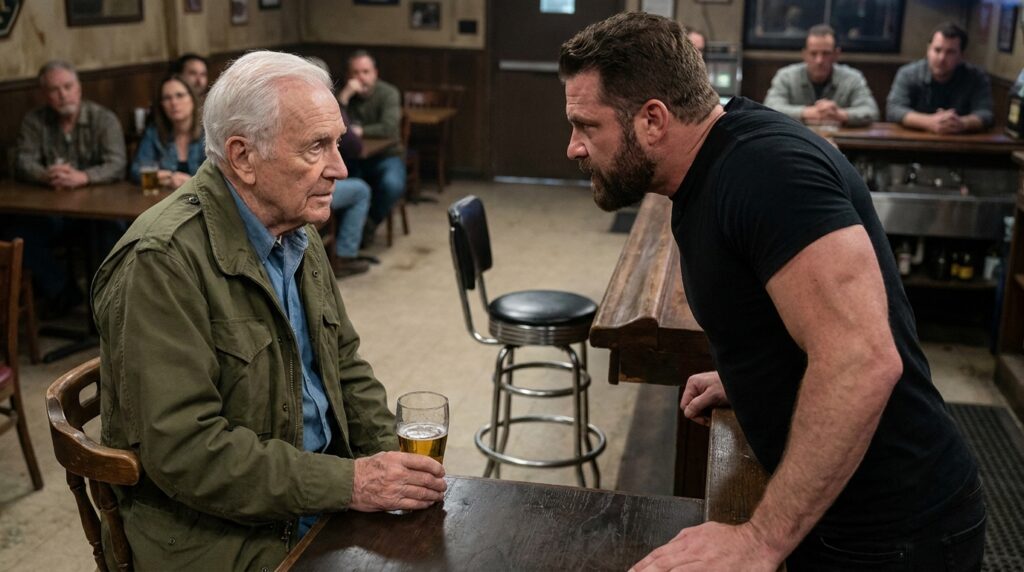
The heavy leather of his boot didn’t just rest near my stool; it ground a stray bit of gravel into the iron floor ring with a dry, crunching whistle. The sound was sharp, vibrating through the metal tube of my seat and straight into the base of my spine. Up close, the aggressor smelled of stale tobacco and grease from a cheap diesel engine—the kind of soot that coats the lungs of men who spend their days fixing broken hydraulic lines on over-worked flatbeds. His broad forearm remained flat on the scuffed oak, his thick wrist twitching slightly as he watched me.
I didn’t blink. Through the dusty mirror behind the bottles of rye, I could see the bartender’s hands freeze entirely. The damp rag stayed pinned under his palm, soaking up the gray, soapy wash water. He didn’t lift his head, but his eyes were fixed on the reflection of the large man’s black t-shirt. There was a sudden, tight silence in the tavern, the kind that usually precedes the snapping of a drive belt or the failure of a structural beam under too much weight.
“You look like you’re in the wrong booth, old-timer,” the man said. His voice wasn’t loud, but it had a heavy, grinding cadence that filled the small space between us. He leaned an inch closer, his shoulder muscles flexing beneath the cotton sleeve. “This end of the bar is reserved for people who actually work for a living.”
I let my fingers trace the circular grease stain on my olive jacket one more time before lowering my hand to my lap. My palm brushed against the underside of the heavy oak bar seat. The wood there was raw, unfinished, and splintered with age. As my thumb slid along the support bracket, it caught on an empty hole. The thick, silver-headed bolt that was supposed to lock the central iron column to the timber seat was gone, leaving nothing but an empty, rusted thread. It was a minor structural failure, a tiny piece of neglect in a building full of it, but my mind logged the geometry of it instantly. Without that bolt, the stool would pivot three inches to the left if the weight wasn’t balanced perfectly.
“I’ve been sitting in this exact spot since before your flatbed had its first oil change,” I said. My voice sounded thin to my own ears, gravelly and dry like a shovel hitting rocky soil, but I kept the rhythm flat. No rise in pitch. No trace of the adrenaline that makes a young man’s throat go tight. “The beer tastes the same everywhere in the room.”
The man gave a short, hard grunt that wasn’t a laugh. He moved his other hand, his fingers curling around the base of my untouched glass pint. He didn’t lift it; he just slid it two inches across the oak, the wet bottom leaving a dark, crescent-shaped track in the dust. It was an old tactic—testing the boundary, seeing if the animal shrinks back when its salt lick is touched.
Out of the corner of my eye, I saw the bartender’s shoulder drop slightly. He reached down into the small, grease-stained pocket of his apron, his fingers brushing against a folded piece of thick, yellowed paper that looked like a legal notice. He didn’t pull it out, but the way his hand lingered there—the nervous, repetitive tapping of his index finger against the stiff crease—told me everything I needed to know about the weight he was carrying. He wasn’t afraid of a bar fight; he was afraid of what happened after the fight, or who this muscular regular represented.
“The beer might taste the same,” the bully muttered, his bearded jaw shifting as he chewed on a piece of tobacco. “But some faces don’t fit the scenery anymore. This town is cleaning up its scrap iron. You should take your jacket and your memories down the road before somebody decides to move you themselves.”
The regulars in the far booths didn’t move. One of them lowered his eyes to his plate of cold fries, his fork hovering an inch above the grease-smeared ceramic. They knew the rules of the dusty gray. When a young man with a wide chest and heavy boots decided to clear a corner, an old soldier was supposed to collect his coins and find a darker place to sit. It was the pragmatism of survival in a place where utility was the only currency that mattered.
I shifted my weight, careful not to let the unbolted frame of the seat list to the left. My right boot found the iron floor ring, locking the heel against the weld. The cold of the metal went right through the thin sole of my shoe. I could feel the tension in the room tightening, a mechanical load increasing pound by pound until the pins were ready to shear. The bully’s breath was hot against my cheek now, smelling of old copper and winter wheat. He thought he was clearing out a piece of dead weight. He thought the silence in the room was his leverage.
“The scrap iron usually stays exactly where it’s dropped,” I said softly, looking at the dead rings of foam inside my glass. “It takes a lot of torque to shift it.”
His grip on the base of my pint tightened until his knuckles went the color of tallow. He didn’t pull back. He was waiting for the flinch, the small hitch in my breath that would give him permission to lift me out of the seat.








