
CHAPTER 5: THE LOCK OF THE TIMBER WALL
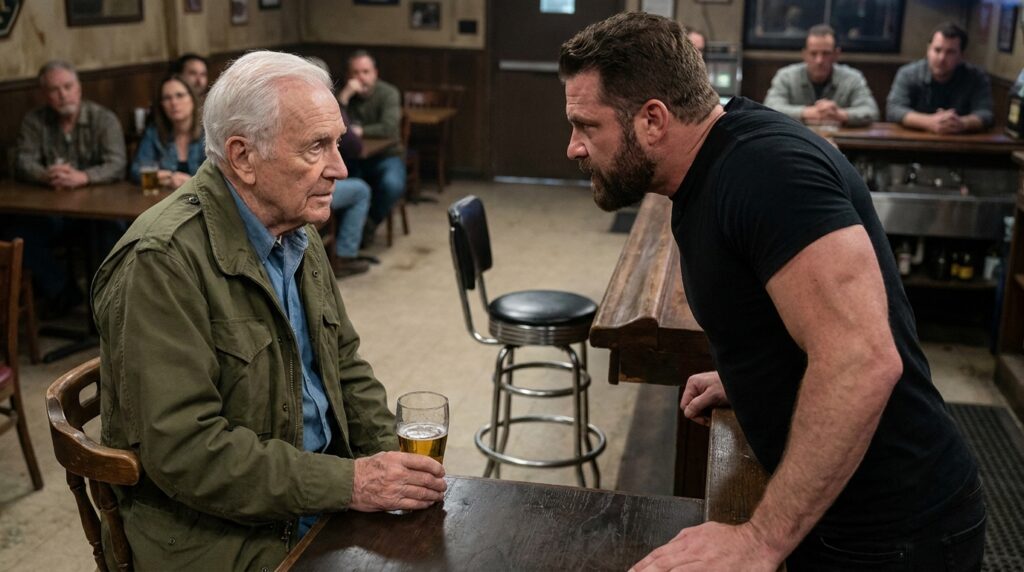
The boot leather didn’t slide a third time. The bully planted his heel with a dull, heavy thud that drove a fresh layer of gray foundry grit into the cracks of the floorboards. His shoulder swung forward, his left arm coming up like a sweeping crane arm to close the final pocket of air between his chest and the scuffed edge of the oak counter. The black cotton of his t-shirt strained across his latissimus muscles until the gray industrial thread at the hem began to fray. He was committed now; his center of gravity had passed the point where a simple step could pull him back from the lane.
I didn’t blink. I didn’t reach for the pocket where an amateur would keep a knife, nor did I raise my hands in the soft, defensive posture that gives an aggressor a clear target for a collar grab. My left hand remained wrapped tightly around the cold iron ring under my seat, my fingers using the three-inch lateral play of the unbolted column to tilt the entire frame slightly out of his direct line of sight. My right boot remained locked against the weld at the base, transforming my leg into a rigid steel strut that ran directly into the joists below.
With a single, unhurried contraction of my thighs, I stood up. The movement was perfectly upright, an economy of motion that used the momentum of his own lunge to close the height gap between us. As my hips cleared the scuffed wood, my right hand dropped down onto the raw underside of the oak timber seat. My thumb caught the edge of the unbolted frame while my four fingers hooked the deep grain of the seasoned wood. I didn’t swing it like a baseball bat; I didn’t lift it above my shoulder where the overhead pipes would catch the grain. I simply rose and drew the entire sixty-pound unit upward and outward in a tight, precise radius that tracked the perimeter of my personal space ring.
The heavy iron base ring of the stool scraped against the floor with a screech that sounded like an ungreased brake shoe hitting a freight train wheel. It was a raw, metallic howl that tore through the ambient hum of the tavern’s neon sign. The thick wooden legs swung into the space between his chest and my chin, the unbolted column locking against the metal foot ring with a solid, resonant clack that signaled the absolute end of the stool’s tolerance. The timber seat was now positioned directly across his sternum, a solid, four-inch block of cured white oak that sat perfectly parallel to his collarbone.
The bully’s chest struck the flat top of the wooden seat before his hands could close around my jacket lapel. The impact wasn’t a clean fracture; it was the heavy, dead thud of a horse hitting a timber gate post. The momentum of his lunge died instantly, the energy transferring through the oak frame, down the iron column, and straight into the iron ring my boot was anchoring to the floor. The force was enough to make the joints of my knees pop under the load, but the white oak didn’t give an inch. It remained a static, unyielding partition between the yard boss and the space he thought he could buy with a broad shoulder.
Behind the bar, the bartender’s hand shook so violently that the wet order pad slipped from his grip again, dropping face down into the sink’s zinc wash water. The grease-pencil numbers—CASE #2026-MUNI-7741—were completely submerged now, the gray fluid dissolving the ink into a shapeless cloud of graphite. He didn’t look down to retrieve it. His eyes were wide, locked on the small brass tag stamped with the number 104 that was riveted to the very base of the stool’s iron column—a corporate inventory marker that matched the registration entry on the disputed municipal deed. The realization hit his face like a cold spray: this wasn’t an anonymous regular defending a bar seat; this was the owner of the structure using the building’s own skeleton to hold the line against the buyout.
“Take one more step,” I said, my voice dropping into that low, gravelly lower register that had once commanded four-ton transport rigs across muddy airfields. The tone was completely dry, flat, and devoid of the high-pitched vibration that adrenaline brings to a frightened throat. “And you’ll regret that choice.”
The bully’s fingers stayed frozen in mid-air, his thumbs less than two inches from the edge of the oak wood. His face had gone the color of skimmed milk beneath his short black beard, his teeth clicking together once as the shock of the sudden deceleration traveled up his neck. He tried to draw a breath, but his chest was pinned against the timber barrier, his ribs unable to expand against the rigid resistance of the iron frame below. He looked down at the stool, then up at my eyes, searching for the small twitch or the widening of the pupil that would signal a bluff. He found nothing but the cold reflection of the amber oil lamps in the mirror behind me.
The tavern regulars didn’t stand up. The man in the second booth remained with his palms flat on the laminate, his head tilted downward as if he were looking at the floorboards to see if the nails were beginning to pull from the joists. They knew the rules of the gray road. When an old machine locks its gears, you don’t stick your fingers into the housing to see why the rotation stopped. You stay clear until the torque drops to zero.
The bully’s shoulders began to sag beneath the tight black cotton of his t-shirt. His elbows dropped an inch, the heavy muscles of his forearms going soft as the forward momentum of his lunge dissipated completely into the wood. He was a professional at crowding people, but he didn’t know how to handle a wall that didn’t have a latch or a hinge. The physical reality of the barrier had rewritten the social logic of the counter in less than three seconds.
“Alright,” he muttered, his voice a low, dry hiss that barely carried over the steady hum of the neon sign. His boots took a short, cautious step backward, the leather heels scraping through the fine layer of foundry grit as he sought to establish a safe distance between his sternum and the oak. “I’m backing off.”
I didn’t lower the stool. My fingers stayed locked against the raw underside of the seat, my heel remaining pressed hard against the iron floor ring until the metal felt like an extension of my own skin. The danger hadn’t cleared the doorway yet; it had only paused to calculate the cost of the next turn.








