
CHAPTER 4: THE CLOSING INCH OF THE LANE
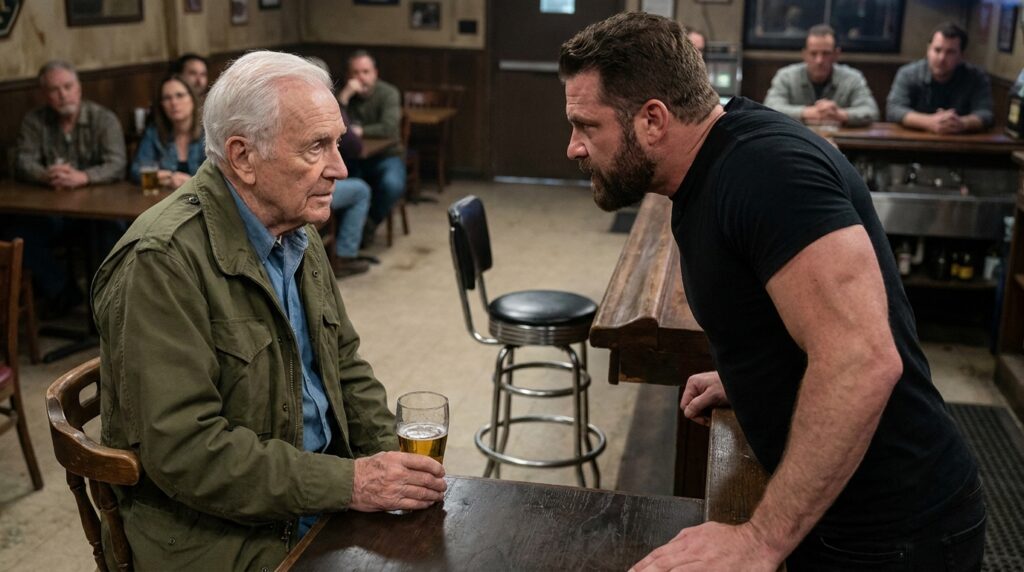
His shoulder dropped, the thick deltoid beneath the black cotton bunching into a tight, dense knot as his center of gravity shifted forward. He didn’t just lean; he threw the collective momentum of his two hundred pounds into the single inch of space that kept him from my chest. It was the classic, unhurried surge of a yard boss used to shifting jammed rusted gears by brute force alone. The smell of his skin—sharp grease, iron shavings, and cold sweat—blanketed my face like a damp rag dropped onto an engine block.
“You think you’re tough, old man,” his voice barked, no longer a whisper but a raw, grating vibration that rattled the small liquor bottles lined up against the dark mirror. “Get up and prove it.”
My right hand didn’t move from my knee, but my left fingers bit deeper into the cold iron floor ring beneath the seat. The missing silver bolt under the timber frame allowed the stool to lurch exactly three inches to the left, a sudden, structural instability that would have thrown any other man off his balance. I logged the slip instantly, using the tilt to slide my heel down against the weld of the bottom pipe. The room seemed to expand and flatten all at once, the dull amber light of the tavern gathering in the grease-filmed glass of my untouched beer pint.
Behind the bar, the bartender didn’t reach for a glass or drop his cloth. Instead, he pulled his hand entirely out of his apron pocket, but in his haste, his knuckles dragged the edge of his order pad out along with it. The small, cardboard-backed pad fell onto the wet zinc sink with a dull slap. On the gray cardboard backing, a string of numbers was scribbled in heavy grease pencil: CASE #2026-MUNI-7741. It wasn’t an order for draft beer. It was a court file reference, the designation for a disputed title hearing. The bartender’s eyes didn’t fix on me or the bully; they stayed glued to that wet piece of cardboard as the gray wash water began to bleed the ink into a smudge. He knew the legal gears were already grinding, and he knew this confrontation at the counter was just the physical tip of an unseen, institutional blade.
“The proof isn’t something you look for in a bar ditch, son,” I said. The words came out flat, dry, and perfectly paced, with no jump in the rhythm to show the sudden spike of heat in my chest. “And I don’t get up unless there’s a reason to shift the weight.”
The bully’s face went the color of rusted pipe. He didn’t wait for the sentence to clear the air between us. His hand shot forward, his thick fingers curling into a claw that targeted the stiff, frayed lapel of my olive military jacket. He wanted to yank me off the stool, to break the upright posture that seemed to offend his sense of scale. The movement was fast, but it had the predictable trajectory of a man who relied entirely on leverage and mass rather than discipline.
I didn’t pull back. Shrinking from an edge only shortens the distance your enemy has to travel. Instead, I let my torso give way two inches to the left, riding the existing play of the unbolted seat frame. His fingers brushed the rough canvas of my collar but failed to anchor, his knuckles scraping hard against the iron zipper teeth of the jacket pocket instead. The friction made a sharp, metallic zip that cut through the dead silence of the room like a shear blade through tin.
The failure to catch a clean hold threw his balance off by a fraction of an inch. His boots slid slightly on the grit-streaked floorboards, the leather heels making a short, dry screech against the wood. In the far booth, the regular who had been staring at his plate stood up so fast his knee caught the underside of the table, sending a plastic salt shaker rolling across the laminate until it dropped off the edge. Nobody moved to pick it up. The room was no longer just a blue-collar tavern; it had become an narrow, high-stress testing lane where every minor error in movement carried a heavy structural cost.
“You’re done talking, old-timer,” the bully growled, his breath coming in a short, ragged hiss through his teeth as he reset his feet. He didn’t look down at his boots, but his shoulders rose another inch, his arms wide to wall me in completely against the oak counter. “You’re going out the door whether you’re attached to that chair or not.”
I looked past his shoulder, tracking his reflection in the dark mirror between the bottles of rye. The bartender had picked up the wet pad, his thumb pressed so hard against the grease-pencil numbers that the cardboard was buckling beneath his grip. He looked like a man who had been forced to watch an old machine run until its bearings caught fire, helpless to stop the rotation because the switch was locked behind someone else’s desk. The contract he had signed wasn’t just a demolition order; it was a surrender document, and he was realizing too late that the terms didn’t include protection for the fixtures.
My right hand came off my knee, the fingers spreading wide as they hovered two inches above the cold timber seat of the stool. Every muscle in my legs went rigid, the heels of my shoes digging into the iron floor ring until the metal began to groan against the mounting screws. The line had been drawn, the tolerance had reached zero, and the next movement wouldn’t belong to the law or the city code. It would belong entirely to the physics of the barrier.








