
CHAPTER 9: THE BALANCED FORCE
The flash of the terminal explosion left a jagged, green phosphorus streak across Marcus’s retinas, but his body was already dropping beneath the level of the primary discharge.
In the sudden, heavy blackness that followed, the vault became a closed grid of acoustic echoes and temperature gradients. He knew the pregnant controller was exactly ten feet away, her boots anchored in the wet silt, her center of gravity shifted slightly to her left to compensate for the weight of her acoustic projector. Marcus didn’t rely on sight. He calculated her position by the faint, rhythmic rustle of her wet nylon top against her chest rig and the tiny, automated hum of her night-vision optics adjusting to the dark.
A civilian would have broken distance. Marcus accelerated inward.
He moved through the dark with the silent, linear efficiency of a heavy pendulum, his boots lifting barely an eighth of an inch above the flooded concrete to eliminate the sound of splashing water. His right shoulder, bruised and stiff from the vehicle impact, locked into a rigid mechanical brace as he closed the gap. He didn’t swing a fist; he offered her skeletal frame a direct, unyielding collision.
The muzzle flash of her weapon cut a horizontal white razor blade through the dark. The round tore through the empty space where Marcus’s head had been a fraction of a second prior, the concussive crack of the supersonic wave shattering the remaining glass tubes on the walls behind him.
Before her cylinder could cycle the next chamber, Marcus’s left hand found her wrist.
It wasn’t a standard grab. His fingers indexed the soft tissue between her ulna and radius, his thumb driving into the deep tendon track with a sudden, localized pressure that forced her fingers to unlock from the grip. The weapon didn’t fall to the floor; Marcus’s right hand caught the barrel before it hit the silt, his hips executing a sharp, clockwise pivot that stripped the directional projector from her chest rig with a dry, metallic pop of plastic buckles.
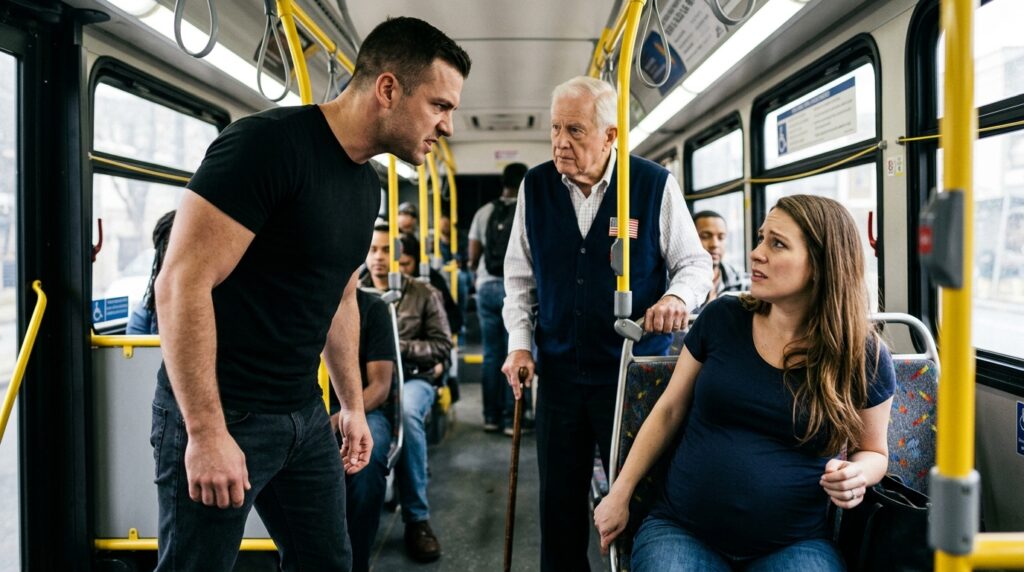
The woman didn’t scream. She didn’t lose her balance. She reacted with the exact mechanical compliance he had observed in the muscular passenger on the bus line—a smooth, immediate transition into a low-leverage defensive posture that proved she shared the same genetic and structural lineage.
Her left heel shot upward, targeted directly at Marcus’s cracked ribs.
Marcus took the force of the strike on the meat of his left forearm, the impact driving a dull, sickening ache through his radius bone. He shifted his weight instantly, using her upward momentum to lift her center of gravity off the wet concrete. With a single, continuous rotation of his shoulders, he drove the heavy aluminum frame of the captured acoustic projector straight down into her bracing knee.
The bone didn’t break, but the mechanical leverage was absolute. The controller’s leg gave way, her shoulder striking the rusted iron column of the backup junction box with a hard, hollow thud.
Marcus held her pinned against the metal, the cold muzzle of her own directional device pressed precisely under her chin line. His breathing remained low, flat, and perfectly regular, his pulse locked down by the ancient, hard-coded command authority that had survived twenty-four years of civilian rust.
The vault settled back into an iron silence, broken only by the steady, dripping hiss of ionized water leaking from the ruined terminal overhead.
“The infrastructure doesn’t belong to a agency, Marcus,” she said, her voice coming through the dark in a low, breathless rasp. She didn’t struggle against the iron frame pinning her throat. Her features were completely invisible in the black, but her tone retained that same chilling, academic detachment. “You think you’ve neutralized the test lane, but the baseline parameters are already archived. Every movement you made on that transit line is currently being decoded by the automated service hubs across forty-eight sectors. You’re a library. You can’t burn the books by shorting out one room.”
Marcus didn’t release the pressure on her throat. He tilted his head slightly, his left hand reaching down to the split lining of his dark canvas vest where the silver tracking filament was still humming with a faint, residual heat.
The red error indicator on the wall panel behind her wasn’t dead. It was flashing a secondary sequence—an automated, low-bandwidth backup frequency that was bypassing the ruined switching station and routing the terminal’s core telemetry files directly into the city’s main civilian transit grid.
“The books,” Marcus whispered, his gravelly voice dropping an octave into the freezing dark, “have already been leaked to the commuters.”
Through the drainage tunnel behind them, the sound of heavy, synchronized boots returned—the rapid, tactical advance of the secondary extraction team closing the perimeter to terminate the counter-move before the data transfer could break the boundaries of the industrial yard.








