
CHAPTER 3: THE INTERCEPTION MATRIX
The heavy rubber edge of Marcus’s right boot came down over the matte-black device with a dull, hollow thud. He didn’t bend down immediately. The bus engine gave a violent, shuddering cough as the vehicle accelerated away from the concrete terminal curb, its suspension groaning under the shifting weight of the remaining passengers.
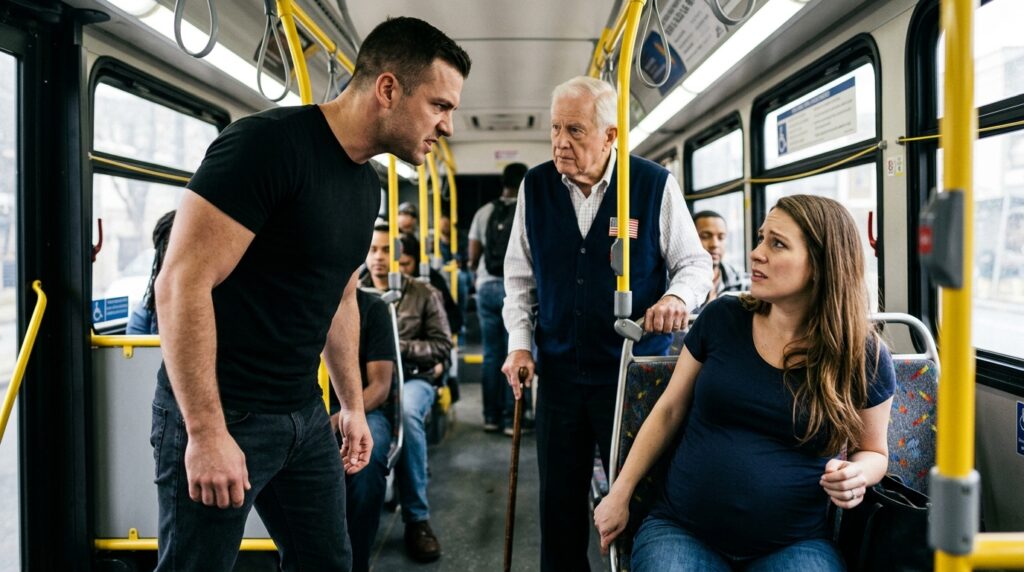
Marcus kept his weight pressed firmly onto the heel of his shoe, pinning the phone against the metal base of the seat frame. His eyes swept the cabin one more time, a rhythmic, three-second sweep that took in every face, every shoulder line, every hand placement. The young executive was looking out the window; the woman with the headphones was already pulling her ear cups back into place. The collective gaze of the cabin had softened, dropping from the high-voltage alertness of a live threat back into the comfortable, listless haze of ordinary transit. They had witnessed a victory, but their understanding of it was shallow, limited to the crude arithmetic of an old man defending a pregnant woman.
He reached down with his canvas bag, pretending to adjust the frayed strap near his ankle. His fingers closed around the ruggedized phone, sliding it smoothly into the deep interior pocket of his canvas vest. The weight of the device was wrong for a commercial cell; it was dense, encased in hard-anodized aluminum with a slightly textured rubberized perimeter designed to prevent slippage in wet conditions. It was exactly two hundred grams, the standard weight of a military-grade tactical receiver.
Marcus turned to the woman beside the window. She had settled back into her seat, her breathing slower now, though her hands still remained curled tightly over her shoulder bag.
“You should get off at the next avenue,” Marcus said, his voice flat, stripped of comforting inflection. “The platform there has better lighting. More security.”
The woman looked up at him, her lips parting as she tried to find the words to frame her gratitude. “Thank you, sir. I didn’t think… I didn’t think anyone was going to stop him. He was so large.”
“He was off-balance,” Marcus replied simply, his jaw tightening as the bus took a sharp left turn. “Take care of yourself.”
He didn’t wait for her response. He moved two steps down the aisle, occupying a new standing position near the central exit doors. His right hand slipped into the vest pocket, his thumb brushing the smooth surface of the device’s screen. There were no external buttons, no brand markings, no regulatory labels etched into the casing. It was a blank slate, the kind of sterile tech issued to regional units operating outside standard jurisdictional frameworks.
The screen hummed against his palm, a continuous, rapid double-pulse that signaled an incoming, high-priority transmission.
Marcus tilted his torso slightly toward the dark corner of the bus door, creating a shadow with his shoulder to mask the illumination of the display. He pressed his thumb against the center of the glass. The screen didn’t open into a standard consumer interface. It immediately executed a vertical scroll of lime-green text, a basic command-line boot sequence that bypassed any commercial carrier network.
A single notification box expanded at the center of the desaturated display. It wasn’t an alphanumeric text message. It was an automated system routing log, displaying a string of encrypted telemetry parameters that Marcus hadn’t seen since the deployment logs of the old Southern Command sector in the winter of ninety-six.
At the bottom of the routing header, where the destination network protocols were listed, three words sat in cold, pixelated clarity: DEST_UNIT: TASK_FORCE_SEVEN.
The blood in Marcus’s veins turned to liquid nitrogen.
Task Force Seven didn’t exist. It hadn’t existed for twenty-four years, not since the day the defense ministry signed the decommissioning orders and wiped every personnel file from the secure databases at Fort Meade. The men who served in that group were either buried under nameless granite markers in Arlington or, like Marcus, living out a calculated, quiet retirement behind cash-only utility bills and untraceable civilian pensions.
The phone pulsed again, the green text flashing twice before dissolving into a live communication window. A single line of text began to type itself across the screen in real time, the letters appearing with the steady, mechanical rhythm of a terminal operator working from a remote, secure location.
PULSE RATE CONFIRMED. MECHANICAL REFLEX RANGE WITHIN FIVE PERCENT OF EXPECTED EFFICIENCY. TARGET MARKS RETAINED.
Marcus stared at the glowing characters, his breathing perfectly regular despite the sudden, hard pressure hammering inside his chest. He didn’t type a reply. He watched the text line linger for exactly five seconds before the phone’s internal system executed a forced wipe. The screen flickered, the lime-green text collapsing into a single, horizontal line of light before the device went entirely dark, its internal battery matrix discharging a faint, chemical smell through the seams of the aluminum casing.
The bus pulled up to the curb of the next avenue stop with a heavy hiss of air brakes. The pneumatic doors slid open, revealing an empty, rain-slicked concrete platform illuminated by the orange glow of a sodium transit light.
Marcus stepped out of the vehicle, his boots hitting the wet pavement with a crisp, measured snap. He didn’t look back at the bus as its taillights dissolved into the gray urban drizzle. He looked down at the dead black phone in his hand, then out toward the empty industrial lane stretching between the shipping warehouses.
The confrontation on the bus hadn’t been an accident of modern urban decay. The muscular man in the black shirt hadn’t been looking for a seat. He had been looking for a reaction. They had been tracking his daily transit route, measuring his physical deceleration, checking to see if the ancient muscle memory of Task Force Seven’s most lethal asset had survived the long, silent freeze of civilian life.
Marcus slipped the dead phone back into his vest, his eyes narrowing as he caught the faint, distant click of a camera shutter from the shadow of the overpass fifty yards away.
The trap had already closed.








