
CHAPTER 2: STRUCTURAL GEOMETRY
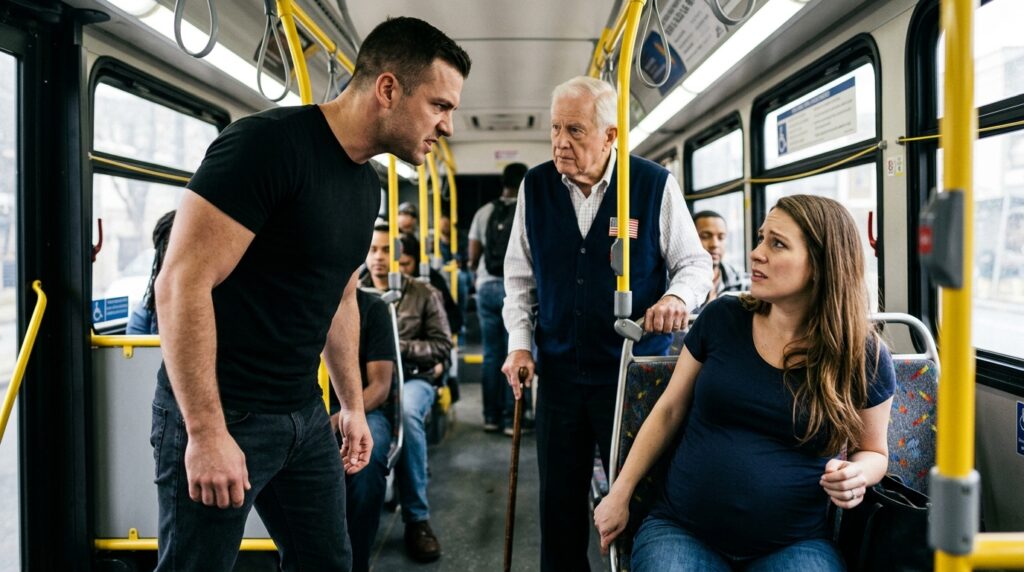
Marcus didn’t push. He didn’t pull. The momentum of the aggressive passenger’s forward rush was a heavy, unrefined mass, and Marcus simply offered it an alternate trajectory.
His left thumb found the soft, anatomical junction just below the man’s radial styloid process—the outer edge of the wrist where the bone flared into a natural ridge. It was a precise, microscopic interception. With his right palm anchoring the man’s elbow to freeze the joint, Marcus executed a tight, downward pivot of his hips. The physics of the movement were ancient, stripped of showmanship, and completely devastating to a top-heavy opponent.
The bully’s broad chest jerked forward, but his feet stayed behind. The sudden, unnatural restriction of his skeletal alignment sent a sharp crack through the cabin’s ambient noise. It wasn’t a bone breaking; it was the violent snap of a leather jacket tightening as two hundred pounds of muscle met an immovable, low-leverage center of gravity. The man’s breath left him in a ragged, involuntary grunt. His fingers, which had been clawing for Marcus’s vest pocket a millisecond prior, flared open, paralyzed by the clean pressure on the median nerve.
Marcus held the lock with absolute, frozen economy. He could feel the rigid trembling of the younger man’s forearm, the heat radiating from the flexed tendons, and the sudden, frantic pulse drumming against Marcus’s thumb.
The bus cabin plunged into a dead, iron silence.
The low hum of the diesel engine beneath the floorboards seemed to drop an octave. In the perimeter of Marcus’s vision, the young man in business casual froze, his thumb hovering an eighth of an inch above his smartphone screen. The woman with the headphones pulled one ear cup down, her mouth opening slightly as she registered the total stillness of the aisle. The aggressive passenger was completely immobilized, pinned by nothing more than an old man’s two-finger grip and a flawless understanding of structural leverage.
Marcus leaned forward an inch, his voice a low, gravelly vibration that barely traveled past the man’s close-cropped temple. “Back away from her right now and show some respect.”
The bully’s eyes were wide, white showing around the dark irises as he stared down at the age-spotted hand controlling his entire body. The arrogance had drained from his face, replaced by the primitive, sharp panic of a predator that had unexpectedly stepped into a heavy steel trap. He tried to twitch his shoulder back, to find a pocket of air to swing his left fist, but Marcus subtly increased the downward angle of the wrist by three degrees. The bully’s knees buckled, his thigh scraping hard against the horizontal stainless steel handrail with a hollow metallic screech.
“Fine,” the man rasped, the words coming out in a tight, strangled wheeze. His face was flushing a deep, mottled red under the gaze of the entire bus. “Fine. I’m backing off.”
Marcus didn’t release him immediately. He waited until the bus hit a seam in the asphalt, using the natural sway of the vehicle to step back and dissolve the lock without giving the man a structural point to launch a counter-attack. He broke contact with a smooth, sweeping motion that restored a clear four feet of distance between them.
The aggressive passenger stumbled back, his boots dragging loudly against the gray transit floor. He clutched his left wrist to his chest, his breath coming in short, ragged bursts. He looked around the cabin, his gaze frantic, looking for a distraction, an ally, or an exit. But the witness layer had locked him out. The passive crowd had transformed into a wall of silent judgment; two passengers in the middle row intentionally shifted their knees outward, narrowing the aisle, physically blocking his path back into the deeper section of the bus.
Marcus stood perfectly centered in the aisle, his hands returning to his sides, his shoulders square. His chest didn’t heave; his breathing remained timed to the steady, mechanical click of the second hand on his nylon-strapped watch.
As the bully retreated toward the rear exit door, his steps uneven, Marcus’s eyes tracked his movement. The desaturated sunlight caught the man’s exposed arm as he grabbed the rear exit handle. Just below the cuff of his black shirt, Marcus noticed a thin, pale mark—a microscopic, surgical scar shaped like a reverse chevron, right above a faded discolored line where a heavy tactical watch strap had sat for years.
It wasn’t a civilian mark. It was the precise exit scar of a low-velocity fragment, the exact type Marcus had seen on dozens of logistics officers stationed near the perimeter fences of the old Southern Command sectors twenty years ago.
The realization hit Marcus with the cold, heavy weight of iron. A civilian bully didn’t carry that specific operational scarring, and a civilian bully didn’t yield to a defensive wrist lock with that exact form of tactical compliance. The man hadn’t just panicked; he had recognized the mechanical lineage of the technique.
The bus began to slow, the distinct chime of the stop-request pull-cord ringing through the ceiling speakers. The rear doors hissed open as the bus ground to a halt against a curb of cracked concrete. The aggressive passenger didn’t look back. He plunged out of the vehicle and into the grey afternoon shadow of the terminal platform, his black shirt disappearing rapidly into the pedestrian crowd.
Marcus didn’t follow him with his body, but his mind was already calculating the variables. He looked down at the yellow-painted floor markers where the struggle had just occurred. Near the edge of the priority seating row, half-hidden beneath the metal base of the seat frame, a small, matte-black object reflected the dull interior lights of the transit cabin.
It was a heavy, ruggedized cellular device, completely devoid of consumer logos, its screen dark but humming with a faint, internal vibration.
Marcus stepped forward, his boot covering the object as the bus doors began to hiss shut once more.








