
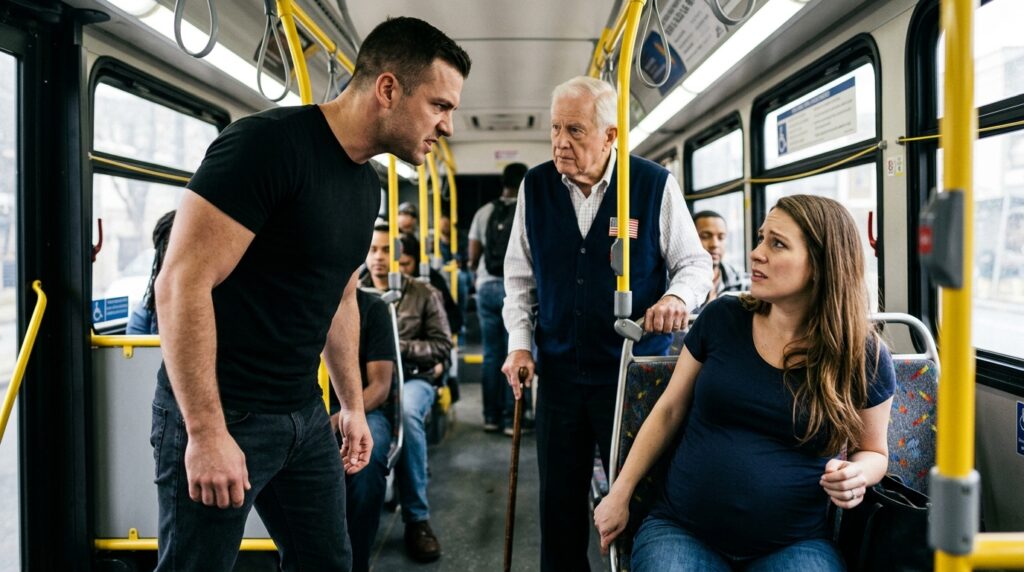
CHAPTER 6: THE BLACK PLATFORM OVERLAY
The needle point entered the skin of his neck with a clean, freezing hiss.
Time lost its linear momentum. The chemical compound inside the cylinder didn’t burn; it spread like a microscopic web of frost through Marcus’s jugular vein, each cold molecule decelerating his nervous system until the dull hum of the rain outside transformed into a series of isolated, heavy impacts against the van’s aluminum roof panels. One drop. Another drop. Each one a distinct, hollow thud.
Marcus didn’t fight the paralysis. He let his eyelids drop by half, his remaining vision narrowing down to a single, desaturated blue horizontal band across the technician’s diagnostic monitor.
The low-frequency tone coming through the main network speaker wasn’t an alarm. It was an over-ride protocol. The lime-green characters on the screen stopped their vertical tracking. They didn’t wipe; they inverted, turning a bright, bleeding crimson that threw a web of sharp red lines across the technician’s flexed knuckles.
“We have a data rupture,” the woman said. Her words came out in a stretched, low-velocity drawl, filtered through the temporal expansion in Marcus’s mind. “The transmission… it isn’t coming from Fort Meade. The handshake is originating from a mobile transceiver inside the perimeter. It’s right behind us.”
The lead operative didn’t depress the cylinder plunger. His thumb froze against the activation valve, his entire upper body locking into a rigid, defensive curve as the side windows of the utility van shattered inward simultaneously.
It wasn’t a tactical breach from an opposing force. It was an acoustic concussion—a high-frequency, non-lethal shockwave pulse designed to disrupt skeletal muscle control. The black sound-dampening panels lining the interior of the van tore away from their adhesive brackets with a dry, ripping screech, exposing the bare, unpainted structural ribs of the vehicle beneath.
The operative in front of Marcus collapsed instantly, his limbs turning to loose, unanchored weights as his body struck the aluminum floor grid with a heavy, metallic clang. The syringe skittered across the metal, its transparent fluid pooling into the grooved drainage tracks near Marcus’s boots.
Marcus remained seated against the doorframe, his spine straight, his body anchoring itself through the sheer, static mass of his skeletal alignment. The paralysis from the needle prick was a shallow layer, easily bypassed by the ancient, hard-coded adrenaline pathways his mind unlocked with a single, deliberate breath. He looked through the shattered pane of the rear door.
The rain-slicked platform of the transit terminal was no longer empty.
A single figure stood beneath the orange sodium light, thirty yards away, completely indifferent to the gray drizzle. She didn’t wear a reflective vest or a tactical uniform. She wore a dark, casual top and jeans, her long brown hair matted against her forehead by the rain—the exact physical profile of the pregnant passenger from the bus seating area.
Except her posture was completely rewritten. The vulnerable, exhausted curve of her shoulders was gone, replaced by the balanced, terrifying symmetry of a command-level controller. Her right hand didn’t hold a canvas shoulder bag; it was wrapped around a heavy, industrial-grade acoustic directional projector, its emitter cone still smoking with a faint, white vapor of compressed gas.
The woman walked toward the van with a slow, unhurried cadence, her boots striking the wet asphalt with a rhythmic precision that Marcus’s broken watch could no longer measure. She didn’t look at the fallen operatives groaning on the floorboards. Her eyes locked directly onto Marcus’s face through the broken glass, her features cast in the hard, unyielding geometry of an instructor verifying a field result.
“The test is completed, Marcus,” she said, her voice carrying through the shattered door without the aid of an electronic amplifier. It was clear, stripped of the frantic panic she had performed inside the cabin less than an hour ago. “The procurement office didn’t open a new theater. There is no Task Force Seven reactivation. There is only the preservation of the baseline.”
She stopped three feet from the bumper, the orange light from the streetlamp catching the dark, metallic surface of the projector in her grip.
“You were never a deep-cover asset left in retirement,” she whispered, her eyes tracking the dark blue ink of the unit tattoo on his exposed arm. “You were the control sample. We needed to confirm if twenty-four years of civilian isolation could naturally erode the mechanical reflex of the Third Protocol. It didn’t. The muscle memory is an absolute structure.”
Marcus didn’t reach for a weapon. He didn’t rise from the metal bench. He let his left fingers stay pressed against the split seam of his canvas vest, his thumb holding the silver tracking filament—the anchor that had just sent his live telemetry data directly back to a secondary, silent receiver buried deep within the city’s municipal infrastructure.
The woman noticed the placement of his hand. A cold, microscopic shift occurred behind her eyes—not fear, but the immediate, tactical recognition of a counter-move she hadn’t calculated into the environmental simulator.
The crimson text on the diagnostic monitor flickered once more, the automated transfer logs dissolving into a single, permanent system loop that read: DATA STORAGE EXPORTED. THIRD-PARTY RECIPIENT NETWORK SECURED.
The ultimate reality of his existence settled over Marcus with the frozen, irreversible weight of a iron vault door dropping into place. He hadn’t survived the purge because he was forgotten. He had been preserved as an engineered standard, a physical library of lethal discipline kept under constant, unseen surveillance by the very architecture that had created him. And now, by executing the defense on the bus, he had validated their science—but through the tracking filament in his vest, he had just given the world the exact coordinates of the machine’s creators.
The sirens began to wail from the western commercial sector, a distant, high-pitched chorus cutting through the steady roar of the rain as the gray utility van’s interior lights went completely dark.








