
CHAPTER 5: THE EXTRACTED EXTENSION
The frozen puddle water tasted of sulfur and diesel exhaust. Marcus lay on his left side, his cheek pressed flat against the slick granite of the curb while the rain beat a frantic, hollow rhythm against his temple.
His right hip was a single, radiating column of white-hot agony. The vehicle’s front bumper had taken him right on the joint, a precise, calculated low-speed impact designed to break a man’s mobility without shattering the femur. Every breath pulled a jagged spasm through his cracked ribs, filling his throat with the hot, metallic copper taste of tissue fluid. He didn’t move his limbs. He let them stay splayed across the wet asphalt, a posture of total defeat, while his remaining eye tracked the advance of the boots approaching his position through the oily water.
Four pairs of heavy, black, identical tactical soles. They didn’t hurry. Their stride was a synchronized, military cadence—the methodical march of cleaners verifying a carcass.
“Subject is grounded,” the lead man said. The voice was different from the driver’s—higher, sharper, lacking the midwestern drawl. “Initiating physical recovery for verification.”
A hand closed around Marcus’s collar, the grip efficient and thick with nomex webbing. He was hauled out of the gutter with a single, brutal upward heave, his back slamming hard against the side panels of the gray utility van. The interior of the vehicle was entirely lined with sound-dampening acoustic foam, the black panels smelling heavily of ozone, synthetic lubricants, and industrial adhesive.
The man who had hauled him up reached straight into Marcus’s vest pocket, his gloved fingers wrapping around the dead aluminum shell of the military burner phone. He didn’t look at Marcus’s face. He turned toward the interior of the van, passing the device into the dim blue light of a built-in diagnostics station.
“We have the target receiver,” the technician seated inside the van muttered. Her fingers moved across a compact mechanical keyboard with a dry, rapid clicking. “Re-routing internal log loops now. Checking the baseline data packet.”
Marcus leaned his head against the cold steel doorframe, his vision swimming with gray, pixelated static. His right sleeve was torn open, exposing the ancient, dark blue ink of his old unit tattoo against his pale skin. He looked down at the floorboards of the van. Beneath the diagnostics console, a small plastic bin held a dozen identical matte-black burner phones, their screens all displaying the same lime-green boot text he had seen on his own device.
The realization didn’t come with an explosion; it came with a quiet, sickening alignment of facts.
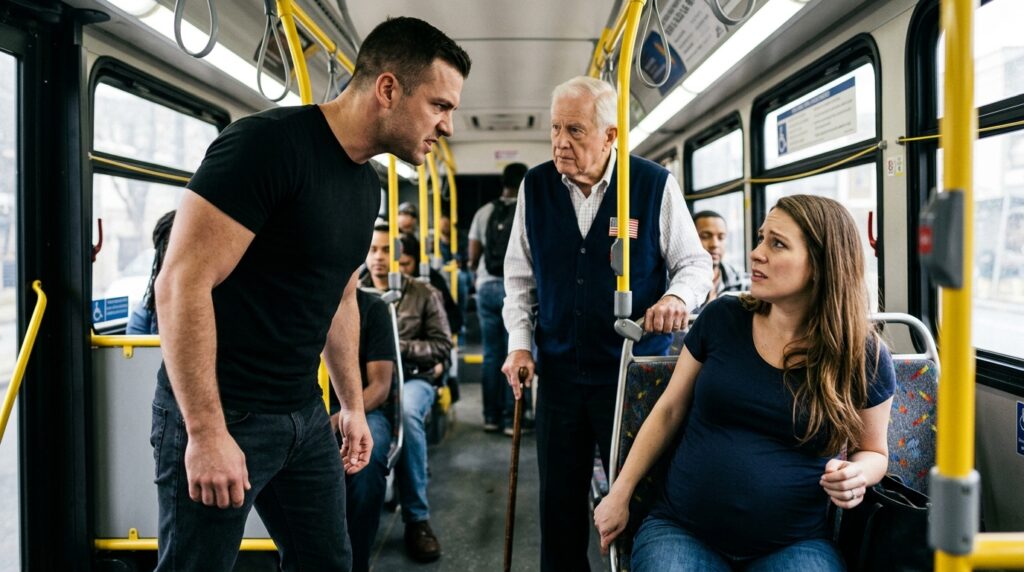
The phone hadn’t been dropped by a panicked bully during a random transit altercation. The bully hadn’t run because he was outmatched. The entire bus route—the aggressive passenger, the pregnant woman, the passive onlookers staring into their screens—had been an engineered stage. A highly structured, high-pressure environmental simulator deployed in a public sector to force Marcus to execute a specific, signature defensive response that could only be linked to one living man.
“Data packet is clear,” the female technician said, her face illuminated by the desaturated blue glare of her monitor. She didn’t look up. “He used the Third Protocol wrist-lock redirection at index mark forty-two. Reaction time was five-point-eight seconds. It’s him. The identity is confirmed.”
The lead operative stepped into the van, his shadow completely cutting off the street light from the alleyway. He pulled a black, compressed-gas cylinder syringe from his utility belt, the needle tip gleaming under the low-voltage interior light of the vehicle.
“You survived twenty-four years because we let the file stay cold, Marcus,” the operative said softly, his thumb resting against the cylinder’s activation valve. “But the procurement office needed to know if the asset’s mechanical reflexes were still operational before they opened the new theater. You’re not being eliminated because you’re old. You’re being brought back into rotation.”
Marcus looked past the needle, his remaining clear sight focusing on the technician’s screen. Beneath his data logs, an administrative command line was running an automated personnel transfer protocol. The text didn’t read TERMINATION ORDER.
It read: RE-ACTIVATION SEQUENCE INITIATED. TARGET ASSET M7-V7 RE-ASSIGNED TO DOMESTIC CONTAINMENT SERVICES.
The old veteran didn’t answer. He didn’t claw for the operative’s throat. He let his head drop back against the hard metal, his left fingers quietly sliding down to the split seam of his vest pocket where a tiny, embedded silver tracking filament—the secondary backup anchor he had carried since his deployment in Berlin—remained completely untouched by the search.
The operative brought the syringe down toward the soft tissue of Marcus’s neck. As the needle broke the skin, a low, mechanical tone began to loop from the diagnostic station’s central console, signaling a new, unlisted transmission breaking into the van’s private network from a completely different sector of the city.








