CHAPTER 8: THE STABILITY OF THE PERMANENT BASELINE
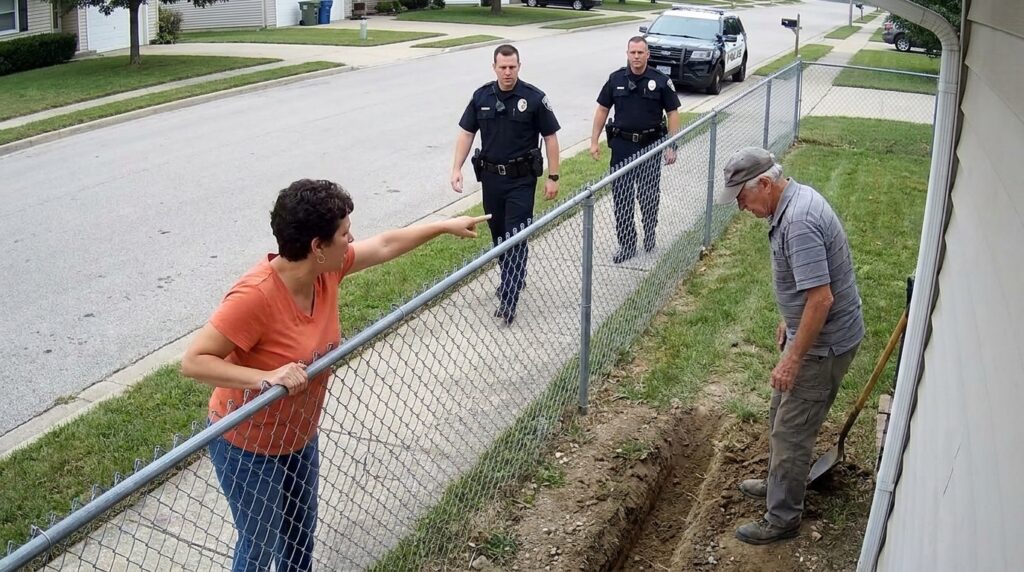
“Arthur, leave the trench alone until the structural remediation team arrives with the shoring timbers,” Officer Miller said, his boots crunching heavily in the dry gravel as he hitched his utility belt. The yellow citation sheet he had wedged into the chain-link mesh was already curling under the dry, heat-sunk breeze, its carbon backing graying out.
Arthur didn’t drop his arms. He stood on the edge of the slump, his boots inches from the red barrier tape that Hendricks had strung between the foundations. His gray ball cap was pulled low, casting a sharp shadow over his lined face. “The mud is slipping into the lateral tile, Miller. If I don’t clear the intake before the city truck backs out, the sludge is going to plug my drain line down to the cellar sump.”
He turned his back on the street. He didn’t look at Evelyn as she retreated across her lawn, her neon orange shirt disappearing behind her front screen door with a dull, aluminum slap that sounded hollow against the massive void below her porch stairs. The neighborhood watchers across the asphalt had begun to tuck their phones away, their tracking lenses lowering as the flashing amber strobes of the public works flatbed shifted into low gear, the diesel roar receding down Elm Street toward the main highway.
Arthur stepped back down into the trench. The water had fallen below his ankles now, leaving a thick, greasy layer of silt over the limestone shelf. He took the steel-bladed spade shovel by its worn wood handle, his palm sliding down the oil-darkened ash until his thumb caught on the grain. The iron blade was cold, heavy with a coat of wet gray clay. He set the tread against the edge of the slumping bank and drove his boot heel down.
The metal bit into the earth with a wet, heavy clunk.
Time slowed down to the simple mechanics of friction and weight. Every muscle in Arthur’s back tracked the leverage as he hoisted the first load of wet topsoil, throwing it neatly onto the blue tarp. The heat off the bungalow walls was intense, but beneath the mud, the ancient bedrock felt like iron. He could see the red granite benchmark stone clearly now. The water had drained completely off its top face, leaving the chiseled crosshair centered inside its circle—stark, unpolished, and completely unmoved by the chaos that had just torn through the perimeter wire.
He looked across the two-foot gap where Evelyn’s fence had pulled away from its posts. The zinc links were warped, hanging like torn webbing above the exposed horizontal well casing. The true county zero-point didn’t care about the thirty years of domestic vigilance she had spent enforcing her borders; it didn’t care about the mortgage papers or the manicured sod. It was just a mark in the rock, set by a man with an iron transit seventy-four years ago, but it held the entire block in an unyielding geometric grip.
Arthur drove the shovel into the clay again. His pulse was slow, synchronized with the dull, rhythmic vibration of the soil as it settled into its new orientation. The border hadn’t just been defended; it had been re-established by the physical constants of the valley. He had spent his whole life watching things wear out—valves leaking, gaskets blowing, boundaries sliding into decay under the weight of human neglect. But here, six inches below the surface of the yard, the baseline remained unbroken.
He cleared the last handful of gravel from the French drain intake, letting the pipe clear its throat with a low, gurgling sigh. The air between the bungalows was quiet now, smelling of wet earth and turned stone. Arthur didn’t look up at the empty porch across the wire. He simply lifted the spade, wiped the steel blade clean with a handful of parched grass, and stood his ground on the dirt he actually owned.