
CHAPTER 1: THE ACCORDION OF THE PERIMETER
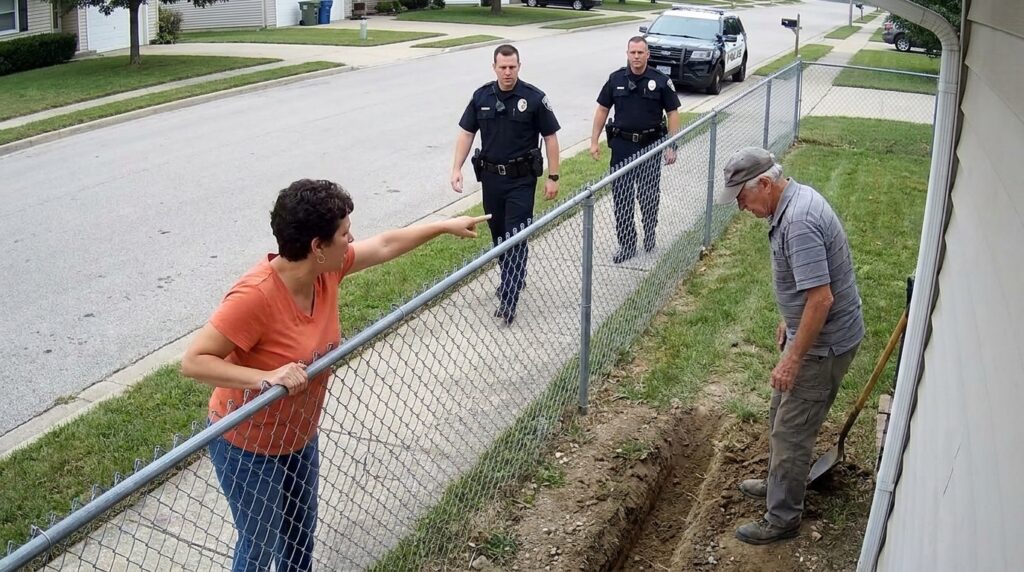
The spade split a dry root with a short, metallic snap that vibration traveled right through Arthur’s calloused palms, but he didn’t look up until the heavy door of the Ford Interceptor clicked open at the curb. The heat off the asphalt was thick, smelling of old oil and parched Kentucky bluegrass. He kept his boots planted four inches down in the fresh, narrow trench, his weight resting squarely on the iron tread of the shovel.
“Sir, put the shovel down and step back from the fence.”
The voice belonged to the stocky one. A primary responder with a wide utility belt that creaked like dry leather every time he shifted his heels in the loose gravel of the driveway. Behind him, the second officer already had his boots spread wide near the bumper, a bald head catching the harsh glare of the midwestern afternoon sun.
Arthur didn’t drop the spade. He lowered it slowly, letting the steel blade rasp against the exposed limestone shelf at the bottom of the cut earth. He kept his hands resting on the worn ash handle, his gray ball cap tilted just enough to shield his eyes from the glare.
“You cannot just come onto my side and start digging there,” Evelyn yelled from behind the wire. Her knuckles were white where they hooked into the zinc-coated chain-link mesh. The bright orange of her T-shirt looked violent against the parched yellow lawn. Her index finger was extended, rigid, thrust through one of the diamond gaps in the fence like a small stake. “I told you three times, Artie. This easement is flagged. You’re undermining my foundation.”
Arthur looked at the finger, then at the stocky officer. His internal clock counted the seconds by the steady tick-tick of the idling cruiser twenty feet away. He had spent forty years maintaining diesel generators in places where an incorrect measurement meant three blocks went dark; he knew exactly how much dirt he had moved. Exactly eleven cubic feet. All of it stayed on the west side of the wire.
“He’s been out here since six AM,” Evelyn continued, her voice rising to a sharp, thin register that made the bald officer glance toward the front porch blinds across the street. “Just hacking away at the line. I have the property description from my closing paperwork right inside.”
The stocky officer didn’t look at her paper. He stepped into the interaction lane between the two bungalows, his eyes fixed on the small mound of dark topsoil Arthur had piled neatly on a blue tarp. “Ma’am, let me talk to the gentleman. Sir, I asked you to step out of the excavation.”
“It’s a French drain, son,” Arthur said. His voice was sparse, dried out by age and tobacco, but it didn’t shake. He didn’t use her name. He kept his eyes on the officer’s tactical vest, checking the nameplate. Miller. “Three-quarter inch washed river stone. If I don’t lay the pipe before Tuesday’s storm, her patio runoff is going to take another half-inch of my cellar wall with it.”
“We aren’t here to grade the masonry, sir,” Officer Miller said. He stepped closer, his boot heel coming down on a fresh survey string Arthur had pinned between two iron spikes. The string went taut, singing a low note. “We have a complaint of criminal trespass and property damage. Step up onto the grass.”
Arthur felt the weight of his seventy years in the hinge of his left knee as he hoisted himself out of the trench. His work pants were caked with dark gray clay at the shins. He reached into his back pocket, his fingers tracking the smooth, sweat-stained plastic of the city permit folder. But as his hand cleared the denim, his thumb caught on something else down in the ditch—a dull, green-crusted edge of old brass that hadn’t been there when he cleared the sod three hours ago. It was an old municipal tap casing, completely flattened by the shifting weight of the earth above it.
“He’s reaching for something,” Evelyn barked, her body slamming harder against the fence until the posts groaned in their concrete footings.
Arthur stopped, his hand still inside the pocket, his eyes locked on the green metal protruding from the bottom of his trench. The orientation was completely wrong. If that valve belonged to the city main, the entire line of the fence was running dead through a public right-of-way.








