CHAPTER 4: THE SUBTERRANEAN VOID
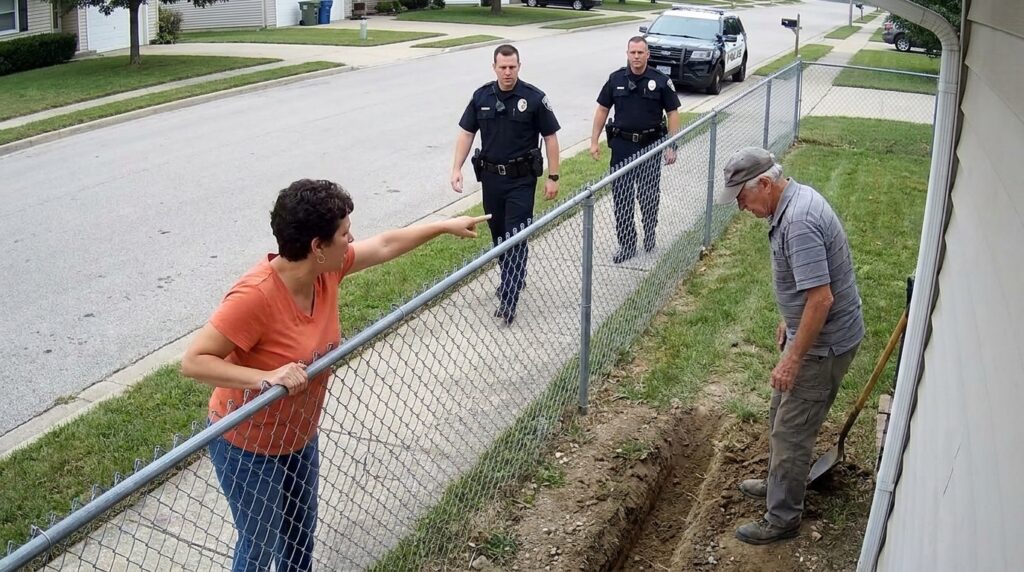
A sharp, hollow crack split the air between the two bungalows, distinct and heavy enough to vibrate through the soles of Arthur’s work boots. It didn’t come from the sky, and it didn’t come from the chain-link fence. The sound came from directly beneath the northern edge of Evelyn’s aggregate patio slab.
Arthur stayed down, his palms pressing flat against the exposed grass strip as the earth beneath the wire gave a microscopic shudder. The narrow fissure he had been watching near the trowel tip suddenly widened by a half-inch, swallowing a loose handful of dry limestone gravel with a soft, subterranean hiss. The oily, iridescent sheen on the mud grew thicker, bubbling as the pressure inside the trench began to vent.
“Get back from there, Miller,” Hendricks said, his broad hand reaching out to grab his partner’s shoulder vest, hauling the stocky officer back onto the dry gravel of Arthur’s driveway. “The soil’s slumping under the post footing. Look at the fence line.”
The galvanized steel post right beside the buried red granite block tilted three degrees to the west, its zinc links groaning as they went taut under the sudden displacement of weight. Evelyn didn’t jump back. She froze, her white knuckles still wrapped around the wire, though her sneakers slipped an inch into the widening patch of damp, spongy turf on her side of the line. Her gaze remained pinned to the chiseled markings on the granite stone, her mouth slightly open, showing the rigid line of her teeth.
“It’s just settling,” she said, her voice dropping into a tight, defensive rumble that lacked any of her previous volume. She looked across the boundary at Arthur, her eyes tracking the grey mud caked onto his knuckles. “The house has been here for nearly thirty years, Artie. It’s not going anywhere because you dug a two-foot ditch. You’re causing this. Your excavation is pulling the lateral support away from my foundation.”
“The ditch didn’t crush the isolation valve, Evelyn,” Arthur said. He stood up slowly, the joint of his bad knee giving a dull, familiar click. He wiped his hands on the sides of his trousers, the dried clay leaving long, chalky streaks across the fabric. “That nineteen-seventy-four main bypass has been weeping into the subgrade since the frost broke in March. Every gallon of your unpermitted concrete pour loaded another three hundred pounds onto an unmapped joint. The water didn’t have anywhere to go but into my cellar wall.”
Officer Miller didn’t look at either of them. He kept his shoulder mic held close to his jaw, his thumb tightening on the transmission toggle as a low hiss of static cut through the afternoon heat. “Dispatch, upgrade that utility request to an emergency main isolation. We have an active sinkhole forming along the property line between forty-four twelve and forty-four fourteen Elm. Structural integrity of an adjacent slab is compromised. Tell the public works crew to bypass the residential shut-off and drop the gate valve at the corner of Orchard Lane.”
“You can’t touch that valve,” Evelyn said, her voice rising again, catching on a sharp breath as she pointed toward the driveway entrance where the police SUV sat idling. “If they shut off the block main, my salon clients can’t wash out their treatments. I’m running a licensed business out of my basement suite, Miller. The county clerk verified my occupancy code last winter.”
Arthur took a step closer to his trench, his eyes tracing the line where the wet clay met the raw, unpolished edge of the red granite benchmark. The stone hadn’t Budged. Even with the soil slumping around its base, the old chiseled crosshair remained perfectly level, anchored deep into the limestone shelf below the topsoil. It was the only stable object between the two houses, a permanent piece of history that refused to yield to the weight of the encroaching development.
But as the flashlight beam from Hendricks’s hand flickered over the widening gap under the fence footing, Arthur noticed a secondary layer of iron emerging from the deep shadow beneath Evelyn’s patio edge. It wasn’t part of the 1974 water valve. It was an old, rusted iron pipe cap—the kind used by industrial drillers to seal off abandoned natural gas test wells back in the late fifties. The cap was welded directly to a heavy steel casing that disappeared horizontally under Evelyn’s living room foundation.
“Miller,” Arthur said, his hand reaching out to tap the officer’s sleeve, his voice dropping into the sparse, transactional cadence he used when an engine block showed an unmapped fracture. “Look under the lip of her slab. Behind the water lead.”
The stocky officer leaned forward again, his hand resting on the grip of his utility belt to keep his gear from dragging in the wet silt. He squinted into the dark, hollow space where the earth had cleared away. The yellow beam from Hendricks’s light highlighted the rough, flaked surface of the iron cap.
“That’s a four-inch high-pressure casing,” Miller muttered, his brow furrowing as he compared the physical metal with the blue sheets inside Arthur’s yellowed permit folder. “That’s not listed on the township utility overlay. Hendricks, check the seventy-four master map description again. Does the county road easement mention an industrial testing line?”
The bald officer flipped through the brittle, cross-hatched pages held against his clipboard, his thumb tracking the margin notes written in faded red ink by a long-dead surveyor. He stopped at the bottom of the third page, his eyes widening slightly as he read the handwritten addendum.
“No,” Hendricks said, his voice flat, stripped of its authoritative edge. He looked up from the paper, his gaze moving past the fence, past Evelyn’s orange T-shirt, directly toward the center of her front porch. “The seventy-four map says the line was abandoned because the entire block layout was shifted forty feet north during the highway expansion. Artie… the benchmark stone down there isn’t just marking your side yard. It’s the zero-point anchor for the old section line. If this stone is where the county says it is, the entire property line doesn’t run down the fence.”
Evelyn’s fingers finally loosed their grip on the chain-link mesh. She took a half-step back, her sneakers leaving two deep, wet impressions in the soft turf. “What are you talking about? The line is right here. The developer put the fence up on the original pins.”
“The pins were wrong, ma’am,” Miller said, his tone shifting from clinical to grim as he tucked Arthur’s folder securely under his arm. “According to this historical section note, the builder used the highway stakes instead of the geological benchmark. This stone down here is the true legal boundary. And if the crosshair is centered…”
He didn’t finish the thought. A low, rhythmic rumbling started down at the end of Elm Street—the heavy, diesel vibration of a public works utility truck turning the corner with its yellow strobe lights flashing against the suburban treetops. The ground beneath the trench gave another soft, wet sigh, and the green brass rim of the crushed 1974 valve sank another two inches into the dark, rising water.