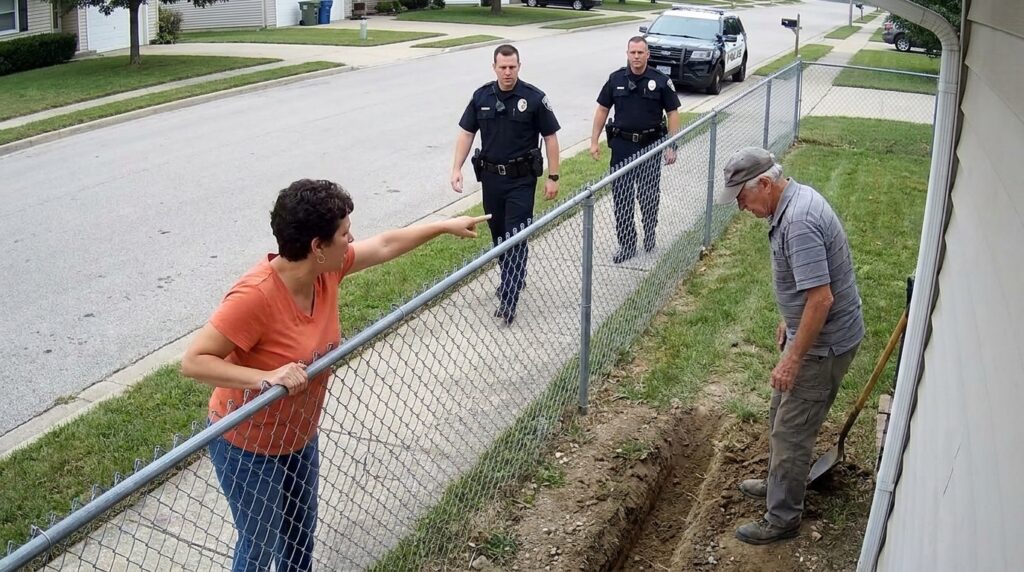
CHAPTER 5: THE UNRAVELING GRID
“Unfold the bottom sheet, Miller,” Hendricks said, his throat dry as he pressed his thumb against the heavy spring of his clipboard. The metal gate snapped down with a sharp, iron report that caused a nesting sparrow to bolt from Evelyn’s gutters. “Not the ninety-four revision. Go back to the seventy-four master plot. Look at the coordinates for the county meridian.”
Officer Miller didn’t look back at the street, even as the heavy diesel brakes of the public works flatbed squealed forty yards away, their rhythm vibrating down through the limestone ridge. His fingers, gray with the fine silt of Arthur’s trench, unclipped the bottom-most vellum map from the weather-beaten folder. The old blueprint gave a crisp, brittle crackle as it caught the hot midday breeze, shedding forty years of dried starch and chalky blue dust onto the yellowed grass.
“Hold that corner,” Miller muttered, his boot scraping against an exposed tree root as he dropped his weight to match Arthur’s stance.
Arthur leaned over the paper, his shadow obscuring the tightly packed ink annotations. His thumb, still rough from forty years of industrial maintenance, pinned the left margin where the original township surveyor had signed his name in faded iron-gall script. “The baseline doesn’t start at the curb line, son. Look at the offset note from seventy-four. The county surveyor used the old railway grade as his primary marker before the concrete highway tore through Block C.”
“This is ridiculous,” Evelyn said, her voice jagged as she paced the two-foot strip of surviving grass on her side of the wire. The bright floral pattern of her blouse looked incongruous against the rising cloud of gray dust. “You’re reading old garbage. The building department issued my occupancy permit based on the eighty-eight plan. My patio isn’t an encroachment if the city inspector signed off on the footer layout.”
“He signed off on a plan that didn’t include the Geological Survey stone, ma’am,” Hendricks said, his broad frame blocking her path at the fence line. He pointed a thick finger down into the hollow where the chiseled granite crosshair caught the direct glare of the sun. “Look at the ink on this seventy-four grid. The whole block—every lot from forty-four-ten down to forty-four-twenty—was shifted forty feet north to clear the state highway easement during construction. But the builder’s crew didn’t measure from the stone. They measured from the new asphalt curb.”
Arthur felt the air go completely still between the two houses. It was a specific kind of silence he had learned to recognize during his years in the service—the cold, dead space that opens up right before a heavy flywheel shears its mounting bolts. “If they used the curb as the zero-point, Miller, the entire grid drifted.”
“It drifted exactly twenty-four inches,” Miller said, his voice flat, completely stripped of its professional neutrality as his eyes tracked the blue lines against the physical dirt. He looked up from the vellum, his gaze cutting straight through the chain-link mesh toward the neat, vinyl-sided corner of Evelyn’s house. “The error didn’t stop at the driveway, ma’am. It carried right through the foundation.”
“Don’t look at my house,” Evelyn hissed, her fingers dropping into the pockets of her blue jeans, her shoulders hunching as if she could physically shield the building from the officer’s calculation. “My house is standard construction. The bank held the escrow until the boundary survey cleared. You’re telling me the bank didn’t check their own collateral?”
“Banks don’t dig for markers, Evelyn,” Arthur said, his hand dropping back onto the ash handle of his spade. The wood was warm, greasy with his own sweat. “They trust the stamp on the plate. But the dirt doesn’t care about a notary public. That stone down there has been sitting right where the federal government put it since nineteen fifty-two, and it says my property line doesn’t end at this wire. It ends two feet inside your basement stairs.”
“No,” she said, her head shaking in a tight, rapid circle that caused her sunglasses to slip down her nose. “No, that’s not how this works. Adverse possession. I’ve been using this yard since ninety-eight. I’ve mowed every inch up to this fence line for twenty-eight years. You can’t just dig up a rock and tell me I don’t own my own house.”
Officer Miller stood up slowly, the brittle vellum paper rattling in his grip as he folded it back into the plastic sleeve. “Adverse possession requires an open, hostile claim against a known border, ma’am. It doesn’t apply when the boundary itself was obscured by an institutional mapping error. And it definitely doesn’t protect a structure that’s actively crushing a high-pressure municipal main.”
Behind them, the low rumble of the public works flatbed stopped. Two men in neon yellow vests stepped off the running boards, their heavy leather work boots crunching in the gravel as they carried an six-foot steel T-wrench toward the water box at the curb. The leader—a man with a thick gray beard and the tired eyes of someone who spent forty winters in utility trenches—looked down into the side yard, his gaze tracing the tilted fence and the dark, bubbling pool of iridescent water around Arthur’s boots.
“We got a drop in line pressure down at forty-four-twenty,” the utility worker shouted, his voice carrying the flat, transactional weight of a civil emergency. “The gate valve at the corner is showing an eleven-pound deficit. Miller, is that the main bypass leaking under the slab?”
Arthur looked down at the chiseled crosshair on the granite block. The stone remained perfectly rigid, but the dark earth on Evelyn’s side of the wire was beginning to slough away in large, greasy chunks, revealing the raw, unpolished underside of her four-inch concrete patio slab. The void beneath her foundation wasn’t a hidden secret anymore; it was an open, muddy maw, steadily widening with every gallon of pressurized water that tore through the fractured iron casing below.