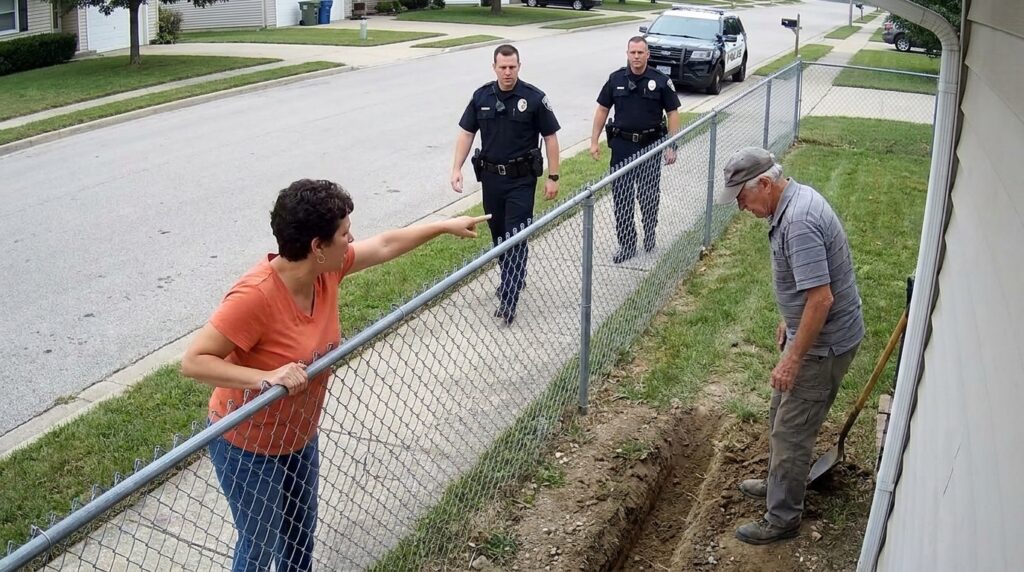
CHAPTER 2: THE FRICTION OF THE RESTRAINT
“Keep your hand out of your pocket, sir,” Officer Miller said, his palm dropping automatically to the hard polymer butt of his Glock. The utility fabric of his vest made a sharp, synthetic scratch against his uniform shirt. “Slowly.”
Arthur didn’t pull his hand back. He simply kept his fingers anchored to the heavy municipal permit folder, his thumb pressing into the sweat-softened cardboard. His gaze remained downward, tracking the sharp angle where the dry clay sloped away from the green-crusted brass rim. The metal was stamped with a faded number—74—barely legible beneath the oxidation and the packed silt. It wasn’t standard residential copper. It was thick-walled water district iron, the kind meant to bear four hundred pounds of pressure per square inch before the county lines divided the valley into quarter-acre lots.
“The folder’s in my right pocket, Officer,” Arthur said, his voice flat, retaining the gray, unhurried cadence of a man who spent his life waiting for engines to cool down before adjusting the valves. “I’m pulling it out now. No sudden moves.”
He extracted the yellowed plastic sleeve with two fingers. The corner was split, held together by a strip of gray duct tape that had dried out and turned brittle at the edges. He didn’t offer it forward; he held it close to his thigh, letting the wind catch the edge of the blue layout paper inside.
Behind the chain-link mesh, Evelyn’s sneakers squeaked against the sun-baked dirt as she shifted her weight, her floral blouse rustling with every jagged breath. “Don’t look at his papers, Miller. He probably drew those himself. He’s been encroaching on my property line since he put up that detached garage five years ago. He thinks because he’s old, the rules don’t apply to him.”
The bald officer—the one whose name tape read Hendricks—stepped closer to the fence line, his broad chest nearly touching the zinc wire. He looked down into the trench, his shadow falling across the exposed brass valve like a cold tarp. “Artie, is it? You said you’re laying river stone?”
“French drain,” Arthur muttered, pointing the tip of his boot toward the limestone shelf. “Evelyn’s patio slab has a four-inch pitch toward my foundation. Every time the rain comes off her roof, it pools right against my sill plate. Look at the mud under that bottom wire. That’s her runoff, not mine.”
“It’s my easement!” Evelyn snapped, her fingernails scraping the galvanized coating of the fence with a dry, metallic screech. “The developer told me when I bought the place in ninety-eight that everything within five feet of the line belongs to the drainage grid for Block C. You’re digging in the public right-of-way, Artie. That’s a county violation.”
Officer Miller took the folder from Arthur’s hand. The paper inside crackled as his thick fingers unfolded the 1994 municipal infrastructure layout. His eyes scanned the blue lines, his brow furrowing as he tracked the cross-hatched boundary sectors. “This is a valid residential utility waiver, ma’am. Stamped by the clerk’s office three weeks ago.”
“I don’t care what his stamp says,” Evelyn said, her voice dropping into a hard, transactional hiss. “He’s undermining the grading. If my concrete cracks because he’s digging a ditch three inches from the post, he’s paying for the replacement. I’ve already called code enforcement. They’re sending an inspector out on Monday.”
“Monday’s too late,” Arthur said, his eyes still fixed on that buried green rim. The friction of the earth had shifted it slightly over the winter; he could see the tiny hairline fracture where the lead solder met the iron pipe casing. It was directly beneath the outer edge of Evelyn’s unpermitted concrete slab. Every pound of her heavy patio was bearing down on a pipe that hadn’t been mapped since the Carter administration. “You want to talk about concrete, Evelyn? Look at the bottom of the cut.”
Officer Miller lowered the paper, his eyes following the line of Arthur’s boot. The bald officer, Hendricks, took a small flashlight from his vest, clicking the beam onto the dark silt inside the trench. The yellow light danced across the rusted iron flange.
“What is that?” Hendricks asked, his voice losing its authoritative edge, replaced by the mechanical curiosity of a city employee who recognizes a problem that involves public works. “That looks like an old main bypass.”
“It’s a nineteen-seventy-four isolation valve,” Arthur said, his thumb tracking the edge of his faded ball cap. “The whole sector used to be an orchard before they laid the asphalt. If that’s the main bypass, Evelyn, your entire concrete patio isn’t just on the line. It’s sitting dead-center on top of the municipal high-pressure feed.”
Evelyn’s hand dropped from the wire. Her face didn’t soften; it hardened, the skin around her jaw tightening until the tendons looked like thin cords under her tanned skin. “That’s ridiculous. The patio was poured by licensed contractors. They cleared it with the county.”
“There’s no easement code listed on your title for a concrete pour, ma’am,” Miller said, his tone shifting as he looked back at the blue sheets in his hand, then at the physical layout of the bungalows. The two houses sat less than fourteen feet apart, a narrow strip of gray gravel and scorched grass separating their destinies. “If this pipe is active, nobody should have poured four inches of reinforced aggregate over it.”
Arthur knelt down in the grass, the dry blades pricking through his work pants as he reached down to clear a handful of loose stones from the valve rim. The grit was hot, catching under his fingernails as he worked. He could feel the faint, rhythmic thrumming of water moving under immense pressure through the iron beneath his knuckles—a deep, industrial pulse that had nothing to do with residential plumbing.
But as his fingers cleared the final layer of silt near the fence post, his knuckles struck something else. Not iron. Not brass. A smooth, square block of red granite buried six inches deeper than the valve, completely hidden behind the concrete footings of Evelyn’s fence line.
Arthur stopped, his fingers freezing in the dirt. He knew that stone. Every old township map from the standard geological survey used red granite blocks to mark the zero-point baseline for the county section lines. And this block was sitting a full twenty-four inches onto his side of the wire.
“Miller,” Hendricks said, his flashlight beam dropping lower into the hole, highlighting the clean, machined edge of the granite. “Look at the marker.”
The stocky officer stepped forward, the gravel crunching under his soles as the silence between the two houses became heavy, broken only by the distant hum of a lawnmower three blocks over. Evelyn didn’t move; her eyes were fixed on the square red stone emerging from the dark earth like an old tooth.