CHAPTER 3: THE CHISELED GEOMETRY OF MALICE
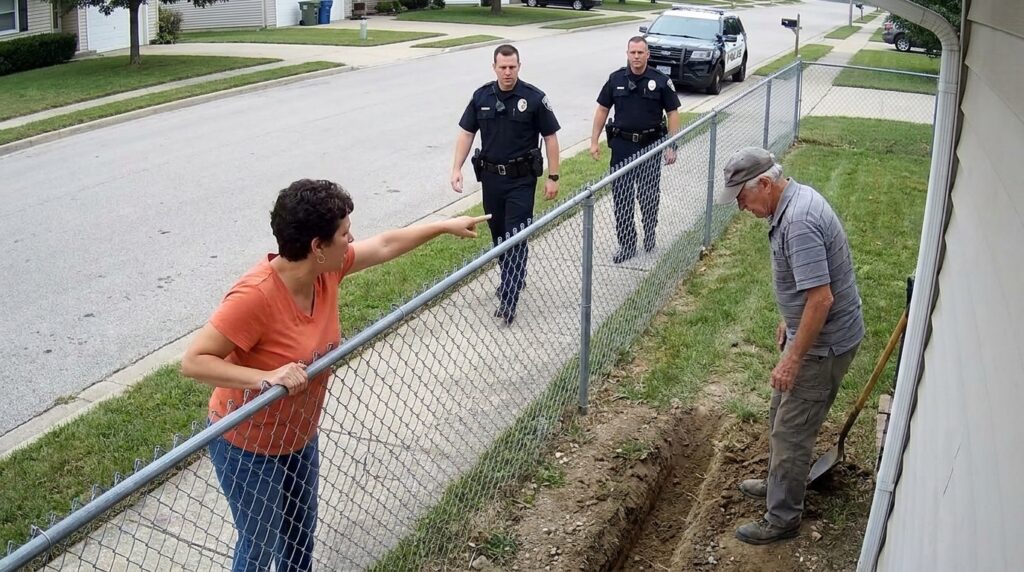
Arthur didn’t use his fingers anymore. The gray, sandy soil beneath the chain-link fence was mixed with sharp limestone aggregate that had already torn a thin line of red across his thumb, so he used the flat tip of a steel trowel he pulled from his side pocket. The tool made a dry, rhythmic scritch-scritch against the side of the red granite block. The stone was cold, maintaining the temperature of deep groundwater despite the mid-afternoon heat beating down on his neck.
“Move back from that footing, Artie,” Evelyn said, but the sharp, commanding edge in her voice had lost its anchor. Her body remained pressed against the zinc mesh, but she had shifted her grip downward, her fingers hooking lower into the links as if her center of gravity had dropped two inches. “Miller, he’s messing with the structural support of my fence line. He’s deliberately trying to destabilize the posts.”
Officer Miller didn’t look up from the spot. He knelt on one knee in the yellowed weeds of the side yard, his black uniform fabric straining against his thighs. The heavy utility vest shifted up toward his chin as he leaned down into the narrow trench. “Hendricks, give me that beam again.”
The bald officer clicked the light back on, the narrow circle of high-intensity white glare cutting across the dark hollow. The illumination settled on the top face of the granite block. There, deeply etched into the stone and filled with forty years of packed black silt, was a chiseled crosshair centered within a circle, flanked by the letters U.S.G.S. BM 412.
“That’s a Geological Survey benchmark,” Arthur said, his hand remaining steady as he wiped the remaining grit away with the sleeve of his striped polo. The fabric was coarse, scraping over the raw stone. “The township surveyor set these every half-mile back when the whole ridge was nothing but timber and gravel pits. It’s the baseline anchor for the entire block grid. If this stone is here, Evelyn, your fence isn’t just two feet over. Your entire concrete driveway is sitting on county right-of-way land.”
“That’s a lie,” she said, but her voice didn’t rise this time. It flattened out, becoming thin and defensive. Her gaze flicked toward the front of her house, toward the wide, smooth sweep of gray aggregate that ran from the street all the way down the narrow lane between their foundations. “The builder had the layout verified by the title company in ninety-eight. I paid four thousand dollars for the title insurance policy alone. They don’t make mistakes like that.”
“Builders don’t look for stones, ma’am,” Officer Miller said, his tone dropping into the objective, clinical register of a state trooper examining a skid mark. He reached into Arthur’s yellowed permit folder, pulling out the secondary document—a municipal right-of-way easement description from 1974. His fingers traced the faded type. “They look at the iron pins left by the last crew. And if the pins were pulled during the grading…”
He didn’t finish the sentence. He stood up slowly, his joints popping with a dry, mechanical sound that seemed to mimic the ticking of the cruiser’s engine at the curb. He looked down the line of the fence, tracing the long, slightly warped run of the wire toward the backyard gate.
Arthur watched the officer’s eyes. He knew exactly what Miller was calculating. The fence wasn’t straight. It had a subtle, nearly imperceptible three-degree belly that bowed inward toward Arthur’s property line, right where Evelyn’s unpermitted concrete patio slab reached its thickest point. The heavy, four-inch-thick mass of aggregate didn’t stop at her back door; it extended like a gray tongue right down to the edge of the wire, its weight pressing against the galvanized posts.
“Look here,” Arthur pointed the trowel tip toward the base of the fence post nearest the green-crusted brass valve. The dark clay was damp there, stained with an oily, iridescent sheen that smelled faintly of old iron and stagnation. “The soil’s giving way because the valve under her slab is leaking. The weight of that unpermitted pour has been crushing the main copper line since last July. That’s why my cellar wall is sweating. It’s not ground moisture, Miller. It’s city water under sixty pounds of pressure, looking for an exit.”
Hendricks stepped around the post, his boots sinking slightly into the soft, spongy sod on Evelyn’s side of the line. He kicked at a tuft of crabgrass near the concrete edge. A tiny, circular bubble of gray water rose from the dirt, popped, and sank back into the silt. “Miller. We’ve got an infrastructure breach here. This isn’t just a boundary dispute.”
“Get off my grass,” Evelyn said, her arm snapping back through the fence link, her fingers curling into a tight fist against her hip. Her orange shirt was damp at the collar now, the heat finally breaking through her composure. “You don’t have a warrant to be on my property, Hendricks. This is a civil matter. My lawyer told me last year that if the city wants to look at the drainage, they have to notify me thirty days in advance by registered mail.”
“Not for an active utility line rupture, ma’am,” Miller said, his hand moving to his shoulder mic with a slow, deliberate motion that carried the full weight of county authority. He clicked the toggle. “Dispatch, this is Unit Twelve. We need a supervisor from public works out at forty-four twelve Elm Street. Active main leak under an unpermitted residential structure. And dispatch—tell them to bring the historical section maps from seventy-four. We’ve got a benchmark discrepancy at the boundary.”
Arthur stayed on his knees, his hands resting on his thighs as he looked at the green valve edge. The deep, rhythmic thrumming through the iron seemed louder now, an industrial heartbeat buried under four inches of illegal concrete, steadily wearing away the earth beneath their feet. He could see a tiny fissure in the clay right near his trowel tip—a dark, widening gap where the dry topsoil was being pulled downward into the hollow below.