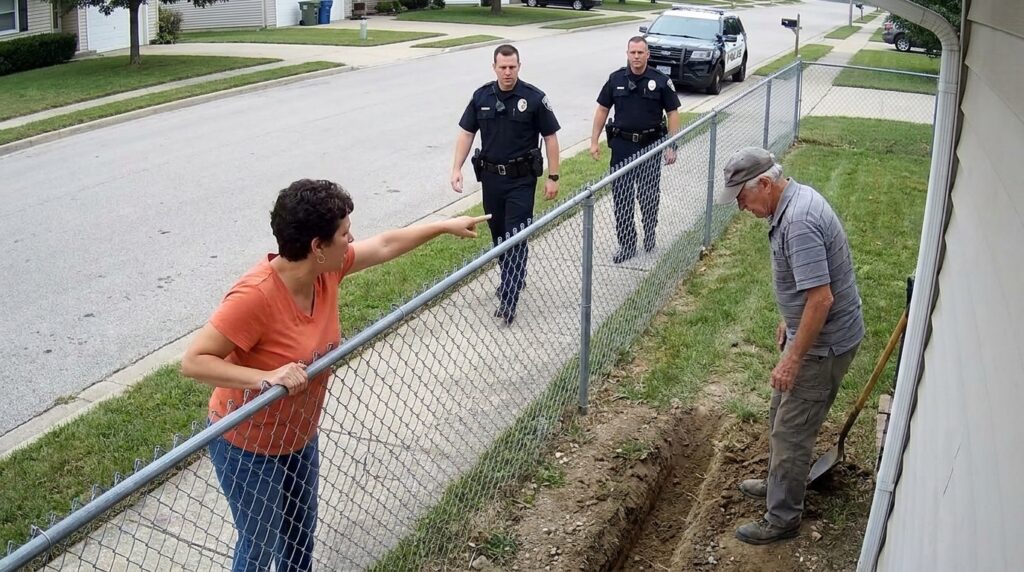
CHAPTER 6: THE SHEAR OF THE SOVEREIGN FLANGE
The iron main didn’t just leak anymore; it tore. A deep, guttural thump vibrated through the floor of Arthur’s trench as the lead-solder seal on the 1974 isolation valve finally sheared under the concentrated torque of the shifting fence post. Instantly, the bubbling puddle at his feet turned into a violent, churning upwelling of gray, gravel-choked water that rose three inches up his shins in less than four seconds.
“Hendricks, clear the lane!” Miller shouted, his leather belt creaking as he lunged across the survey string to grab Arthur by the elbow. The stocky officer’s boots slid in the sudden slick of clay, his shoulder pinning Arthur against the dry siding of his own garage as the ground beneath the chain-link fence line simply went hollow.
Arthur didn’t panic, but his fingers clamped tight around the ash handle of his spade, using the iron blade as an anchor against the shifting bank. He watched the red granite benchmark stone. The block remained level, but the six feet of gray topsoil on Evelyn’s side of the line suffered a massive structural collapse. With a wet, heavy suction sound, the entire earthen ledge vanished down into the four-foot void created by the leaking main, leaving the outer edge of her concrete patio slab hanging completely in midair like a gray tooth.
“My slab!” Evelyn screamed. She didn’t drop back toward her porch; she moved sideways along the remaining strip of sod, her fingernails clawing at the air as if she could manually hold the aggregate together. A long, jagged fracture line—as wide as a man’s thumb—snapped across the center of her patio with a dry, concrete report that sounded like a rifle shot. “Miller, stop him! He’s undermining the house! The whole foundation is going to slide into his ditch!”
“Get back on your porch, ma’am!” Officer Miller roared, his voice cutting through the high-pressure hiss of the venting water main. He kept his left hand clamped on Arthur’s arm, hauling the old veteran out of the collapsing trench and onto the hard, stable gravel of the driveway. “The subgrade is completely washed out under your footings. The public works crew needs to drop the gate valve now!”
At the curb, the two utility workers didn’t wait for a formal order. The grey-bearded leader had already slammed the six-foot steel T-wrench down through the iron street grate, his shoulders twisting with heavy, mechanical strain as he fought forty years of rust inside the municipal line valve. “It’s not turning, Miller! The packing nut is seized! We need a breaker bar from the truck or the whole block pressure is going to blow right through this lateral line!”
Arthur wiped a spray of gritty mud from his chin with the back of his hand. He looked down into the crater forming between the bungalows. The rising water was swirling around the old four-inch industrial gas casing he had spotted earlier—the one that disappeared horizontally under Evelyn’s living room foundation. The rusted cap was vibrating now, a low, metallic ring traveling down its length that had nothing to do with water pressure.
“The main’s not just hitting the dirt, Miller,” Arthur said, his voice remaining sparse and hard despite the spray of muddy brine hitting his boots. He pointed the iron tip of his spade toward the vibrating casing. “The water’s jetting dead-center against that fifty-eight gas sleeve. If that old well-cap sheers off under the hydraulic force, we aren’t just looking at a flooded cellar. We’re looking at forty years of pockets of sour gas venting right next to her furnace pilot.”
The bald officer, Hendricks, froze, his flashlight beam dropping onto the iron cap. The metal was flaking away in large, dark scabs under the impact of the pressurized water. “Miller… look at the meter box on her wall. It’s rattling.”
Evelyn stopped her pacing. Her face turned a dull, chalky white that made the bright orange of her shirt look like a warning flag. She looked down at the exposed horizontal casing, then back at Arthur’s old, unyielding face under the gray cap. “That’s an old line. The builder said it was dead. They told me when they laid the basement floor that everything below the slab was solid limestone.”
“They lied to you, Evelyn,” Arthur said, his hand tightening on the spade until the wood groaned against his calluses. “They used the old survey stakes from the highway expansion because it saved them three thousand dollars in excavation costs. They poured your living room over a county zero-point and an active utility right-of-way. Your whole house is sitting on an error.”
“No,” she whispered, her hands dropping to her sides, her shoulders collapsing inward as the structural fracture line across her patio widened by another inch. A large chunk of aggregate broke free from the edge, falling into the swirling mud below with a dull, heavy splash. “The bank… the bank verified the grid.”
“The bank didn’t check the vellum sheets from seventy-four, ma’am,” Miller said, his tone turning cold as he stepped between her and the collapsing edge of the wire. “Hendricks, get the residents out of forty-four-ten. We’re evacuating the immediate side lane until public works can kill the block main. Arthur, get your truck out of the driveway.”
Arthur didn’t move toward his keys. He stood his ground on the gravel, his eyes fixed on the red granite benchmark stone. The water was rising over its top face now, but the chiseled crosshair remained perfectly visible through the clear ripple—an unyielding, permanent baseline that no amount of shifting dirt or broken concrete could erase. The victory was a false flag; the border hadn’t just been defended—the entire neighborhood grid was beginning to pull apart at the seams.