
CHAPTER 7: THE RECKONING AT THE LINE LIMIT
The hemlock needles didn’t cushion the drop. They were frozen into rigid, jagged mats that tore at the knees of Thomas McCall’s trousers as he slid down the first sixty feet of the flume bed. The sheer incline forced his center of gravity low, his boots carving deep, ragged tracks through the dark shale before his heels locked against an exposed limestone root.
He didn’t check his breath. His fingers were already tightening around the edges of the stolen maintenance order, the paper crumpled against the metal body of the tracking receiver in his pocket. Below him, the forest floor opened into the flat, gravelly shoulder of Route 9, where the asphalt split the ridge from the lower valley floor. The diner was three miles south, its lights a tiny, weak amber smudge against the heavy gray bank of incoming sleet.
The tracking frequency on the handheld receiver didn’t hiss; it emitted a single, high-pitched metallic click every four seconds, indicating a localized sweep pattern coming from the mill yard behind him. They weren’t tracking his truck anymore. They were tracking the transponder code stamped into his old unit file—the legacy blueprint he had spent his forty-third year mapping out under orders that had officially ceased to exist.
He reached the base of the cut, his joints stiffening as his boots met the hard, unyielding level of the macadam shoulder. The wind off the blacktop smelled of old oil and raw salt. Across the lane, parked squarely inside the drainage ditch to avoid visibility from the upper ridge, was the Kawasaki enduro bike from the diner lot. It was idling, its high-mounted exhaust pipe puffing short, gray feathers of carbon into the weeds.
Leaning against the fork tubes was the Challenger.
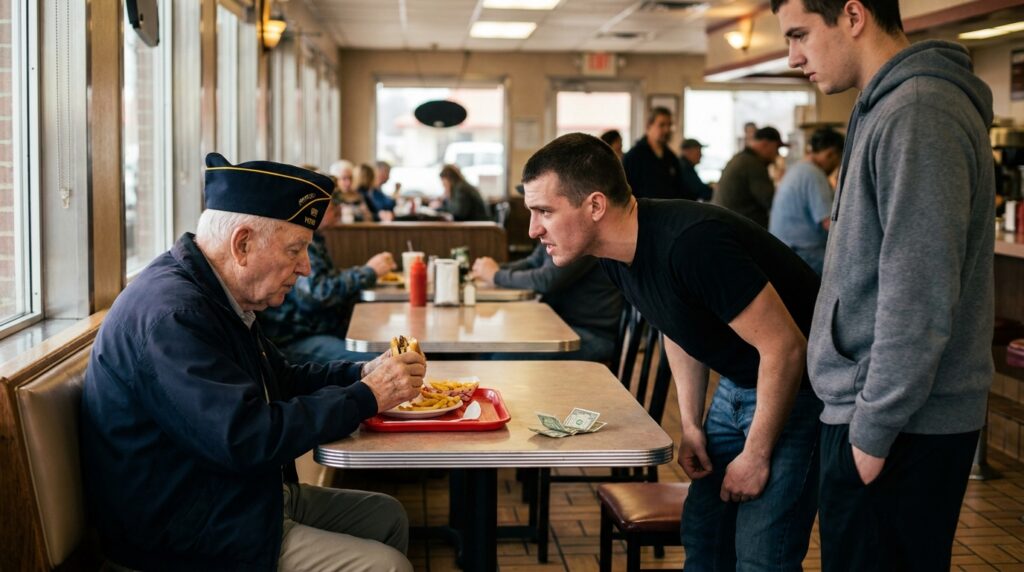
His black t-shirt was covered in white limestone dust from the diner floor, his jaw swollen where the original wedge strike had redirected his momentum. He didn’t have his phone out. His hands were tucked inside a heavy utility belt he’d taken from the storage racks behind the mill—a belt lined with the same three-groove crimping tools and modular locking pins that had sealed the gate.
“The supervisor said you’d hit the flume line, Mac,” the boy said. His voice was thin, reedy from the cold, but his footing was wide, his weight distributed evenly across the balls of his sneakers. He wasn’t playing the amateur now; he had been placed at the intercept point because his mass was sufficient to delay a seventy-eight-year-old veteran until the black pickup truck could clear the shale gate. “The ledger is closed at the office. You don’t have the mileage left to get these sheets to the county seat.”
Thomas stepped onto the asphalt lane. His left hand remained deep in his pocket, his index finger pressing the power toggle on the tracking receiver until the screen went black, cutting the signal loop. He didn’t look at the bike’s engine block. He looked at the boy’s shoulders—specifically the slight, left-side drop that indicated an unhealed rib fracture from their three-second encounter at the booth.
“The county seat doesn’t have a file for this ridge,” Thomas said, his voice dropping into that gravelly, institutional register that had nothing to do with age and everything to do with terrain command. “They never did. The holding company didn’t buy this ground from the engineers. They bought the registry keys from someone who wanted the old grid wiped before the auditors arrived.”
The Challenger didn’t lunge. He took a single, calculated step to the right, his boots clicking on the frozen macadam, keeping his shadow directly across Thomas’s line of approach toward the highway junction. “It doesn’t change the printout. The equipment is already on the trailers. The fencing goes up at midnight.”
“The fencing is forty-ton modular zinc,” Thomas said, his eyes locking onto the small, silver identification plate riveted to the Kawasaki’s frame rail beneath the tank—a plate stamped with the same 1992 ordnance registry code as the junction box at the mill. “It requires a three-phase generator to carry the current. You don’t have the line cleared for that kind of load unless you use the old subterranean easement we laid under the Sunoco lot.”
The boy’s smirk vanished, the skin around his bruised mouth tightening until the pale break across his nose went white. “You’re an old man who eats lunch alone at a broken counter. You don’t own the dirt.”
“I drew the line,” Thomas said quietly.
He moved before the boy could adjust his balance. It wasn’t the explosive rush of a twenty-year-old athlete; it was a cold, mechanical step-through that eliminated the distance between their frames before the Challenger’s right arm could clear his utility belt. Thomas’s right hand didn’t strike; his forearm formed a rigid, diagnostic bar that caught the boy’s collarbone from below, utilizing his own upright mass to leverage the Challenger backward against the padded seat of the enduro bike.
The motorcycle tipped six degrees before the kickstand bit into the soft shale of the ditch, the iron metal giving a sharp, dry ping as the weight settled. The Challenger gasped, his fingers clawing at Thomas’s canvas sleeve, but the old man’s grip was locked into the fabric of the black t-shirt, his thumb pressing directly into the nerve cluster beneath the collarbone until the boy’s knees went slack.
With his left hand, Thomas reached down and tore the master ignition key from the bike’s triple clamp, along with the magnetic utility fob that swung from the brass ring. The fob was stamped with the terminal clearance code for the regional land registry—the physical key needed to unlock the digital file that masked the military easement as an abandoned utility strip.
The sound of the black diesel truck braking at the top of the flume cut signaled the end of his grace period. The heavy commercial headlights caught them both in two long, bright rectangles of amber light that turned the falling sleet into a silver screen.
Thomas stepped back from the bike, his boots perfectly balanced on the white center line of Route 9. He didn’t drop his chin, and he didn’t run. He looked up at the ridge, where the supervisor’s silhouette was visible against the glare of the high beams, his radio unit still raised to his mouth like an unheeded warning.
The ledger wasn’t open anymore. Thomas McCall had the coordinates, he had the validation stamp, and he had the physical key to the network. He slid his leg over the saddle of the idling Kawasaki, his old joints cracking once under the cold steel, before he twisted the throttle and let the rear tire bite the asphalt, heading south toward the junction where the true map of the valley would finally be restored.








