
CHAPTER 2: THE ANATOMY OF A STAINED COUNTER
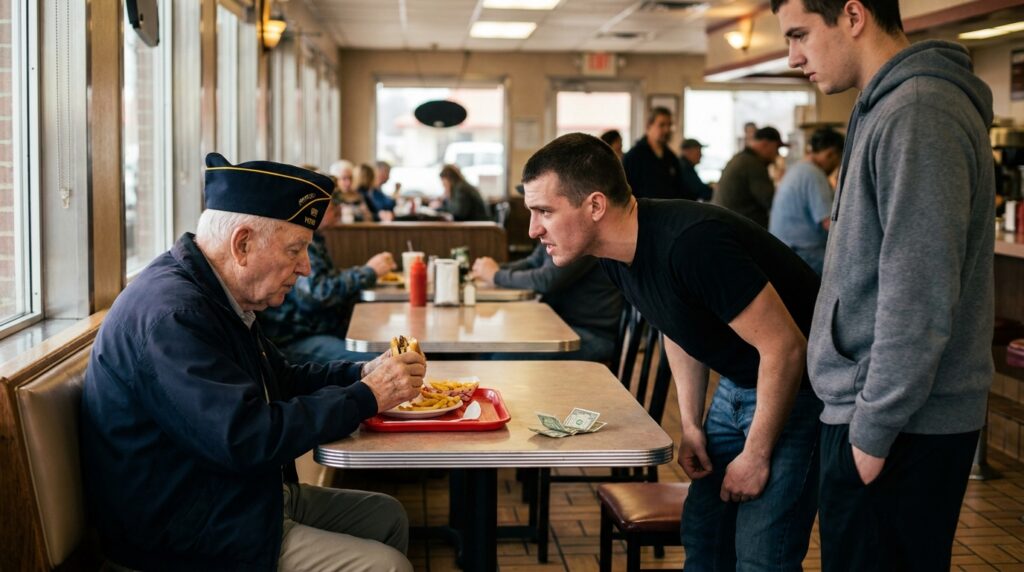
The linoleum floor didn’t cushion the Challenger’s landing. It met his shoulder with the dull, flat impact of unyielding plywood, the sound vibrating through the grease-filmed legs of Thomas McCall’s booth.
Thomas didn’t look down at the boy’s face. His hands remained steady, though the skin across his right knuckles was white, the old joint stiffness screaming under the sudden spike of adrenaline. He turned the metallic square over in his palm. It was lightweight, roughly the size of a matchbook, made of injected-molded polymer that had been painted matte black to avoid catching the light under a vehicle’s frame. On the side, beneath a layer of road grit and dried salt, was the crisp, stamped seal of the county road commission. But it had been altered. Someone had used a three-pronged tool to score a deep groove through the serial number, rendering the hardware unvouchered.
The short-order cook had his hands flat on the stainless-steel pass, his shoulders hunched as if expecting a secondary blast. A heavy ceramic mug lay on its side two booths down, dark coffee pooling toward the edge of the Formica and dripping onto the floor in a slow, rhythmic tap.
“You touched him,” the Sidekick wheezed from the base of the salad bar. He wasn’t trying to stand. His fingers were pressed against his upper lip, checking the dark, viscous smear that ran down his chin. His legs were still tangled in the lower chrome rack of the cart, a plastic bowl of grated carrots overturned across his sneakers. “You’re dead, old man. You don’t know who his family is. You don’t know what’s coming down that road.”
“I know what a state-issued transponder looks like,” Thomas said. His voice didn’t rise above the hum of the overhead compressor. It was the dry, flat tone he’d used in briefing rooms when the humidity was eighty percent and the map coordinates were already obsolete. “And I know the county doesn’t mount them to the underside of old Kawasakis with industrial zip-ties.”
He stepped out of the booth lane, his boots catching on a stray salt shaker. The weight of his seventy-eight years felt heavy in his calves, the cold air from the diner’s vestibule settling into his joints like damp iron. He didn’t check on the Challenger, who was now rolling onto his side, his breath coming in ragged, shallow gasps as his ribs reminded him of the floor’s density. Thomas walked toward the cash register at the front counter.
The waitress, a woman named Martha whose name tag had tilted sideways during the three-second commotion, was clutching a plastic-bound menu against her chest like a breastplate. Her eyes didn’t fix on Thomas; they were glued to the navy veteran cap, specifically the gold lettering that had gone slightly frayed at the edges over a decade of garage work.
“I didn’t see anything, Mac,” she whispered, her chin jerking toward the back hallway where the payphone used to hang. “They’ve been hanging around the junction for three weeks. Trashing the pumps at the Sunoco. The sheriff won’t come out this far for a couple of broken lights.”
“They aren’t here for the lights, Martha,” Thomas said.
He laid the twenty-dollar bill on the rubber coin mat. The bill was crisp, folded lengthwise, the way he’d kept his currency since his first deployment. He didn’t wait for change. His hand went back to his pocket, his index finger tracing the three unique grooves carved into the tracking device. A professional tool had done that—a specialized crimping iron used by regional logistics companies to lock down fleet vehicles. It wasn’t the kind of hardware an unemployed twenty-year-old found in a scrap heap behind the high school.
Behind him, the Challenger let out a low, venomous curse, his boots scraping against the baseboard as he finally hauled his athletic frame into a sitting position against the vinyl padding of the booth. His black t-shirt was torn at the shoulder, revealing a pale stretch of skin that was already turning a deep, bruised purple where Thomas’s inner wedge had diverted his weight.
“That’s my tracker,” the boy spat, his mouth wet with saliva and dark blood from his split lip. He tried to glare through his tangled dark hair, but his eyes were wide, the pupils dilated with the erratic panic of a predator that had just discovered the fence was electrified. “Give it back, or I’ll find that cabin of yours. I know where you park that gray truck.”
Thomas stopped three inches from the heavy glass door of the vestibule. The afternoon light outside was flat, filtered through a low ceiling of grey November clouds that smelled of impending salt and diesel exhaust from the interstate five miles north. He didn’t turn his torso. He merely tilted his head slightly, letting his profile lock the boy into the frame of his peripheral vision.
“The truck has four-wheel drive,” Thomas said quietly. “And the road up to my place doesn’t have turning room for a motorcycle. Keep that in mind when your ribs stop hurting.”
He pushed the door open, the overhead brass bell giving a single, tinny ring that was immediately swallowed by the wind coming off the asphalt. The gravel lot was mostly empty, save for his own faded Dodge Ram and the high-piped Kawasaki enduro bike parked at an aggressive angle near the propane tank cage. Thomas walked with a slow, deliberate stride, his boots crunching into the crushed limestone. His left hand was already deep in his jacket pocket, his thumb running over the three-groove puncture mark on the casing.
The town below the ridge was small—four hundred souls, two auto-body shops, and an empty grain elevator that had been rotting since the railroad pulled its spikes out in eighty-eight. But someone with access to county tracking hardware was mapping the perimeters. They were checking who stayed, who left, and who was too old to move when the pressure started to lean.
He reached the driver’s side of the truck, his keys heavy in his palm. Before he inserted the steel into the lock, his eyes dropped to the rear wheel well. The black undercoating was scratched. A fresh, bright silver silver line ran along the frame rail, right where a magnetic base would have clung if someone had been moving in a hurry while he was inside eating his lunch.








