
CHAPTER 4: THE THRESHOLD OF INTERDICTION
The steel cable didn’t yield. It was a one-inch braided industrial line, anchor-bolted into the split trunks of two mature hemlocks on either side of the old mill gate. The bright yellow aluminum sign hanging from its center shivered in the northern draft, its unweathered edges throwing back a sharp, geometric glint that didn’t belong in these woods.
Thomas brought the truck to a halt six inches from the barrier. He didn’t drop the engine into park; his right boot stayed heavy on the brake pedal, feeling the low, rhythmic shudder of the V8 vibrating through the floorboards. In his rearview mirror, the amber running lights of the black diesel pickup stopped three hundred yards down the hill, its nose angled toward the left shoulder to block the retreat. They were checking his reaction time. They wanted to see if seventy-eight years of bone and cartilage would panic, break formation, or turn the wheels into the ditch.
He didn’t touch the steering column. His left hand reached down, his fingers wrapping around the cold, brass stem of his micrometer on the seat. With his index finger, he pushed the stolen transponder against the brass gauge, sliding the vernier scale until the steel jaws nipped the edges of the three-groove puncture mark. Four point two millimeters. Exactly.
The tool that had defaced the county property was the same heavy-duty crimping iron used to seal the corporate freight locks down at the rail spur. The kids in the diner hadn’t bought that hardware at a surplus store. They were field assets, hired to establish a localized perimeter, and this gate was the line where the data collection ended and the enforcement began.
A figure stepped out from behind the yellow aluminum sign. It wasn’t the Challenger, but a man older, thicker, wearing a dark canvas field jacket that lacked any commercial branding or service patches. He carried a clipboard in his left hand, his right thumb hooked under the heavy leather belt of his trousers. His boots were clean, unspotted by the red clay that lined the ditches of Route 9. An out-of-town supervisor.
“Road’s closed, neighbor,” the man said. He didn’t yell; his voice carried across the truck’s hood with the flat, institutional drone of an insurance adjuster or a structural auditor. He walked to the driver-side window, his soles crunching deliberately on the shale. “Structural decay on the upper culvert. County logistics took over the easement twenty minutes ago.”
Thomas rolled the window down three inches. The cold mountain air cut through the gap, carrying the smell of raw diesel exhaust and wet, rotting bark. He kept both hands visible on the rim of the steering wheel, his thumbs hooked loosely over the horn ring.
“The culvert has a steel corrugated bed,” Thomas said, his voice flat, gravelly, and entirely lacking in conversational grease. “It was rated for forty tons when the county laid it in ninety-four. It doesn’t decay in twenty minutes.”
The man with the clipboard smiled, though his eyes remained fixed on Thomas’s navy veteran cap, scanning the gold-threaded letters as if checking them against a roster. “The paperwork says otherwise. We have an injunction to clear the ridge line for a grid upgrade. All private access points north of the junction are under temporary containment. You’ll need to turn that rig around and head back to the interstate.”
“There isn’t turning room on this grade for a long-bed,” Thomas said.
“Then you’ll have to back it down,” the supervisor replied, his fingers tapping a slow, rhythmic pattern against the aluminum frame of his clipboard. “The driver behind you will give you all the clearance you need. He’s very accommodating about relocations.”
Thomas looked past the man’s shoulder. Beyond the hemlocks, where the old mill’s gravel sorting yard opened up, three industrial flatbed trailers were parked in a neat, diagonal row. They weren’t loaded with timber or gravel. They carried heavy, modular steel fencing sections and pre-fabricated security kiosks—the kind used to establish rapid, military-grade perimeters around commercial demolition zones or contested resource extractions. A corporate land-clearance package, fully unboxed and waiting for the local population to be drifted out of the valley by petty harassment.
The decoy secret was right there on the clipboard—a printed county maintenance order with a forged signature from the district engineer, authorized by the same logistics firm that held the tracking contract. They wanted the town to think this was a standard state utility upgrade, a bureaucratic inconvenience that would make the old holdings unlivable until the deeds were surrendered for pennies. But they hadn’t accounted for the metric scale on a brass micrometer.
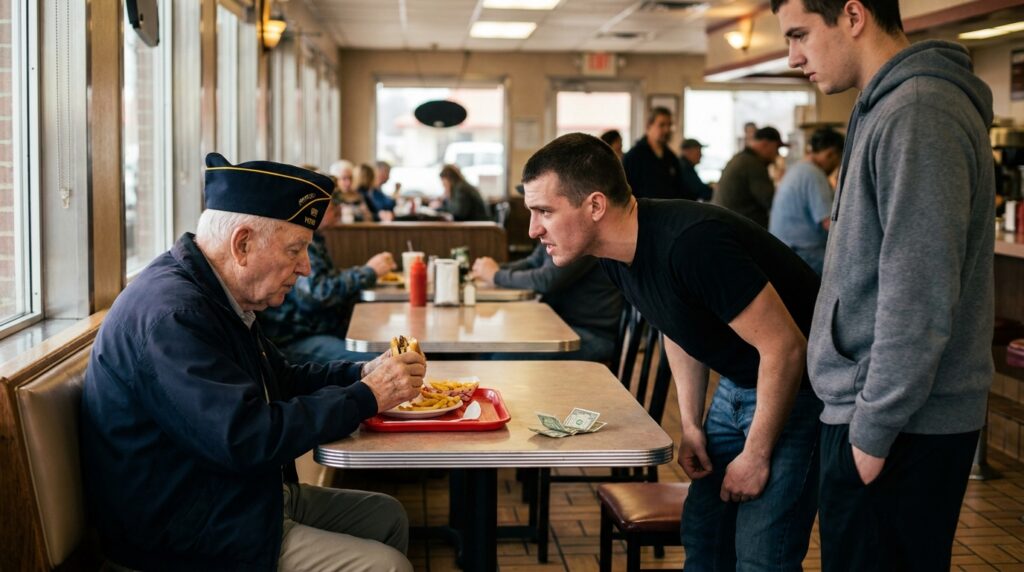
“I left twenty dollars on the mat at the diner,” Thomas said, his fingers tightening on the wheel until the old leather cover creaked. “That covers the meal and the wear on the floorboards. I don’t like leaving a ledger open.”
The supervisor’s smile went rigid. He took a half-step back from the door panel, his hand dropping away from his belt line as his eyes signaled something toward the black pickup truck idling down the slope. “You’re making an error in calculation, Mr. McCall. This isn’t a local dispute. The valley is already accounted for on the balance sheets. You’re just a line item that hasn’t been cleared yet.”
“I’ve been a line item before,” Thomas said quietly.
He didn’t wait for the supervisor to counter. His right foot transitioned from the brake to the accelerator in a single, sharp punch, while his left hand slammed the heavy iron transfer-case lever forward into four-wheel-drive low. The front axle engaged with a dry, metallic thud that rattled the dashboard. The truck didn’t surge forward into the cable; instead, Thomas dialed the steering wheel hard to the left, using the low-gear torque to force the heavy steel bumper into the soft, rotting loam of the embankment.
The truck tilted fifteen degrees, the left fender scraping through the dry hemlock brush with a sound like tearing tin. The maneuver wasn’t a retreat; it was a tactical displacement. By occupying the high side of the ditch, he took away the black diesel’s primary line of approach, forcing the vehicle behind him to choose between a head-on climb through the clay or a blind reverse down the rock cut.
Through the side window, Thomas saw the supervisor reach into his canvas jacket, his hand emerging with a heavy, black radio casing. But Thomas was already moving past the gate line, the truck’s undercarriage grinding over a hidden limestone shelf as he drove deeper into the shadow of the mill yard.








