
CHAPTER 10: THE RESTORATION OF THE SURVEYORS LEDGER
The frozen mud at the culvert’s lip didn’t give way until Thomas McCall placed his full weight on his left heel, the hard crust fracturing with a dry snap that sent a vibration straight up his hip joint. He didn’t slow down his descent. He kept his torso low against the concrete bank of the drainage channel, his right hand shielding the crumpled maintenance document while his fingers tracked the cold, rectangular edge of the digital utility fob hidden in his palm.
Ahead, the single-lane concrete span of the second bridge rose out of the dark hemlock bottom like an iron-ribbed gate. They had already positioned their blockade. Two commercial utility vans were parked bumper-to-bumper across the bridge deck, their white roof-mounted strobe lights rotating through the falling sleet in a rhythmic, blinding pattern of amber and blue. A heavy steel barricade section had been chained across the pedestrian lane, its galvanized zinc links reflecting the cold glare.
Thomas didn’t drop into the ditch line. He stepped directly onto the concrete apron of the bridge approach, his boots clicking evenly against the hard-packed limestone aggregate.
Standing beside the left-hand strobe van was a man in an tailored winter overcoat that carried no company logo—the district administrative director, flanked by the supervisor from the mill gate. Between them sat a portable ruggedized server terminal, its cathode-ray tube screen humming with a high-pitched electric whine that cut through the sound of the rushing creek below.
“That’s far enough, McCall,” the director said. He didn’t use a radio or a megaphone; his voice was thin, dry, and carried the quiet arrogance of a legal team that had already filed its summary judgments at the state capital. “The district network loop is performing its final write operation. The server doesn’t have an entry lane for a legacy engineer’s objections.”
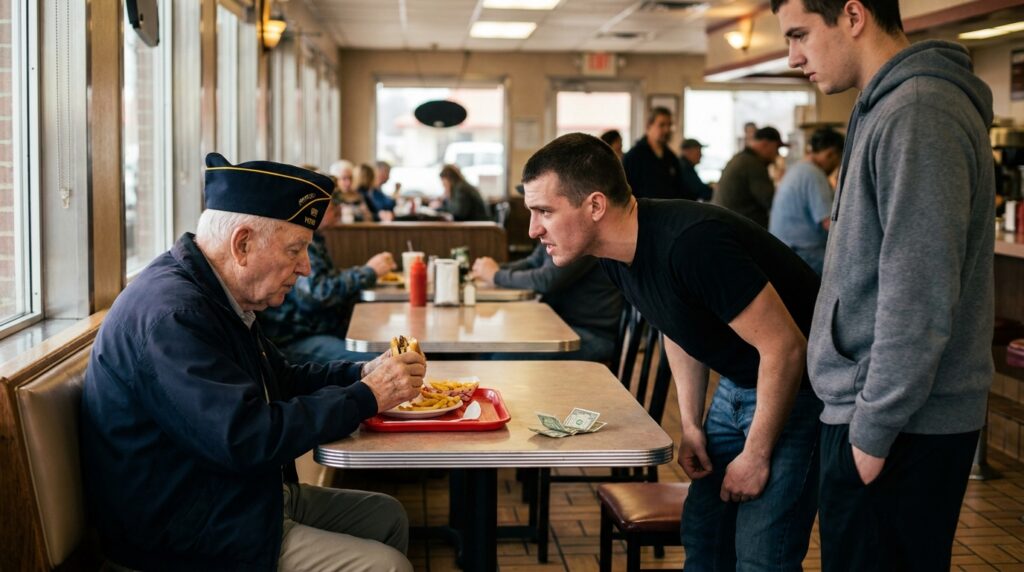
Thomas stopped five feet from the terminal table. He didn’t adjust his navy veteran cap, though the sleet was freezing into a clear, stiff glaze across the gold lettering. He looked at the green text scrolling across the director’s monitor—the Master Title Register for the entire county corridor, currently updating its encryption keys to lock out the local public records.
“The server is running on a three-phase loop that requires an unvouchered military token to authorize a title overwrite,” Thomas said. His gravelly voice didn’t rise above the idling diesel engines of the vans. He reached into his jacket pocket, his fingers extracting the brass micrometer alongside the stolen magnetic fob. “You didn’t generate those authorization blocks in Delaware. You pulled them from Colonel Vance’s administrative archive after the unit was deactivated.”
The director’s face went completely rigid under the amber strobe light, his fingers halting mid-stroke above the terminal’s keyboard. “Vance signed the easement transfers before the company took control of the infrastructure, McCall. The transaction is completely legal on the state balance sheets.”
“Vance didn’t have the clearance to sign off on Section 14,” Thomas said quietly. He stepped forward, his boots perfectly balanced on the expansion joint of the bridge. “He was a logistics administrator. I was the surveyor who laid the physical iron pins in ninety-two. The master ledger requires the precise physical width of the boundary die to unlock the core registry.”
Thomas didn’t look at the supervisor, who was currently reaching toward his canvas jacket for his sidearm. With his right hand, Thomas drove the steel jaws of his brass micrometer directly into the terminal’s diagnostic interface slot—the exact spot where the orange fiber splice had been monitored. He rotated the metric dial to exactly four point two millimeters.
The hardened steel jaws of the gauge met the internal copper pins with a sharp, blinding spark.
The green screen on the server terminal didn’t go dark; it flashed into an automated system override sequence, the corporate encryption layers cracking wide open as the physical signature of the original surveyor’s tool verified the command. The Master Title Register halted its write operation at ninety-nine percent, the red text reversing itself across the screen until the original federal easement designation emerged from the code: Section 14 – Public Trust – Unalterable.
“Shut it down!” the director screamed, his hand lunging toward the terminal’s main power toggle, but Thomas’s left arm was already in position.
His forearm locked against the director’s collarbone with a single, controlled defensive check that redirected the administrator’s weight into the side panel of the strobe van. The supervisor cleared his holster, his weapon leveling toward Thomas’s chest, but the sudden, high-decibel howl of the district emergency siren up the mountain signaled that the state administrative loop had just acknowledged the data correction. The corporate network was locked out. The original geographic blueprint of the valley was permanently burned back into the server architecture.
Thomas stepped back from the terminal table, his fingers pulling the brass micrometer cleanly from the destroyed interface slot. The gold-threaded letters on his navy cap glinted under the blue strobe lights as he looked at the two men pinned against the bridge rail.
“The line is drawn,” Thomas said, his low voice settling through the freezing sleet like iron into stone. “Think twice next time, boys.”
He turned his back on the blockade, his steady, measured footsteps carrying him away from the bridge and down the open lane of Route 9, where the lights of the town were finally beginning to clear the valley mist.








