
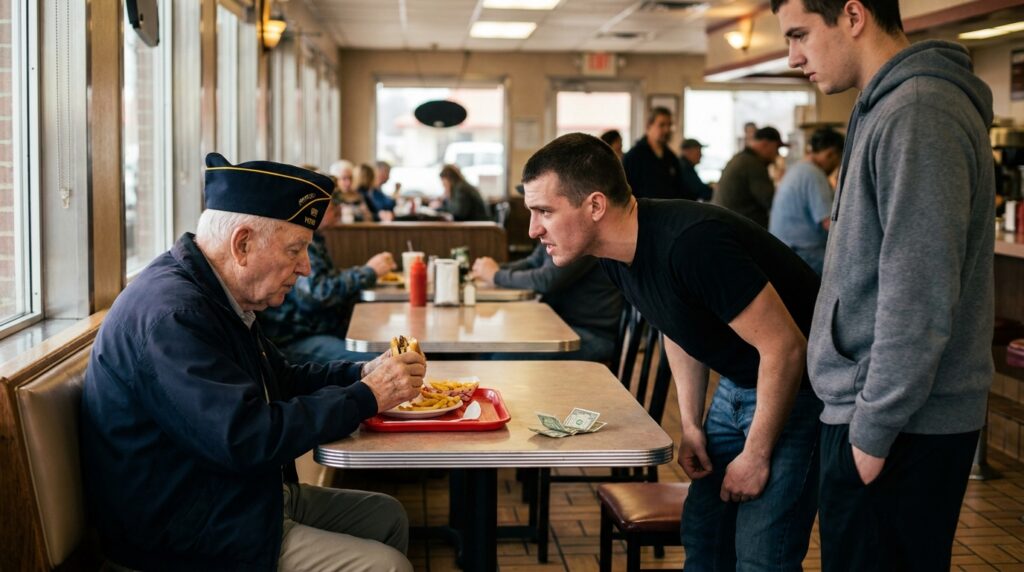
CHAPTER 3: THE SHADOW OF THE CHALLENGER
The silver scratch on the frame rail was exactly six inches long, the exposed steel still bright and free of road oxidation. Someone had tried to clamp a magnetic housing to the undercarriage while the short-order cook was dropping fries into the vats. They had been clumsy with the placement, tearing through the factory rubberized undercoating before losing their grip.
Thomas didn’t climb into the cab immediately. He stood in the gap between the open driver-side door and the body panel, using the rusted metal as a partial shield for his torso while his eyes swept the perimeter of the gravel lot. The wind was picking up from the north, whistling through the empty propane cage and rattling the plastic sign above the Sunoco pumps across the two-lane state highway. A black pickup truck—a late-model commercial vehicle with heavy-duty leaf springs—was idling near the edge of the tree line three hundred yards down. Its headlights were dark, but the exhaust vapor rolled thick and white from beneath the bumper, matching the steady cadence of a diesel engine that wasn’t being used for farming.
He slid his thumb over the small transponder in his pocket. The plastic edges were cold, the three-groove score mark biting into his skin. They weren’t just monitoring the highway corridor; they were hunting for specific coordinates, and his faded Dodge Ram was now firmly on the grid.
He pulled himself into the driver’s seat. The springs in the old bench groaned under his weight, a sharp contrast to the silent, oiled efficiency of the tactical transports he used to map out in the sand. He turned the key. The starter motor clicked twice before the old V8 caught with a ragged, heavy rumble that shook the steering column. He adjusted the rear-view mirror. Inside the diner’s glass vestibule, the shadow of the Challenger was visible, leaning against the cigarette machine while Martha wiped down the counter with frantic, short strokes. The young man wasn’t watching the floor anymore; he had a phone pressed to his ear, his lips moving rapidly as his eyes stayed locked on the truck’s rear license plate.
Thomas shifted into reverse, the transmission dropping into place with a mechanical clunk. He backed out slowly, his boots precise on the worn rubber pads of the pedals. He didn’t accelerate hard into the turn. A hasty exit was a signature—a piece of behavioral data that told the watchers exactly how much they had rattled him. He wanted them to see a seventy-eight-year-old retired laborer driving a fifteen-year-old utility vehicle at exactly twenty-five miles per hour.
As the truck cleared the gravel apron and settled into the right-hand lane of Route 9, the black diesel pickup at the tree line clicked its running lights on. Amber rectangles broke through the grey afternoon gloom. The truck pulled onto the macadam, maintaining a consistent gap of five hundred yards, its nose heavy and stable against the crosswind.
Thomas kept his eyes on the road ahead. The highway carved through a limestone cut where the hills had been blasted out thirty years ago to make room for timber haulers. The rock walls were black with weeping groundwater, long icicles beginning to form in the deep crevices where the sun never reached. His cabin was seven miles up the ridge line, past the old lumber mill that had been sold off to a holding company out of Delaware three years back.
He reached into the glove box without dropping his gaze from the center line. His fingers bypasses the old maps, the vehicle registration, and the spare fuses until they found the heavy, cold cylinders of his old brass micrometer. He pulled it out, setting it on the bench seat beside the stolen transponder. He needed to measure the width of the three-groove puncture mark on the casing. Every machining tool left a unique signature—a microscopic variation in the die width that could be traced back to a specific batch of industrial crimpers. If the tool belonged to the county road commission, the groove would measure exactly four point two millimeters. If it belonged to a private security firm or an industrial engineering outfit, the footprint would tell him who bought the block.
The rearview mirror showed the amber running lights approaching the limestone cut. The diesel wasn’t gaining speed, but it was positioning itself on the crown of the road, blocking any oncoming traffic from passing. It was a boxing maneuver—a standard tracking protocol designed to herd a target into a predictable cul-de-sac before the secondary units moved into position at the flanks.
Thomas reached the turnoff for the old mill road. The asphalt ended here, replaced by packed shale and frozen red clay that wound upward through the dead hemlocks. He flipped his turn signal on, letting the amber light click three times before he turned the wheel. He wanted the diesel to know exactly where he was going. He wanted them to think he was heading for the security of his own porch, where the trees grew thick and the clear sight lines vanished.
As the rear wheels hit the shale, the truck kicked up a small cloud of white dust that hung in the damp air like smoke. Thomas glanced at the micrometer on the seat. The small steel dial was vibrating against the vinyl, its metric increments glinting under the dashboard’s green illumination. He didn’t need the tool to know the truth. The scratch on his own frame rail had been done by the same tool that defaced the transponder. They had already mapped the valley. Now, they were just waiting to see who would try to hold the line when the real pressure arrived.
A mile up the grade, where the hemlocks closed in and the light died completely, a heavy steel cable was strung across the access gate of the old mill. It hadn’t been there when he drove down at ten this morning. Attached to the center of the cable was a fresh, bright yellow aluminum sign, its bolt threads unrusted, bearing the emblem of the same regional logistics firm that supplied the county’s fleet.








